Which Flashing Material for Roof Offers Maximum Lifespan?
Compare the best flashing material for roof longevity. We analyze copper, steel, and aluminum lifespans, costs, and failure modes to prevent leaks.

The Hidden Vulnerability: Why Flashing Fails Before Shingles
Roof systems are only as durable as their weakest transition point. While architectural asphalt shingles or standing seam metal panels may carry 30- to 50-year warranties, the flashing material for roof penetrations, valleys, and wall intersections often dictates the true functional lifespan of the entire assembly. Water intrusion rarely occurs through the open field of the roof; it exploits microscopic gaps, corroded edges, and failed sealant joints at material transitions.
Selecting the correct flashing metal requires matching the material's galvanic properties, thermal expansion coefficient, and environmental resistance to the specific roof covering and regional climate. A premature flashing failure at year 12 will compromise a roof system designed to last 30 years, leading to structural rot and interior water damage. Below, we break down the metallurgical realities, exact thickness specifications, and real-world degradation factors of the most common flashing materials.
Never allow dissimilar metals to touch without a dielectric barrier. Installing copper flashing directly against aluminum gutters or galvanized steel panels creates a galvanic cell. In the presence of rainwater (the electrolyte), the less noble metal (aluminum or zinc) will rapidly corrode and disintegrate. Always separate dissimilar metals using a peel-and-stick rubberized asphalt membrane or heavy-duty building felt.
Lifespan Matrix: Comparing Roof Flashing Materials
The following matrix outlines the baseline specifications for premium flashing materials. Costs reflect 2026 wholesale material pricing and do not include fabrication or installation labor.
| Material | Standard Alloy / Grade | Nominal Thickness | Expected Lifespan | Material Cost (Per LF) |
|---|---|---|---|---|
| Copper | Cold-Rolled (ASTM B370) | 16 oz (0.0216') or 20 oz (0.027') | 70 - 100+ Years | $16.00 - $24.00 |
| Stainless Steel | Type 304 or 316 | 24 Gauge (0.0239') | 50 - 75 Years | $9.00 - $15.00 |
| Galvalume Steel | AZ50 Coating | 24 or 26 Gauge | 25 - 40 Years | $3.50 - $6.00 |
| Galvanized Steel | G90 Zinc Coating | 24 or 26 Gauge | 15 - 25 Years | $2.50 - $4.50 |
| Aluminum | 3003-H14 Alloy | 0.019' or 0.024' | 20 - 40 Years | $4.00 - $7.00 |
Copper: The Century-Lasting Standard
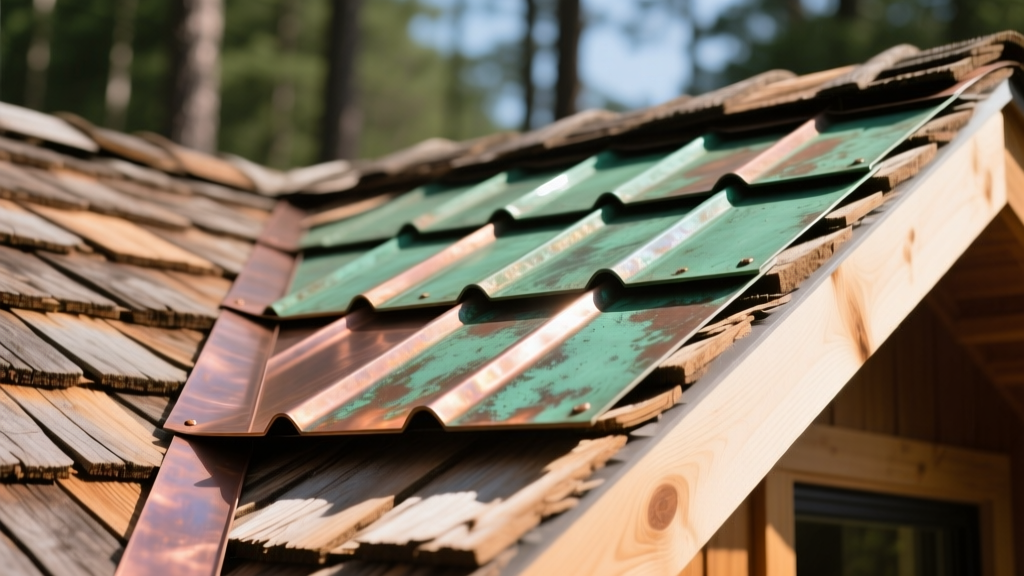
When evaluating the ultimate flashing material for roof longevity, copper remains unmatched. According to the Copper Development Association, properly installed copper flashing routinely outlasts the building structure itself. The material undergoes a natural oxidation process, transitioning from a bright metallic finish to a dark brown, and eventually to a protective green patina (basic copper sulfate). This patina acts as a self-healing shield against atmospheric corrosion.
For residential applications, 16-ounce copper (0.0216 inches thick) is the minimum acceptable standard for step flashing and wall counters. For high-wear areas like box gutters, valleys, and chimney crickets, 20-ounce copper (0.027 inches) is required to resist physical deformation from ice damming and thermal expansion. Edge Case Warning: Copper runoff is highly acidic during its initial oxidation phase and will stain light-colored asphalt shingles, stucco, and limestone. Always install a sacrificial slip sheet or apply a clear polyurethane coating to the first three feet of copper if runoff staining is a concern.
Galvanized vs. Galvalume: The Budget Compromise
Steel flashing relies entirely on its metallic coating to prevent the underlying carbon steel from oxidizing into structural red rust. Galvanized steel uses a G90 zinc coating (0.90 ounces of zinc per square foot). While economical, zinc degrades steadily when exposed to acidic rain and coastal salt spray.
Galvalume (an aluminum-zinc alloy coating, typically AZ50) offers vastly superior durability. The aluminum component forms a tight oxide barrier, while the zinc provides galvanic protection at the cut edges. If you are using steel flashing, Galvalume is the mandatory choice for any roof system expected to last beyond 20 years. However, any field-cut edge on steel flashing exposes the raw carbon core. These cut edges must be immediately treated with a cold-galvanizing compound or zinc-rich primer to prevent 'edge creep' rust.
Aluminum: Lightweight but Chemically Reactive
Aluminum flashing (typically 3003-H14 alloy in .019' or .024' thickness) is highly resistant to atmospheric rust and is exceptionally easy to bend on-site. However, aluminum has a severe chemical vulnerability: it is rapidly destroyed by alkaline environments. Wet concrete, fresh stucco, and masonry mortar have a pH between 12 and 13, which aggressively dissolves aluminum's protective oxide layer.
If aluminum flashing must interface with a masonry chimney or stucco parapet wall, the metal must be completely isolated using a bituminous-backed membrane or coated with a heavy layer of asphalt roof cement. Without this dielectric separation, the aluminum will literally dissolve into the masonry within 5 to 7 years, leaving a direct path for water intrusion.
Stainless Steel: The Coastal Fortress
For environments where copper is architecturally prohibited and steel degrades too quickly, stainless steel is the optimal flashing material for roof penetrations. Type 304 stainless steel is excellent for inland applications, offering a 50+ year lifespan with zero maintenance. However, for projects within 5 miles of a saltwater coastline, Type 316 stainless steel is mandatory. Type 316 contains 2-3% molybdenum, which drastically increases its resistance to chloride pitting caused by marine aerosols.
Environmental Degradation Factors by Region
Theoretical lifespans assume moderate climates. Real-world durability requires adjusting your material selection based on local environmental stressors:
- Coastal & Marine Zones: Salt aerosols accelerate galvanic corrosion. Avoid galvanized steel entirely. Specify Type 316 stainless steel or copper. Ensure all fasteners match the flashing metal to prevent localized galvanic cells.
- Industrial & High-Pollution Areas: Sulfur dioxide and nitrogen oxides in the air create acid rain. Acidic runoff strips zinc coatings from galvanized steel at twice the normal rate. Copper and aluminum perform significantly better in high-pollution zones.
- High Thermal Cycling (Desert Climates): Extreme daily temperature swings cause massive expansion and contraction. Copper and aluminum have high coefficients of thermal expansion. If not properly detailed with expansion cleats and oversized fastener slots, the metal will buckle, tear, and pull away from the wall intersections.
Installation Tolerances That Dictate True Lifespan
Even a 100-year copper flashing will fail in 5 years if installed with improper tolerances. The National Roofing Contractors Association (NRCA) and the Sheet Metal and Air Conditioning Contractors' National Association (SMACNA) mandate strict installation protocols that separate professional assemblies from catastrophic failures.
Amateur installations rely heavily on polyurethane caulking and roofing tar to seal flashing joints. Professional metalwork relies on mechanical overlaps and gravity. Sealants have a maximum lifespan of 10 to 15 years before they dry out, crack, and lose adhesion. A properly hemmed and overlapped metal joint will remain watertight for the life of the metal itself, long after any chemical sealant has failed.
Minimum Overlap and Hem Specifications
- Step Flashing Headlap: Each piece of step flashing must overlap the piece below it by a minimum of 2 inches. In regions with driving wind-driven rain, increase this to 3 inches.
- Valley Flashing Overlap: Open metal valleys require a minimum 6-inch center fold, with roofing shingles trimmed to leave a 3-inch open water channel. The top edge of the valley metal must extend at least 4 inches under the ridge cap.
- Counter-Flashing Reglets: When flashing into a masonry wall, never simply caulk the top edge of the metal to the brick. A 1/4-inch deep reglet (slot) must be cut into the mortar joint. The counter-flashing hem is inserted into the reglet and sealed with a high-modulus polyurethane sealant, allowing the metal to expand and contract without breaking the seal.
Fastener Compatibility
Fasteners are the most frequently overlooked failure point. Never use standard galvanized roofing nails to secure copper or stainless steel flashing. The galvanic reaction will corrode the nail head within months, leaving the flashing loose and vulnerable to wind uplift. Always use solid copper nails for copper flashing, and Type 304 or 316 stainless steel ring-shank nails for stainless and Galvalume flashing. Fasteners should be placed at the top edge of the flashing overlap, ensuring they are completely covered by the overlapping shingle or subsequent flashing course.
FAQ: Flashing Material for Roof Maintenance
Can I paint my copper flashing to keep it shiny?
Yes, but it requires rigorous maintenance. To prevent the natural patina process, copper must be cleaned with a specialized metal brightener and sealed with an architectural-grade, UV-stable clear polyurethane or Incralac coating. This coating must be stripped and reapplied every 3 to 5 years. If the coating is allowed to peel, moisture becomes trapped against the metal, causing localized pitting that is far worse than natural weathering.
Is rubberized asphalt (peel-and-stick) a valid replacement for metal flashing?
Rubberized asphalt membranes (like Grace Ice & Water Shield) are excellent secondary underlayment barriers, but they are not a substitute for primary metal flashing in exposed areas. UV radiation degrades exposed asphalt membranes within 30 to 60 days. Peel-and-stick products should only be used as concealed under-flashing beneath the primary metal step or valley flashing to provide a secondary line of defense against ice dam backflow.
How often should roof flashing be inspected?
Flashing should be physically inspected every 3 years, and immediately following any severe hail or wind event. Inspectors should look for 'oil-canning' (buckling of the metal due to thermal stress), lifted fastener heads, degraded reglet sealant, and any signs of galvanic pitting where dissimilar materials meet.
Written by
Sarah WhitfieldSarah Whitfield is a chartered quantity surveyor (MRICS) and construction cost analyst with 15 years of experience in material pricing, procurement strategy, and project budgeting. She earned her degree in Construction Management from the University of Reading (UK) and has worked on projects ranging from $2M custom homes to $180M mixed-use developments across North America and Europe. Sarah currently leads cost estimating for BuildMat Insight, maintaining a proprietary database of 4,000+ material price points updated quarterly. She is a frequent contributor to RSMeans cost data panels and has presented at the International Cost Engineering Council (ICEC) congress. Based in Denver, CO, Sarah is an avid trail runner and volunteer mentor for Women in Construction.
More from Sarah Whitfield
View all
Wood & Lumber
What Are the Different Types of Wood? A Builder's Guide
Compare structural softwoods, finish hardwoods, and engineered lumber. Analyze Janka ratings, MOE values, and 2026 pricing for construction.
Aug 4, 2026

Walls & Panels
Steel Framing vs Wood Framing: Corrosion and Moisture Defense
Compare steel framing vs wood framing for moisture resistance. Learn about galvanized coatings, condensation risks, and corrosion protection strategies.
Jul 21, 2026

Stone & Masonry
How to Cut Stone Veneer: Wet Saw vs Grinder Comparison
Compare the best tools for cutting stone veneer. We review wet saws, angle grinders, and chop saws to help you achieve clean, chip-free cuts.
Jul 21, 2026