Silicone Roofing Material vs. Acrylic & TPO: Flat Roof Comparison
Compare silicone roofing material against acrylic coatings and TPO membranes. Analyze costs, ponding water resistance, and 2026 installation specs.

The Reality of Silicone Roofing Material in Low-Slope Applications
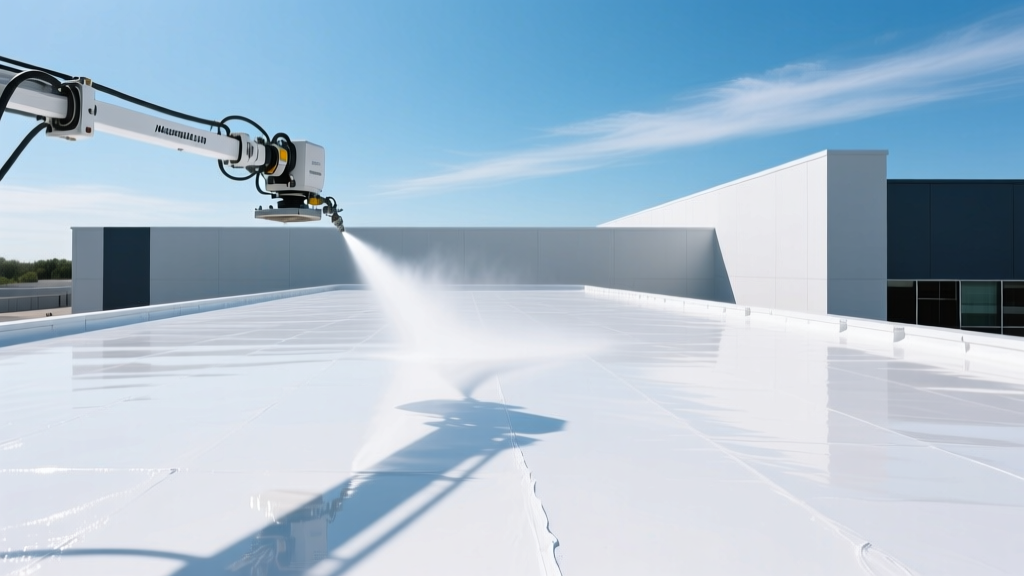
Specifying a low-slope or flat roof system requires navigating a complex matrix of chemical compatibilities, structural movement, and water drainage realities. Silicone roofing material—specifically high-solids, moisture-cured silicone roof coatings—has emerged as the dominant restoration choice for existing commercial roofs. Unlike single-ply membranes that rely on mechanical fasteners, adhesives, or heat-welded seams, silicone forms a seamless, monolithic, and fully adhered membrane directly over the existing substrate.
However, silicone is not a universal panacea. When compared to water-based acrylic elastomerics or thermoplastic single-ply membranes like TPO (Thermoplastic Polyolefin), silicone presents distinct chemical advantages alongside specific installation vulnerabilities. Understanding these trade-offs is critical for facility managers and roofing contractors aiming to maximize lifecycle value.
- Choose Silicone If: The roof has poor drainage, historical ponding water issues, or requires a seamless restoration over an aging modified bitumen or metal deck.
- Choose Acrylic If: The roof has excellent positive drainage, a strict upfront budget, and requires high initial solar reflectance without premium material costs.
- Choose TPO If: This is a new construction project, the existing roof requires a complete tear-off down to the decking, or the building requires a specific FM Global wind-uplift rating that coatings cannot achieve.
Silicone vs. Acrylic Coatings: The Ponding Water Test
The most critical differentiator between silicone and acrylic roof coatings is their chemical reaction to standing water. Acrylic coatings (such as Henry 587 Dura-Brite or Karnak 109) are water-based emulsions. They cure through coalescence—meaning the water evaporates, and the acrylic polymers fuse together. While highly reflective and cost-effective, acrylics remain slightly water-sensitive. If water ponds on an acrylic roof for more than 48 hours, the coating can re-emulsify, leading to blistering, peeling, and ultimate membrane failure.
Chemical Composition and Moisture Curing
Silicone roofing material (such as GacoRoof 100% Silicone or Henry 887 HS) is a solvent-free, high-solids elastomer that cures via moisture absorption from the atmosphere. Once cured, silicone is entirely impervious to water. It will not re-emulsify, blister, or degrade under permanent ponding water. This makes silicone the only coating system warranted for areas with poor drainage, eliminating the need for costly structural tapering or the installation of additional roof drains prior to coating.
Furthermore, silicone maintains its flexibility across extreme temperature fluctuations. While acrylics can become brittle in sub-zero temperatures and overly soft in extreme heat, silicone's inorganic backbone (siloxane bonds) remains stable from -40°F to 300°F, resisting UV degradation far longer than organic carbon-based polymers.
Silicone vs. TPO and EPDM Single-Ply Membranes
When a roof reaches the end of its lifecycle, building owners often debate between a full tear-off and replacement with a single-ply membrane (like 60-mil TPO or EPDM) versus a silicone restoration system. According to the Single-Ply Roofing Industry (SPRI), TPO dominates the new construction market due to its heat-welded seams and clean aesthetic. However, restoration scenarios heavily favor silicone.
| Feature | High-Solids Silicone Coating | 60-Mil TPO Membrane | Water-Based Acrylic Coating |
|---|---|---|---|
| Seam Integrity | Seamless / Monolithic | Heat-welded (Primary failure point) | Seamless / Monolithic |
| Ponding Water Resistance | Excellent (Impervious) | Good (Depends on seam integrity) | Poor (Re-emulsifies) |
| Dry Mil Thickness | 20 - 30 mils | 60 mils (Reinforced) | 20 - 24 mils |
| Tear-Off Required? | No (Restoration) | Yes (Usually) | No (Restoration) |
| Dirt Pickup Resistance | Low (Inherently tacky) | High (Smooth surface) | Medium (Washes clean with rain) |
Real-World Failure Modes: Where Silicone Systems Fail
While silicone is highly durable, improper specification and application lead to catastrophic failures. Contractors must account for three primary edge cases:
1. Asphalt Bleed-Through
Applying silicone directly over an asphalt-based substrate (like modified bitumen or built-up roofing) without a bleed-blocking primer will result in severe aesthetic and chemical failures. The oils in the asphalt will migrate through the silicone, turning the white roof yellow or brown within months. This is not merely cosmetic; the migrating oils can degrade the silicone's UV-resistant top layer. A specialized bleed-blocking base coat, such as GacoBleedTrap or an epoxy primer, is mandatory and adds approximately $0.45 to $0.65 per square foot to the project cost.
2. Adhesion Loss on EPDM and TPO
Silicone will not adhere directly to the slick surface of EPDM rubber or weathered TPO. The surface must be power-washed to remove chalk and oxidation, followed by the application of a specific adhesion-promoting primer (e.g., GacoFlex E53 for EPDM). Skipping the primer or failing to verify adhesion via field pull-tests will result in the silicone membrane peeling off in large sheets during high-wind events.
3. Dirt Pickup and Albedo Degradation
Silicone is inherently slightly tacky, even after full cure. In high-pollution or heavily wooded areas, silicone roofs will accumulate dirt, pollen, and soot, which significantly reduces their solar reflectance. While the U.S. Department of Energy notes that cool roofs rely on high albedo to reduce HVAC loads, a dirty silicone roof can lose up to 30% of its initial reflectivity. Facility managers must budget for low-pressure washing every 3 to 5 years or specify a newer generation of 'low dirt-pickup' silicone formulations, which utilize specialized silicone resins to create a harder, smoother surface.
"The most common cause of coating failure is not the material itself, but the substrate preparation. Silicone is a premium, moisture-cured elastomer; it will perfectly encapsulate moisture, dirt, and loose granules if the roof is not properly power-washed and primed. Surface prep accounts for up to 40% of the labor cost, and it is exactly where budget-cutting contractors compromise the system."
— Industry Best Practices for Low-Slope Restorations
2026 Pricing Breakdown: Material and Labor Costs
When evaluating the financial viability of silicone roofing material, it is essential to look at the fully installed system cost, which includes surface preparation, primers, detail work (flashing, penetrations), and the base/top coats. Pricing below reflects national averages for commercial applications between 10,000 and 50,000 square feet.
- High-Solids Silicone System: $2.85 to $4.50 per sq. ft. installed. (Material cost alone is roughly $1.80 to $2.40 per sq. ft., as high-solids silicones contain nearly 100% active ingredients, yielding higher coverage rates per gallon compared to solvent-cut alternatives).
- Acrylic Elastomeric System: $1.75 to $3.00 per sq. ft. installed. (Lower material costs, but requires multiple coats to achieve dry mil thickness due to water evaporation during curing).
- 60-Mil TPO Tear-Off and Replace: $6.50 to $9.50+ per sq. ft. installed. (Includes landfill fees for the old roof, insulation replacement, and mechanical fastening).
Hidden Costs in Surface Preparation
Contractors often submit low bids by minimizing surface prep. A proper silicone restoration requires a minimum 2,500 PSI power wash to remove environmental pollutants and loose granules. If the roof has existing wet insulation, those sections must be cut out, replaced with like-materials (e.g., polyiso board), and flashed before coating. According to the Environmental Protection Agency (EPA), maintaining the reflective properties of roof systems also requires ensuring that underlying moisture is completely eradicated prior to encapsulation, as trapped moisture will cause thermal blistering regardless of the coating type used.
Final Verdict: When to Specify Silicone
Silicone roofing material is the superior choice for existing low-slope buildings suffering from ponding water, complex penetration layouts, or aging modified bitumen surfaces where a full tear-off is financially unfeasible. Its seamless nature eliminates the primary failure point of single-ply membranes (the seams), and its moisture-cured chemistry provides unparalleled waterproofing longevity.
However, for new construction, buildings with strict aesthetic requirements regarding dirt accumulation, or structures requiring heavy wind-uplift ratings that demand mechanically fastened assemblies, TPO or PVC single-ply membranes remain the standard. For steep-slope applications or roofs with perfect, rapid drainage where budget is the primary constraint, acrylic coatings offer a highly reflective, cost-effective alternative. Specify silicone when water resistance and seamless encapsulation are the non-negotiable priorities for the building envelope.
Written by
Sarah WhitfieldSarah Whitfield is a chartered quantity surveyor (MRICS) and construction cost analyst with 15 years of experience in material pricing, procurement strategy, and project budgeting. She earned her degree in Construction Management from the University of Reading (UK) and has worked on projects ranging from $2M custom homes to $180M mixed-use developments across North America and Europe. Sarah currently leads cost estimating for BuildMat Insight, maintaining a proprietary database of 4,000+ material price points updated quarterly. She is a frequent contributor to RSMeans cost data panels and has presented at the International Cost Engineering Council (ICEC) congress. Based in Denver, CO, Sarah is an avid trail runner and volunteer mentor for Women in Construction.
More from Sarah Whitfield
View all
Wood & Lumber
What Are the Different Types of Wood? A Builder's Guide
Compare structural softwoods, finish hardwoods, and engineered lumber. Analyze Janka ratings, MOE values, and 2026 pricing for construction.
Aug 4, 2026

Walls & Panels
Steel Framing vs Wood Framing: Corrosion and Moisture Defense
Compare steel framing vs wood framing for moisture resistance. Learn about galvanized coatings, condensation risks, and corrosion protection strategies.
Jul 21, 2026

Stone & Masonry
How to Cut Stone Veneer: Wet Saw vs Grinder Comparison
Compare the best tools for cutting stone veneer. We review wet saws, angle grinders, and chop saws to help you achieve clean, chip-free cuts.
Jul 21, 2026