Thatched Roof Material Comparison: Reed vs Straw vs Synthetic
Compare water reed, long straw, and synthetic thatched roof materials. Expert analysis on 2026 costs, lifespans, fire ratings, and pitch requirements.

The Material Science of Thatch
When specifying a thatched roof material, architects and homeowners must navigate a complex matrix of botanical properties, structural requirements, and modern building codes. Thatch is not a single product; it is a category of overlapping vegetation applied in thick, water-shedding layers. The performance of a thatched roof—its lifespan, thermal resistance, and fire vulnerability—is dictated entirely by the specific stem morphology of the chosen material and the geometry of the roof pitch.
According to Historic England's guidance on thatched roofs, the survival and weathering characteristics of natural thatch depend on the rapid shedding of water from the outer 2 to 3 inches of the roof surface. If water penetrates deeper into the bundle, the internal stems rot, leading to catastrophic structural failure. This fundamental mechanic drives the selection process between traditional botanical materials and modern engineered alternatives.
Natural vs. Synthetic Breakdown
Water Reed (Phragmites Australis)
Water reed is the undisputed gold standard for natural thatching. Harvested from wetlands during the winter months when the sap is low, water reed stems are hollow, rigid, and naturally coated in a silica-rich cuticle. Because the stems are hollow and tightly packed, water runs off the exterior of the reed rather than being absorbed.
- Lifespan: 50 to 70 years (often exceeding 80 years in optimal, windy climates).
- Minimum Pitch: 45 degrees. Anything shallower allows wind-driven rain to penetrate the bundles.
- Aesthetics: Crisp, clean lines with a uniform, tailored appearance. The ridge is typically wrapped in wheat straw or sedge for contrast.
- Installation Note: Water reed is applied butt-down and does not require surface wire netting, as the tight packing deters birds and pests.
Long Straw (Winter Wheat)
Long straw is a byproduct of grain harvesting, specifically winter wheat that has been processed through a comber to align the stems. Unlike water reed, straw stems are crushed and solid, meaning water actually travels through the stems and exits at the bottom of the bundle. This requires a much steeper pitch to ensure rapid drainage.
- Lifespan: 20 to 30 years.
- Minimum Pitch: 50 degrees.
- Aesthetics: A softer, rounded, 'poured' look with a distinct eaves overhang. It offers a more rustic, traditional English countryside aesthetic.
- Installation Note: Because the stems are softer and exposed at both ends, long straw must be covered with 19-gauge galvanized wire netting to prevent birds from nesting and pulling the straw out.
Combed Wheat Reed
Often confused with water reed, combed wheat reed is actually straw that has been heavily processed to remove the grain and leaves, leaving only the rigid lower stems. It is laid butt-down like water reed but behaves more like long straw regarding water absorption. It serves as a middle-ground option where water reed is unavailable or cost-prohibitive, offering a 30 to 40-year lifespan and requiring a 45-degree minimum pitch.
Synthetic Thatch (HDPE / PVC)
Modern synthetic thatch, typically manufactured from High-Density Polyethylene (HDPE) or UV-stabilized PVC, has revolutionized commercial and tropical resort applications. Brands like Palmex and Thatchseal engineer individual synthetic leaves that interlock and are nailed directly to a solid roof deck.
- Lifespan: 50+ years with zero botanical degradation.
- Minimum Pitch: 30 degrees (when installed over solid plywood/OSB decking with an underlayment).
- Aesthetics: Highly realistic from the ground, though close-up inspection reveals the polymer extrusion patterns.
- Installation Note: Requires standard roofing nails and a solid deck. No specialized thatching spars or hazel wood fixings are required.
Head-to-Head Specification Matrix
| Feature | Water Reed | Long Straw | Combed Wheat | Synthetic (HDPE) |
|---|---|---|---|---|
| Expected Lifespan | 50 - 70 Years | 20 - 30 Years | 30 - 40 Years | 50+ Years |
| Minimum Roof Pitch | 45° | 50° | 45° | 30° (Solid Deck) |
| Substrate Requirement | Open Timber Rafters | Open Timber Rafters | Open Timber Rafters | Solid Plywood/OSB |
| Fire Rating (Untreated) | Class C / Unrated | Class C / Unrated | Class C / Unrated | Class A (ASTM E108) |
| Pest / Bird Resistance | High (No netting) | Low (Needs netting) | Medium | Absolute |
| Maintenance Cycle | Ridge replace (15 yrs) | Netting patch (5 yrs) | Ridge replace (12 yrs) | None |
Critical Installation & Code Variables
Specifying a thatched roof material in 2026 requires strict adherence to modern fire and structural codes. The Society for the Protection of Ancient Buildings (SPAB) emphasizes that while traditional thatching techniques remain largely unchanged, the underlying fire safety mechanisms have evolved drastically.
⚠️ Fire Code Warning: The Thatchbatts System
Natural thatch is inherently combustible. Surface-applied fire retardant sprays are largely ineffective long-term, as they wash away in the rain and can trap moisture, accelerating internal rot. For new builds or major renovations, building inspectors now mandate the use of Thatchbatts (or equivalent high-density rockwool fire barriers). These 50mm thick, foil-faced rockwool boards are friction-fitted between the roof rafters beneath the thatch. In the event of an internal house fire, Thatchbatts provide a 1-hour fire resistance rating (BS 476-3 / ASTM E119 equivalent), preventing flames from breaching the roof space and allowing occupants time to evacuate. Synthetic thatch inherently achieves a Class A fire rating without sub-decking barriers.
Fixings and Structural Load
Natural thatch relies on hazel or willow spars (sways) driven horizontally into the rafters, with the thatch tied down using stainless steel wire or traditional tarred twine. The dead load of a natural thatched roof is surprisingly light—typically 7 to 10 lbs per square foot (psf) when dry. However, architects must calculate for saturation load, which can increase the weight to 15-18 psf during prolonged winter rain, plus regional snow loads. Synthetic thatch is significantly lighter (approx. 3-4 lbs per square foot) but requires a continuous solid deck, which adds structural weight to the framing.
2026 Cost Analysis per Thatcher's Square
Thatching costs are calculated by the 'thatcher's square,' which equals 100 square feet (9.29 square meters). Prices below reflect 2026 market rates for materials and specialized master thatcher labor, which remains a severe bottleneck in the industry.
- Water Reed: $950 to $1,400 per square. The high cost is driven by the scarcity of high-quality, winter-harvested Norfolk reed and the intense physical labor required to dress and beat the bundles.
- Long Straw: $750 to $1,100 per square. Material is cheaper, but the labor to apply the surface netting and dress the eaves increases the time on scaffolding.
- Synthetic Thatch: $450 to $800 per square. While the material cost per square foot is comparable to premium architectural shingles, the installation is done by standard roofing contractors rather than specialized thatchers, drastically reducing labor premiums.
Expert Insight: Never attempt to cut costs by mixing water reed and long straw on the same roof plane. The differing rates of water shedding and compression will cause the roof line to undulate within three years, creating water dams that guarantee localized rot.
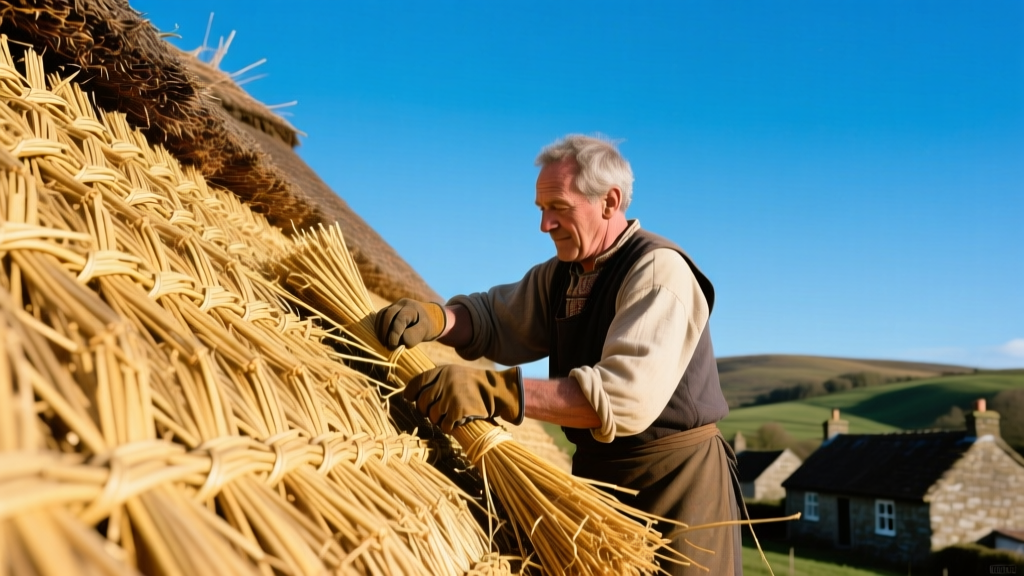
Decision Framework: Which Material is Right for Your Project?
Selecting the correct thatched roof material requires aligning your architectural goals with your local climate and maintenance tolerance.
- Choose Water Reed if: You are building a heritage-accurate residence in a temperate, windy climate, have a roof pitch of at least 45 degrees, and possess the budget for a 60-year lifecycle asset. It offers the highest ROI for luxury residential properties.
- Choose Long Straw if: You are restoring a Grade II listed historical property where conservation officers mandate the original aesthetic, and your roof features complex dormers and valleys that benefit from straw's pliability.
- Choose Synthetic Thatch if: You are designing a commercial resort, a pool pavilion, or a residential home in a high-fire-risk zone (WUI - Wildland-Urban Interface). Synthetic material eliminates the fire hazard, bypasses the need for specialized thatchers, and allows for lower roof pitches (down to 30 degrees) over standard insulated roof decks.
Ultimately, the choice of thatched roof material dictates not just the visual character of the building, but the structural engineering of the rafters, the fire safety strategy of the interior, and the decades-long maintenance schedule of the property.
Written by
Sarah WhitfieldSarah Whitfield is a chartered quantity surveyor (MRICS) and construction cost analyst with 15 years of experience in material pricing, procurement strategy, and project budgeting. She earned her degree in Construction Management from the University of Reading (UK) and has worked on projects ranging from $2M custom homes to $180M mixed-use developments across North America and Europe. Sarah currently leads cost estimating for BuildMat Insight, maintaining a proprietary database of 4,000+ material price points updated quarterly. She is a frequent contributor to RSMeans cost data panels and has presented at the International Cost Engineering Council (ICEC) congress. Based in Denver, CO, Sarah is an avid trail runner and volunteer mentor for Women in Construction.
More from Sarah Whitfield
View all
Wood & Lumber
What Are the Different Types of Wood? A Builder's Guide
Compare structural softwoods, finish hardwoods, and engineered lumber. Analyze Janka ratings, MOE values, and 2026 pricing for construction.
Aug 4, 2026

Walls & Panels
Steel Framing vs Wood Framing: Corrosion and Moisture Defense
Compare steel framing vs wood framing for moisture resistance. Learn about galvanized coatings, condensation risks, and corrosion protection strategies.
Jul 21, 2026

Stone & Masonry
How to Cut Stone Veneer: Wet Saw vs Grinder Comparison
Compare the best tools for cutting stone veneer. We review wet saws, angle grinders, and chop saws to help you achieve clean, chip-free cuts.
Jul 21, 2026