Best Fire Resistant Material for Fire Pit Builds: 2026 Review
Compare the best fire resistant material for fire pit builds in 2026. We review fire brick, castable refractory, and steel liners with costs and specs.

The Thermal Shock Problem: Why Standard Masonry Fails
Wood-burning fire pits routinely generate core temperatures between 1,200°F and 1,500°F. When standard concrete blocks, veneer stone, or Type N mortar are exposed to this heat, they undergo a catastrophic structural failure known as thermal shock. The primary culprit is quartz inversion. Standard concrete contains silica, which rapidly expands at exactly 1,063°F. Because the exterior of the masonry remains cool while the interior surface superheats, this uneven expansion creates immense internal shear stress, resulting in explosive spalling, deep cracking, and eventual collapse of the fire pit wall.
Selecting the correct fire resistant material for fire pit interiors is not just about longevity; it is a critical safety requirement to prevent structural failure and contain radiant heat. Below is a comprehensive technical comparison of the four primary refractory materials used in modern fire pit construction.
Head-to-Head Material Comparison Matrix
| Material | Max Service Temp | 2026 Avg. Cost (per sq. ft.) | Expected Lifespan | Best Application |
|---|---|---|---|---|
| High-Duty Fire Clay Brick | 3,200°F | $14.00 - $18.50 | 25+ Years | Traditional masonry builds, square/rectangular pits |
| Castable Refractory Cement | 3,000°F | $12.00 - $16.00 | 15 - 20 Years | Curved walls, seamless custom monolithic liners |
| 304 Stainless Steel Liner | 1,600°F (Continuous) | $35.00 - $60.00 | 10 - 15 Years | Modern inserts, gas conversions, thin-profile builds |
| Ceramic Fiber Board (Backer) | 2,300°F | $22.00 - $28.00 | Indefinite (if protected) | Insulation layer behind stone veneers or steel |
High-Duty Fire Clay Brick: The Traditional Standard
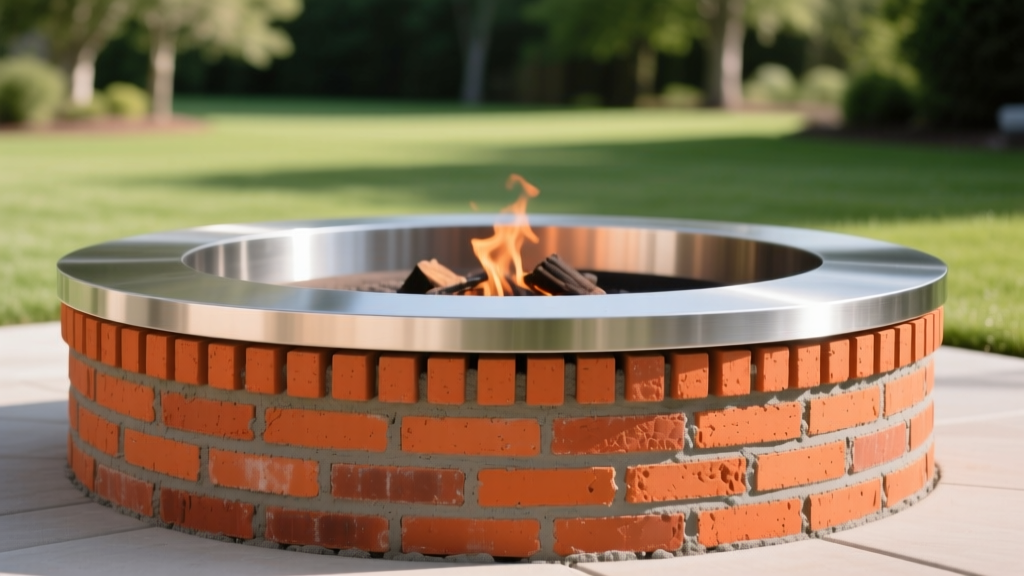
Fire brick is the most reliable and widely specified fire resistant material for fire pit liners. However, not all fire bricks are equal. According to ASTM C27 (Standard Classification of Fireclay and High-Alumina Refractory Brick), bricks are classified by their alumina content and temperature limits. For a wood-burning fire pit, you must specify High-Duty (Class 32) fire brick, which contains roughly 40% alumina and withstands up to 3,200°F. Medium-duty bricks are acceptable for low-heat gas burners but will degrade prematurely under heavy wood loads.
Pros and Cons of Fire Brick
Pros: Unmatched thermal mass; absorbs and radiates heat evenly; highly resistant to mechanical impact from firewood; modular sizing allows for complex geometric patterns.
Cons: Requires specialized refractory mortar; heavy; limits interior shapes to faceted polygons unless cut with a wet masonry saw.
Critical Installation Specifics
Standard masonry mortar will melt and fail. You must use a calcium aluminate-based refractory mortar, such as HeatStop 50. The mortar joints must be kept exceptionally tight—maximum 1/16-inch to 1/8-inch thick. Thick mortar joints create weak points where the mortar can shrink and fall out over repeated thermal cycling. As of 2026, high-duty fire bricks cost approximately $2.50 to $3.50 per unit, meaning a standard 36-inch circular pit requiring roughly 60 bricks will cost between $150 and $210 for the brick alone.
Castable Refractory Concrete: The Seamless Custom Fit
For curved, monolithic, or organically shaped fire pits, castable refractory cement (such as Kast-O-Lite 26 LI or Rutland Castable Refractory) is the optimal choice. Unlike standard concrete, castable refractory uses calcium aluminate cement and lightweight aggregates (like expanded shale or pumice) to provide high heat resistance and low thermal conductivity.
WARNING: Explosive Spalling Risk During Curing
The most common failure mode for castable refractory is explosive spalling during the first fire. Castable cement requires water to set, and this water becomes chemically bound and trapped in the matrix. If you light a full wood fire immediately after the 24-hour air cure, the trapped water flashes to steam, expanding 1,600 times in volume and literally blowing the liner apart. You must perform a strict thermal cure: burn only crumpled newspaper for 2 hours on day one, add small kindling for 2 hours on day two, and gradually increase the fire size over a 5-day period to safely boil off the residual moisture.
Mixing and Formwork Requirements
Castable refractory must be mixed to a stiff, 'earth-moist' consistency, not a soupy slurry. Excess water drastically reduces the final compressive strength and increases the curing time. When building formwork for a circular fire pit, use 3/4-inch plywood lined with 6-mil polyethylene sheeting to prevent the wood forms from absorbing water out of the refractory mix. Strip the forms after 24 hours and allow the liner to air-dry for an additional 48 hours before beginning the thermal cure schedule.
Stainless Steel and Corten Liners: The Modern Insert
Metal liners are increasingly popular in contemporary landscape architecture due to their thin profiles and clean lines. However, metal selection dictates the lifespan of the pit. Mild steel and standard Corten (weathering steel) will oxidize rapidly and warp when exposed to direct, sustained wood-fire temperatures unless they are exceptionally thick (minimum 3/8-inch plate).
For most residential builds, a 304-grade stainless steel insert is the superior fire resistant material for fire pit applications. 304 stainless contains high levels of chromium and nickel, resisting oxidation up to 1,600°F. To prevent the steel from warping or 'oil-canning' under thermal expansion, the liner must be a minimum of 14-gauge (0.075 inches) thickness, though 12-gauge (0.105 inches) is highly recommended for pits larger than 30 inches in diameter.
The Air Gap Requirement
Steel conducts heat rapidly. If a stainless steel liner is placed directly against a combustible deck or a standard masonry retaining wall, it will transfer enough heat to ignite the surrounding materials. You must maintain a minimum 2-inch continuous air gap between the steel liner and the outer decorative shell, utilizing ceramic fiber spacers to maintain the gap and allow convective cooling.
Ceramic Fiber Board: The Insulation Backer
Ceramic fiber board (often sold under brand names like Insulite or Kaowool Board) is a rigid, high-temperature insulation material. It is not a primary liner. Ceramic fiber is fragile, sheds microscopic glass fibers when abraded, and cannot withstand the mechanical impact of firewood being thrown into the pit.
Instead, ceramic fiber board is used as a secondary backer layer. If you are building a fire pit with a natural stone veneer and want to protect the structural concrete block core from thermal degradation, you line the inside of the block with 1-inch thick ceramic fiber board (rated to 2,300°F), and then install a fire brick or steel primary liner in front of it. This creates a highly efficient thermal break that keeps the exterior stone cool to the touch while reflecting heat back into the fire bowl.
Decision Framework: Matching Material to Build Type
Use this diagnostic framework to select the correct fire resistant material for fire pit projects based on your specific design parameters:
- IF you are building a traditional, square, or multi-level masonry pit and want maximum durability: CHOOSE High-Duty Fire Clay Brick with HeatStop 50 mortar.
- IF your design features sweeping curves, an asymmetrical organic shape, or a seamless monolithic interior: CHOOSE Castable Refractory Cement, provided you have the time to execute the 5-day thermal cure.
- IF you are building a modern, thin-profile architectural pit, integrating a gas burner, or require a lightweight insert for a rooftop deck: CHOOSE a 12-gauge 304 Stainless Steel Liner with a 2-inch ventilated air gap.
- IF you are cladding the exterior with expensive natural stone or installing the pit on a composite deck: ADD a 1-inch Ceramic Fiber Board backer layer behind your primary liner to block radiant heat transfer.
Code Compliance and Clearance Requirements
While backyard fire pits are often treated as casual landscaping features, permanent, wood-burning masonry fire pits fall under local building codes and fire marshal regulations. In the United States, the foundational standard for solid fuel-burning appliances is NFPA 211 (Standard for Chimneys, Fireplaces, Vents, and Solid Fuel-Burning Appliances).
Under NFPA 211 and most localized 2026 building codes, a permanent masonry fire pit must maintain a minimum clearance of 10 feet from any combustible structure, including house eaves, pergolas, and property lines. Furthermore, if the fire pit is built on a combustible surface (like a wood deck), the base must consist of a non-combustible hearth extension that extends at least 18 inches beyond the fire chamber in all directions, constructed of masonry or rated composite materials over a thermal break. Always consult your local Authority Having Jurisdiction (AHJ) before pouring footings or ordering refractory materials, as local ordinances regarding open-air burning and spark-arrestor requirements can override general material guidelines.
Written by
Elena RodriguezElena Rodriguez is a civil engineer and technical writer specializing in concrete technology, masonry systems, and ASTM/ACI compliance. She earned her B.S. in Civil Engineering from Texas A&M University and spent a decade at a materials testing laboratory, performing over 2,000 concrete compressive strength tests and masonry prism evaluations. Elena is an ACI-certified Field Testing Technician (Grade I) and a member of ASTM Committee C12 on Natural Building Stone. She currently consults on forensic engineering cases involving concrete failures and moisture intrusion. Based in San Antonio, TX, Elena is a proud member of the Society of Women Engineers (SWE) and coaches her daughter's FIRST Robotics team.
More from Elena Rodriguez
View all
Walls & Panels
Cost Analysis: Light Gauge Steel Framing Advantages and Disadvantages
Evaluate light gauge steel framing advantages and disadvantages through a strict cost analysis lens, comparing material, labor, and lifecycle expenses.
Aug 4, 2026

Walls & Panels
Gypsum Board Types: Exact Specifications, Thickness & Dimensions
Compare standard, Type X, and moisture-resistant gypsum board types. Get exact specifications, thicknesses, dimensions, and ASTM standards for your project.
Aug 4, 2026

Fire Resistance
Best Fire-Resistant Outdoor Decking Materials: 2026 Buyer Guide
Discover the best fire-resistant outdoor decking materials for 2026. Compare Class A PVC, aluminum, and hardwood options for WUI compliance and safety.
Aug 4, 2026