Specifying Fire Resistant Flooring Materials: Application Guide
Learn how to specify and apply fire resistant flooring materials. Compare ceramic, concrete, and terrazzo for commercial code compliance and assembly ratings.

The most effective fire resistant flooring materials include porcelain tile, polished concrete, and specialized fire-retardant treated (FRT) wood, which consistently achieve Class A fire ratings under ASTM E648 testing. This application guide is specifically written for architects, general contractors, and facility managers who need to specify non-combustible or fire-rated floor coverings for commercial, industrial, and high-risk residential environments. Selecting the right material ensures compliance with the National Fire Protection Association (NFPA) life safety codes while maintaining structural integrity during thermal events.
Executive Summary and Key Takeaways
- Top Materials: Porcelain tile, polished concrete, and FRT wood offer the highest inherent fire resistance.
- Code Compliance: Commercial egress paths require a minimum Class I (or Class A) rating per NFPA 101.
- Cost Factor: Non-combustible options range from $6.00 to $18.00 per square foot installed.
- Primary Standard: ASTM E648 measures critical radiant flux to determine floor covering fire performance.
Table of Contents
Understanding Fire Testing Standards
Specifying fire resistant flooring materials requires a precise understanding of standardized testing methodologies. Building codes rely on specific metrics to evaluate how floor coverings behave when exposed to direct flames and radiant heat in corridor egress scenarios.
ASTM E648 and NFPA 101 Requirements
The ASTM E648 Standard Test Method evaluates the critical radiant flux of floor covering systems using a radiant heat source. The NFPA 101 Life Safety Code mandates that floor coverings in exit enclosures and exit access corridors must meet specific minimum classifications based on this test.
Flame Spread Index: A numerical value assigned to a material based on the speed and extent to which flame travels across its surface during standardized testing. Class A materials have an index of 25 or less, indicating minimal surface combustion risk.
Critical Radiant Flux: The level of incident radiant heat energy measured in watts per square centimeter at the most distant point where a flooring material sustains flame propagation. Higher values indicate superior resistance to heat-driven fire spread across corridors.
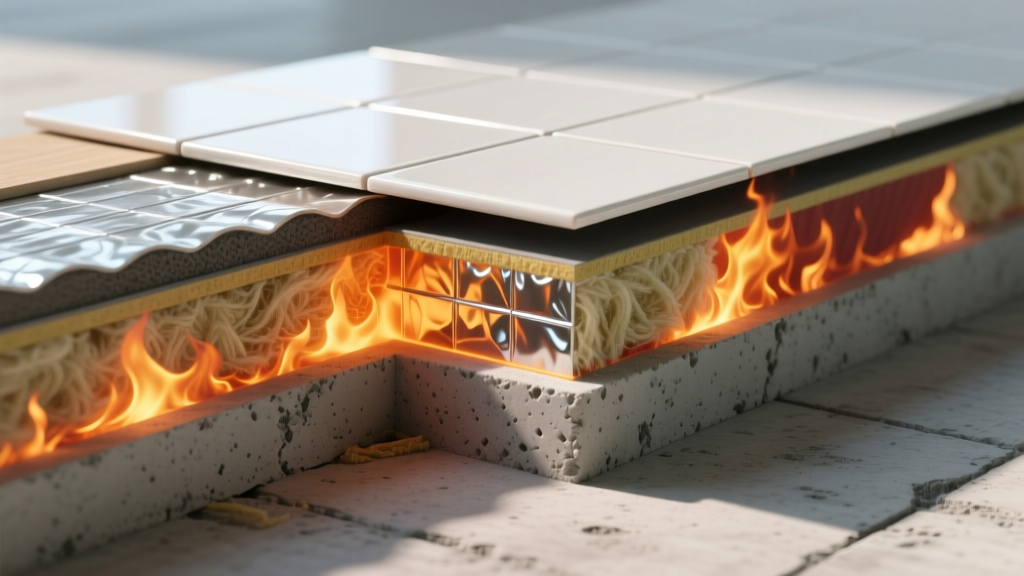
Top Fire Resistant Flooring Materials
Different environments demand varying levels of thermal resistance, structural load capacity, and aesthetic performance. The following materials represent the industry standard for non-combustible and fire-rated floor assemblies in 2026.
Porcelain and Ceramic Tile
Porcelain tile is manufactured by firing refined clay at temperatures exceeding 1200°C (2192°F), creating a vitrified, entirely non-combustible surface. It achieves a Class A fire rating and produces zero toxic smoke when exposed to structural fires. The primary limitation is the substrate; the underlying mortar and subfloor must also possess adequate fire-resistance ratings to prevent assembly collapse.
Polished Concrete
As an inorganic, mineral-based material, polished concrete is inherently non-combustible and provides exceptional thermal mass. A standard 3/4-inch minimum thickness concrete topping slab over a steel deck can achieve a 45-minute fire resistance rating for the overall floor-ceiling assembly. It is the default specification for industrial facilities and modern commercial egress paths.
Fire-Retardant Treated Wood
For projects requiring the aesthetic warmth of wood, fire-retardant treated (FRT) wood is pressure-impregnated with chemical salts that reduce surface flame spread. According to the American Wood Council FRT Guidelines, these treatments lower the flame spread index to 25 or less. FRT wood is strictly for interior applications, as moisture leaches the chemical retardants over time.
Application Guide by Environment
Matching the material to the specific fire hazard profile of the room ensures both safety and code compliance. High-heat areas require non-combustible materials, while egress paths require high critical radiant flux values.
Commercial Kitchens and High-Heat Zones
Commercial kitchens generate extreme ambient heat and open-flame hazards. Porcelain tile or sealed concrete are the only acceptable options here, as they will not ignite, melt, or off-gas when exposed to dropped hot materials or grease fires. Avoid any polymeric or resin-based coatings in these zones.
Egress Corridors and Stairwells
Exit access corridors require flooring that prevents flame propagation to allow safe occupant evacuation. The NFPA 101 code requires a minimum Class I (critical radiant flux of 0.45 watts per square centimeter) rating in these areas. Specialty fire-rated luxury vinyl plank (LVP) with mineral core backing can meet this requirement while providing underfoot comfort.
Material Selection Decision Matrix
Use the following comparison table to evaluate fire resistant flooring materials against project-specific constraints. This framework balances fire performance with installed costs and ideal use cases.
| Material Type | Fire Rating / Classification | Best Application | Average Installed Cost (2026) |
|---|---|---|---|
| Porcelain Tile | Class A (Non-combustible) | Commercial kitchens, lobbies, bathrooms | $11.00 - $18.00 / sq ft |
| Polished Concrete | Class A (Non-combustible) | Industrial warehouses, egress corridors | $6.00 - $12.00 / sq ft |
| FRT Hardwood | Class A (Index ≤ 25) | Interior residential, boutique hospitality | $14.00 - $22.00 / sq ft |
| Mineral Core LVP | Class I (Flux ≥ 0.45 W/cm²) | Hospital corridors, multi-family housing | $8.50 - $14.00 / sq ft |
Frequently Asked Questions
What is the best fireproof flooring for kitchens?
The best fireproof flooring for kitchens is unglazed porcelain tile or sealed polished concrete. Both materials are entirely inorganic, meaning they cannot ignite, melt, or release toxic fumes when exposed to the high temperatures and open flames typical of residential and commercial cooking environments.
What is the fire rating of luxury vinyl plank?
Standard luxury vinyl plank (LVP) typically achieves a Class II or Class III rating, making it unsuitable for commercial egress paths. However, specialized rigid mineral core LVP products are engineered to achieve a Class I rating (critical radiant flux of 0.45 W/cm² or greater), allowing them to be used in code-compliant exit corridors.
Are there non-combustible commercial flooring options that look like wood?
Yes, wood-look porcelain tile provides the exact visual aesthetic of hardwood while maintaining a completely non-combustible, Class A fire rating. Additionally, high-definition architectural concrete stains can mimic wood grain patterns on polished concrete substrates without introducing any combustible organic materials to the floor assembly.
Conclusion and Next Steps
Specifying the correct fire resistant flooring materials is a critical component of passive fire protection and life safety design. By selecting non-combustible options like porcelain and concrete, or properly tested FRT wood and mineral core resilient flooring, you ensure your building meets stringent NFPA 101 egress requirements. Your immediate next step is to cross-reference the Material Selection Decision Matrix above with your project's local building code amendments, then request the specific ASTM E648 test reports from your shortlisted manufacturers to verify compliance before finalizing your specifications.
Written by
David NakamuraDavid Nakamura is a licensed architect (AIA) and construction technology writer focused on sustainable building methods, mass timber engineering, and high-performance building envelopes. He holds a Master of Architecture from the University of Washington and is a certified Passive House Consultant (CPHC). David spent eight years at the Seattle firm Mithun, where he led the design of three LEED Platinum projects, before founding his own practice specializing in net-zero residential design. He serves on the editorial advisory board of GreenBuilder Magazine and has authored peer-reviewed papers on cross-laminated timber (CLT) connections for the Journal of Structural Engineering. In his spare time, David teaches woodworking at Pratt Fine Arts Center and kayaks the Puget Sound.
More from David Nakamura
View all
Construction Cost
Labor Cost to Build a Deck Per Sq Ft: 2026 Installation Guide
Discover the exact labor cost to build a deck per sq ft in 2026. This installation guide breaks down contractor rates, complexity factors, and hidden fees.
Aug 4, 2026

Construction Cost
How Much Does It Cost to Build a 3 Bedroom House? Financing Guide
Learn exactly how much it costs to build a 3 bedroom house and explore 2026 financing options, construction loan types, and budget frameworks for your build.
Aug 4, 2026

Construction Cost
Cost to Build a Tennis Court: 2026 Guide
How much does it cost to build a tennis court in 2026? Breakdowns for asphalt, concrete, and synthetic surfaces plus fencing and lighting.
Jul 30, 2026