Decoding the Fire Resistance Rating of Materials for Code Compliance
Learn how the fire resistance rating of materials is tested, classified, and applied to meet IBC code compliance for commercial and residential builds.

The Anatomy of a Fire Resistance Rating
The fire resistance rating of materials is fundamentally a measure of time, not temperature. When the International Building Code (IBC) mandates a 2-hour fire-resistance rating, it requires the building assembly to withstand the standard time-temperature curve defined by ASTM E119 (or UL 263) for 120 minutes. During this test, the assembly must maintain its structural integrity, prevent the passage of flames and hot gases, and limit heat transmission to the unexposed side.
The standard time-temperature curve is aggressively non-linear, designed to simulate a severe compartment fire. The furnace temperature reaches 1,000°F at 5 minutes, 1,550°F at 30 minutes, 1,700°F at 1 hour, and peaks at 2,000°F at the 4-hour mark. For load-bearing walls and columns, the test concludes with a high-pressure hose-stream test to evaluate the assembly's structural cohesion after thermal shock.
The term "fireproof" is a marketing fallacy. All building materials will eventually fail under sustained thermal attack. The correct industry terminology is "fire-resistive," which acknowledges that the material is engineered to delay failure for a specific, tested duration, allowing time for occupant egress and firefighter intervention.
Assembly vs. Material: The Crucial Distinction
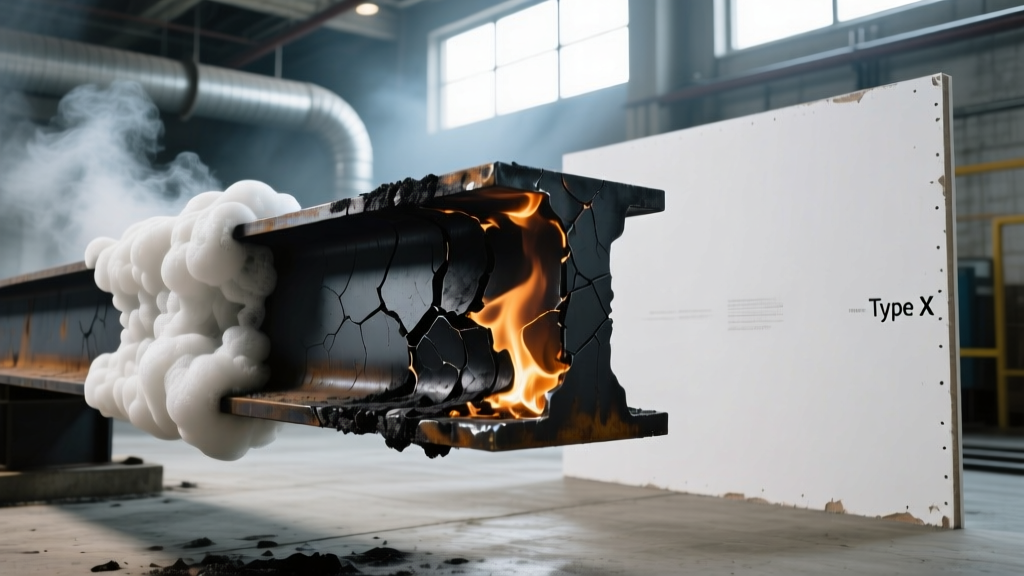
A common error in construction specification is assuming that raw materials possess standalone fire ratings. In reality, the fire resistance rating of materials applies to assemblies, not isolated components. A 5/8-inch Type X gypsum board possesses inherent fire-resistive properties due to its chemically combined water, but it only achieves a 1-hour rating when mounted on specific framing (e.g., 16-inch o.c. wood studs or 25-inch o.c. steel studs) using defined screw patterns and joint treatments.
| Core Material | Fire-Resistive Mechanism | Typical Assembly Contribution |
|---|---|---|
| Type X Gypsum Board | Calcination: The core contains ~21% chemically combined water. Under heat, this water vaporizes, absorbing massive amounts of thermal energy and delaying heat transfer. | 30 to 60 minutes per layer, depending on framing and fastening. |
| Lightweight Concrete | Low thermal conductivity and internal moisture vaporization. The porous aggregate structure insulates the inner core from rapid temperature spikes. | Approximately 1 hour per 3.5 inches of thickness for solid walls. |
| Structural Steel | Non-combustible, but loses 50% of its yield strength at 1,000°F. Requires protection to maintain structural integrity during a fire. | 0 minutes unprotected. Requires Spray-Applied Fire-Resistive Material (SFRM) or intumescent coatings to achieve 1 to 3-hour ratings. |
| Mass Timber (CLT/Glulam) | Predictable charring. The outer layer chars at roughly 1.5 inches per hour, creating an insulating carbon barrier that protects the uncharred inner core's structural capacity. | Calculated via IBC Chapter 23 char-layer methods; typically 1 to 2 hours for heavy sections. |
IBC Construction Types and Required Ratings
The International Code Council (ICC) categorizes buildings into five primary construction types based on the fire resistance rating of materials used in their structural frames and enclosing walls. Understanding these baselines is mandatory for code compliance and insurance underwriting.
- Type I (A & B): Non-combustible. Structural elements require 3-hour to 4-hour ratings. Typical for high-rises and large hospitals.
- Type II (A & B): Non-combustible. Structural elements require 1-hour to 2-hour ratings (Type IIA) or 0 hours (Type IIB). Common in modern commercial warehouses.
- Type III: Non-combustible exterior walls (2-hour), combustible interior framing. Typical for mixed-use retail with residential above.
- Type IV: Heavy Timber (Mass Timber). Exterior walls non-combustible (2-hour), interior timber elements rely on mass and charring rather than applied fireproofing.
- Type V (A & B): Combustible. Wood-framed. Type VA requires 1-hour ratings throughout; Type VB requires no ratings. Standard for single-family homes and low-rise apartments.
Upgrading a 1-Hour Wall to a 2-Hour Assembly
When architectural changes or code updates require upgrading a partition from a 1-hour to a 2-hour fire resistance rating of materials, simply adding a second layer of standard 1/2-inch drywall is insufficient and often fails testing. Instead, specify high-performance assemblies:
- Upgrade the Core: Utilize enhanced Type C gypsum boards (e.g., USG Sheetrock Brand Firecode C), which feature a denser core and higher fiberglass reinforcement to prevent the board from shrinking and cracking under extreme thermal stress.
- Cavity Insulation: Fill the stud cavity with mineral wool insulation (such as Rockwool Safe'n'Sound). Unlike fiberglass, mineral wool has a melting point exceeding 2,150°F, drastically slowing convective heat transfer within the wall cavity.
- Staggered Joints: Ensure all face-layer joints are staggered over the base-layer joints by at least 24 inches to prevent continuous thermal leakage paths.
Navigating Engineering Judgments (EJs)
In complex commercial projects, the exact wall or floor assembly required by the architect may not exist in the UL Fire Resistance Directory or the NFPA databases. When a specific combination of materials hasn't been physically tested, the IBC (Section 703.2.3) allows for an Engineering Judgment (EJ).
An EJ is not a loophole; it is a rigorous analytical process. A licensed Fire Protection Engineer (FPE) must extrapolate data from existing, tested assemblies to prove that the proposed untested assembly will perform equivalently. Relying on EJs for critical life-safety shaft enclosures is heavily scrutinized by Authorities Having Jurisdiction (AHJs) and should be avoided in favor of pre-tested UL designs whenever possible.
Technical FAQ: Fire Resistance Rating of Materials
Does adding a second layer of standard drywall equal a Type X upgrade?
No. Standard 1/2-inch gypsum board lacks the glass-fiber reinforcement and core density of Type X. Under the ASTM E119 curve, standard board will calcine and fall off the framing much faster, exposing the studs to direct flame. Upgrades must utilize certified Type X or Type C boards to achieve higher hourly ratings.
How do fire ratings apply to wall penetrations?
A 2-hour wall is rendered useless if a plumbing pipe or electrical conduit melts and creates a pathway for smoke and fire. Penetrations must be protected using systems tested to ASTM E814 (UL 1479). These systems are graded by an "F-Rating" (flame containment time) and a "T-Rating" (temperature transmission limit). The firestop system must match the exact pipe material and diameter tested.
Can I paint over intumescent steel coatings?
Intumescent coatings swell up to 50 times their original thickness when exposed to heat, forming an insulating char that protects structural steel. You cannot apply standard architectural latex paint over them. Standard paint can act as an insulator that delays the thermal trigger, or it may chemically inhibit the char-forming reaction. Only topcoats explicitly approved by the intumescent manufacturer's technical data sheet may be applied.
Written by
Sarah WhitfieldSarah Whitfield is a chartered quantity surveyor (MRICS) and construction cost analyst with 15 years of experience in material pricing, procurement strategy, and project budgeting. She earned her degree in Construction Management from the University of Reading (UK) and has worked on projects ranging from $2M custom homes to $180M mixed-use developments across North America and Europe. Sarah currently leads cost estimating for BuildMat Insight, maintaining a proprietary database of 4,000+ material price points updated quarterly. She is a frequent contributor to RSMeans cost data panels and has presented at the International Cost Engineering Council (ICEC) congress. Based in Denver, CO, Sarah is an avid trail runner and volunteer mentor for Women in Construction.
More from Sarah Whitfield
View all
Wood & Lumber
What Are the Different Types of Wood? A Builder's Guide
Compare structural softwoods, finish hardwoods, and engineered lumber. Analyze Janka ratings, MOE values, and 2026 pricing for construction.
Aug 4, 2026

Walls & Panels
Steel Framing vs Wood Framing: Corrosion and Moisture Defense
Compare steel framing vs wood framing for moisture resistance. Learn about galvanized coatings, condensation risks, and corrosion protection strategies.
Jul 21, 2026

Stone & Masonry
How to Cut Stone Veneer: Wet Saw vs Grinder Comparison
Compare the best tools for cutting stone veneer. We review wet saws, angle grinders, and chop saws to help you achieve clean, chip-free cuts.
Jul 21, 2026