Nylon Waterproof Fabric Material: A Construction Selection Guide
Compare PU, TPU, and silicone-coated nylon waterproof fabric material for construction enclosures, tensile facades, and temporary weatherproofing.

Architectural Applications for Nylon Waterproof Fabric Material
Nylon waterproof fabric material serves critical roles in modern construction, ranging from temporary weather enclosures and scaffolding wraps to permanent tensile facades and lightweight roofing membranes. Unlike PVC-coated polyester, which dominates heavy-duty permanent architecture, nylon offers superior strength-to-weight ratios, higher tear resistance, and better cold-weather flexibility. When specifying temporary enclosures for winter construction or designing lightweight tensile canopies, understanding the precise interplay between nylon yarn denier, weave patterns, and waterproof coatings is essential for structural integrity and longevity.
According to the Whole Building Design Guide, tensile membrane structures require materials that balance high tensile strength with minimal bias stretch. Nylon inherently exhibits higher elongation at break than polyester, making it ideal for applications requiring dynamic load absorption, such as wind-baffling scaffolding nets and temporary hurricane-rated enclosures. However, raw nylon is hydrophilic and absorbs water, necessitating advanced coating technologies to achieve true waterproofing and dimensional stability.
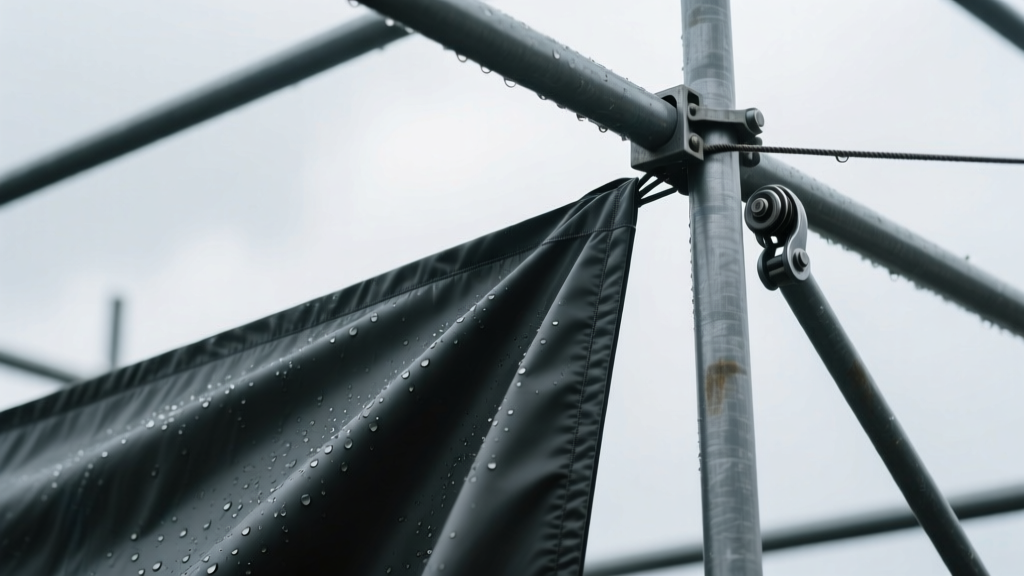
Coating Chemistries: PU vs. TPU vs. Silicone
The waterproof performance of nylon fabric is dictated entirely by its coating or laminate. Selecting the wrong chemistry for a specific construction environment leads to premature delamination, hydrolysis, or UV degradation.
Polyurethane (PU) Coatings
Standard PU coatings are applied as a liquid layer to the interior face of the nylon weave. They offer a hydrostatic head (HH) rating between 1,500mm and 3,000mm, sufficient for standard scaffolding wraps and short-term weather enclosures. PU remains highly flexible in sub-zero temperatures, preventing the cracking often seen in rigid PVC membranes during winter construction. However, standard PU is susceptible to hydrolysis—a chemical breakdown triggered by prolonged exposure to high heat and humidity, which causes the coating to become sticky and peel away from the nylon substrate.
Thermoplastic Polyurethane (TPU) Laminates
For heavy-duty construction hoarding and long-term temporary enclosures, TPU laminates are the superior choice. TPU is applied as a pre-formed film bonded to the nylon via heat and pressure. It delivers hydrostatic head ratings exceeding 10,000mm and offers exceptional abrasion resistance against rough concrete and steel edges. Crucially, TPU is highly resistant to hydrolysis and can be RF (radio frequency) welded, allowing for the creation of completely waterproof, stitch-free seams in large-scale enclosure panels.
Silicone-Impregnated Nylon (Silnylon)
Silnylon involves impregnating the nylon weave with liquid silicone, filling the gaps between yarns rather than applying a surface layer. This results in an exceptionally lightweight, highly UV-stable material with a HH rating of 2,000mm to 4,000mm. While it dominates the ultralight tensile and canopy market, silnylon cannot be heat-welded and requires specialized silicone-based seam sealers, making it less practical for rapid deployment of large construction enclosures.
Performance Matrix: Material Selection Guide
| Coating Type | Hydrostatic Head | UV Stability | Weldability | Primary Construction Use |
|---|---|---|---|---|
| Standard PU | 1,500 - 3,000mm | Moderate (Requires UV inhibitors) | No (Sew & Tape only) | Short-term scaffolding wraps, dust barriers |
| TPU Laminate | 10,000mm+ | High | Yes (RF and Hot Air) | Heavy-duty winter enclosures, water diversion |
| Silicone (Silnylon) | 2,000 - 4,000mm | Exceptional | No (Requires chemical sealants) | Lightweight tensile canopies, shade sails |
Specifying Denier, Weave, and Bias Stretch
Denier (D) measures the linear mass density of the nylon yarns, calculated as the weight in grams of 9,000 meters of the yarn. Higher denier counts yield thicker, heavier, and more puncture-resistant fabrics, but at the cost of increased weight and reduced packability for temporary deployment.
Ripstop vs. Oxford Weaves
- 70D to 210D Ripstop: Features a reinforced crosshatch grid woven at regular intervals (typically 3mm to 5mm). If the fabric is punctured by a stray piece of rebar or sharp scaffolding clamp, the tear is contained within the grid square. Ideal for lightweight tensile facades and interior dust containment.
- 420D to 1000D Oxford: Utilizes a dense basket weave without the ripstop grid, offering a smoother surface that sheds debris and concrete slurry more effectively. 420D Oxford with a TPU backing is the industry standard for exterior winter construction enclosures, providing the necessary mass to resist wind-flutter and abrasion against structural steel.
When engineering enclosures subject to high wind loads, contractors must account for nylon's bias stretch. Nylon stretches significantly more on the bias (diagonal to the weave) than on the straight grain. Panels must be cut and tensioned with the primary load vectors aligned with the warp and weft yarns to prevent catastrophic deformation. For comprehensive safety standards regarding wind loads on temporary structures, refer to the OSHA scaffolding and enclosure guidelines.
Real-World Failure Modes and Edge Cases
Specifying the correct material is only half the battle; understanding how nylon waterproof fabric material fails in the field prevents costly mid-project replacements.
- Hydrolytic Degradation in PU: Storing PU-coated nylon rolls in unventilated, humid shipping containers before deployment can trigger hydrolysis before the material is even installed. Always specify hydrolysis-resistant PU formulations if the material will be stockpiled in coastal or high-humidity environments.
- UV-Induced Embrittlement: Unstabilized nylon loses up to 50% of its tensile strength after six months of direct UV exposure. Ensure the supplier certifies the inclusion of UV-inhibiting additives (such as hindered amine light stabilizers, or HALS) in both the yarn dope and the coating chemistry.
- Seam Slippage: In high-tension tensile applications, the nylon yarns can pull apart at the needle holes of sewn seams, a failure mode known as seam slippage. This is mitigated by using finer needles, higher stitch counts (8-10 per inch), and bonding a structural reinforcement tape over the seam allowance.
Seam Engineering: Welding vs. Sewing
The waterproof integrity of an enclosure is only as strong as its seams. The chosen coating dictates the seam construction methodology:
RF and Hot Air Welding: Exclusive to TPU and PVC coatings. Welding melts the coating layers together, creating a monolithic, 100% waterproof bond that is often stronger than the base fabric. This is mandatory for ground-level water diversion barriers and heavy-duty roofing membranes.
Sewing and Taping: Required for PU and Silnylon. Panels are sewn using PTFE (Teflon) thread, which resists UV degradation and chemical rot. The needle holes are then sealed using a heat-activated PU seam-sealing tape applied over the interior stitches. For critical applications, specify a double-lapped seam with tape applied to both sides.
2026 Procurement and Cost Benchmarks
Pricing for nylon waterproof fabric material fluctuates based on petrochemical indices and supply chain dynamics. As of 2026, wholesale procurement (rolls of 100+ linear yards) generally falls within the following ranges:
70D Silnylon (Ripstop): $6.50 - $9.00 per linear yard (60" width).
210D PU-Coated Oxford: $3.20 - $4.80 per linear yard (60" width).
420D TPU-Laminated Ripstop: $11.00 - $15.50 per linear yard (60" width).
1000D Cordura with Heavy PU: $14.00 - $18.00 per linear yard (60" width).
When evaluating bids, require suppliers to provide third-party testing certificates verifying the hydrostatic head rating per ASTM D751 Standard Test Methods for Coated Fabrics. Relying solely on manufacturer-published specifications without independent verification frequently results in underperforming materials arriving on the job site, leading to water ingress and subsequent construction delays.
Written by
Sarah WhitfieldSarah Whitfield is a chartered quantity surveyor (MRICS) and construction cost analyst with 15 years of experience in material pricing, procurement strategy, and project budgeting. She earned her degree in Construction Management from the University of Reading (UK) and has worked on projects ranging from $2M custom homes to $180M mixed-use developments across North America and Europe. Sarah currently leads cost estimating for BuildMat Insight, maintaining a proprietary database of 4,000+ material price points updated quarterly. She is a frequent contributor to RSMeans cost data panels and has presented at the International Cost Engineering Council (ICEC) congress. Based in Denver, CO, Sarah is an avid trail runner and volunteer mentor for Women in Construction.
More from Sarah Whitfield
View all
Wood & Lumber
What Are the Different Types of Wood? A Builder's Guide
Compare structural softwoods, finish hardwoods, and engineered lumber. Analyze Janka ratings, MOE values, and 2026 pricing for construction.
Aug 4, 2026

Walls & Panels
Steel Framing vs Wood Framing: Corrosion and Moisture Defense
Compare steel framing vs wood framing for moisture resistance. Learn about galvanized coatings, condensation risks, and corrosion protection strategies.
Jul 21, 2026

Stone & Masonry
How to Cut Stone Veneer: Wet Saw vs Grinder Comparison
Compare the best tools for cutting stone veneer. We review wet saws, angle grinders, and chop saws to help you achieve clean, chip-free cuts.
Jul 21, 2026