Waterproof Material Glue for Exterior Bonding: 2026 Review
Compare the best waterproof material glue options for 2026. We review polyurethane and MS polymer adhesives for exterior masonry, wood, and metal.

The Chemistry of Waterproof Adhesives in Modern Construction
Selecting the correct waterproof material glue for exterior and high-moisture applications requires a fundamental understanding of adhesive chemistry. Standard PVA (polyvinyl acetate) wood glues and basic acrylic construction adhesives undergo catastrophic hydrolysis when exposed to continuous moisture, leading to bond failure, substrate rot, and structural compromise. In 2026, the professional construction market relies almost exclusively on two advanced chemical families for permanent, waterproof structural bonding: Polyurethane (PUR) and Modified Silane (MS) Polymers.
Polyurethane adhesives are moisture-curing. They react with ambient humidity and the inherent moisture within porous substrates to crosslink into a rigid, waterproof thermoset plastic. This makes them exceptionally strong for wood-to-concrete or masonry-to-metal applications. However, the curing reaction releases carbon dioxide (CO2). If trapped between non-porous materials, this off-gassing causes the adhesive to foam and expand, weakening the bond line.
Conversely, MS Polymers (Modified Silane) cure via a silane-terminated moisture mechanism that does not produce CO2 off-gassing. They offer superior UV resistance, remain permanently flexible to accommodate thermal expansion, and contain zero isocyanates, making them the preferred waterproof material glue for bonding glass, metals, and plastics in exterior environments. According to research published by the USDA Forest Products Laboratory, matching the adhesive's modulus of elasticity to the substrate's natural expansion rate is the single most critical factor in preventing exterior bond shearing.
Chemistry Comparison Matrix: PUR vs. MS Polymers
| Property | Polyurethane (PUR) | MS Polymer (Modified Silane) | Epoxy (Marine Grade) |
|---|---|---|---|
| Tensile Strength | 290 - 450 psi | 300 - 400 psi | 1,500 - 3,000 psi |
| Elongation at Break | 400% - 800% | 300% - 600% | 2% - 5% |
| Cure Mechanism | Moisture (Releases CO2) | Moisture (No off-gassing) | Chemical (2-Part Resin/Hardener) |
| UV Resistance | Poor (Requires painting) | Excellent | Poor to Moderate |
| Substrate Compatibility | Porous to Porous/Non-Porous | Any to Any (Non-porous ideal) | High-load structural joints |
Top Product Reviews for Exterior Bonding
1. Sika Sikaflex-1a Polyurethane Sealant & Adhesive
Sikaflex-1a remains the industry benchmark for polyurethane-based waterproof material glue. It is a one-component, moisture-curing adhesive designed for heavy-duty construction joints. Its high elongation rate (800%) allows it to absorb significant structural movement, making it ideal for bonding wood framing to concrete foundations or attaching exterior masonry veneers.
- Pricing (2026): $8.50 - $10.50 per 10.1 oz cartridge.
- Shore A Hardness: 30 (Remains highly flexible).
- Cure Rate: 3mm per 24 hours at 73°F and 50% relative humidity.
- Pros: Exceptional adhesion to untreated wood, concrete, and brick without a primer. Paintable after full cure.
- Cons: Contains isocyanates (requires PPE). Will foam if applied too thickly between non-porous substrates like aluminum and glass. Poor UV resistance if left exposed.
2. Chem Link M-1 Advanced Polymer Adhesive
Chem Link M-1 represents the cutting edge of MS Polymer technology. Because it relies on silane-terminated chemistry, it produces no isocyanates and no CO2 off-gassing during the curing process. This makes it the ultimate waterproof material glue for bonding non-porous exterior elements, such as metal flashing to PVC membranes, or glass block to aluminum framing.
- Pricing (2026): $12.00 - $14.50 per 10.1 oz cartridge.
- Shore A Hardness: 25 (Highly elastic, absorbs vibration).
- Cure Rate: 4mm per 24 hours. Can be applied to damp (but not actively dripping) substrates.
- Pros: Zero VOC, zero isocyanates. Superior UV and weathering resistance. Will not foam or expand in confined joints. Excellent color stability.
- Cons: Higher upfront cost. Lower initial grab (tack) compared to polyurethanes; requires mechanical bracing for the first 4 hours on vertical overhead applications.
3. Loctite PL Premium Max Polyurethane Construction Adhesive
Loctite PL Premium Max is formulated specifically for high-strength structural bonding in exterior environments. While Sikaflex-1a leans toward elastomeric sealing and flexible bonding, PL Premium Max cures to a much harder, more rigid state, making it the preferred waterproof material glue for structural timber framing, decking substructures, and heavy landscape timber retention walls.
- Pricing (2026): $9.00 - $11.50 per 9 oz cartridge.
- Shore A Hardness: 55 (Rigid, high-load bearing).
- Cure Rate: 24 hours to full structural strength (thin beads).
- Pros: Highest tensile strength in its class (up to 450 psi on wood-to-wood). Can be applied in temperatures as low as 20°F (-6°C). Bridges gaps up to 1/4 inch.
- Cons: Rigid cure means it cannot accommodate significant thermal expansion/contraction cycles. Unpaintable (only available in gray/brown). Requires aggressive solvent cleanup before curing.
A common failure in exterior bonding occurs when contractors use moisture-curing polyurethane (like PL Premium) between two highly dense, non-porous substrates (e.g., steel brackets bolted to epoxy-coated concrete). Because the adhesive requires ambient moisture to cure, and cannot draw moisture from the substrates, the center of the glue bead remains liquid indefinitely. Always use an MS Polymer or a 2-part structural epoxy for non-porous to non-porous exterior bonds.
Substrate Preparation and Application Protocol
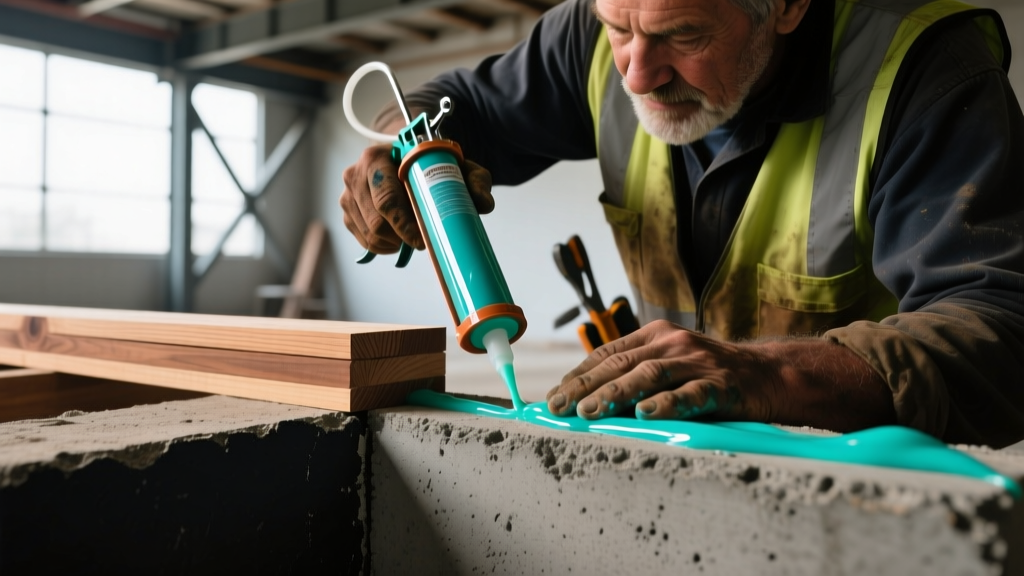
Even the most advanced waterproof material glue will fail if the substrate interface is compromised. Follow this strict preparation protocol to ensure maximum crosslinking and adhesion.
- Moisture Content Verification: For wood substrates, use a pin-type moisture meter. The ideal moisture content for polyurethane adhesives is between 12% and 18%. Below 10%, the PUR will not cure properly; above 20%, the rapid CO2 off-gassing will cause the adhesive to foam and lose tensile strength.
- Concrete Curing and Profiling: Ensure concrete has cured for a minimum of 28 days. New concrete contains high levels of alkalinity and free lime, which can saponify (break down) certain adhesive bonds. Mechanically abrade the concrete surface with a wire brush or grinder to remove laitance and expose the aggregate profile.
- Solvent Wiping (Non-Porous Substrates): For metals, glass, or plastics, wipe the bonding surface with methyl ethyl ketone (MEK) or denatured alcohol. Allow the solvent to flash off completely. Never use standard glass cleaners, as they leave silicone-based surfactant residues that act as a bond-breaker.
- Bead Profiling: Apply the adhesive in a continuous zig-zag or thick ribbon pattern. Do not create closed loops or circles, as this traps air and prevents the moisture necessary for curing from reaching the center of the bead.
- Clamping Pressure: Apply firm, even pressure. For polyurethanes, use just enough pressure to squeeze the adhesive into a 1/16-inch to 1/8-inch thick film. Over-clamping will starve the joint, resulting in a bond line that is too thin to absorb thermal movement.
Decision Framework: Which Adhesive for Your Project?
Use the following conditional framework to select the correct waterproof material glue for your specific 2026 construction scenario:
- IF you are bonding pressure-treated lumber to a concrete foundation where slight seasonal shifting is expected → Choose Sika Sikaflex-1a for its high elongation and flexible cure.
- IF you are attaching exterior aluminum trim, PVC architectural elements, or glass blocks where UV exposure is high and off-gassing could cause visual defects → Choose Chem Link M-1 (MS Polymer).
- IF you are constructing a heavy-timber retaining wall, structural deck framing, or load-bearing exterior sheathing where maximum rigidity and shear strength are required → Choose Loctite PL Premium Max.
Industry Standards and Testing References
When specifying adhesives for commercial or high-liability residential projects, ensure the selected waterproof material glue meets rigorous industry testing standards. Guidelines from APA - The Engineered Wood Association dictate that exterior structural adhesives must maintain minimum shear strengths after undergoing cyclic boil-dry testing. Furthermore, for elastomeric joint sealants and flexible adhesives, verify compliance with ASTM International standards, specifically ASTM C920, which governs the physical properties, durability, and artificial weathering resistance of elastomeric joint sealants and structural adhesives used in building envelopes.
Written by
Sarah WhitfieldSarah Whitfield is a chartered quantity surveyor (MRICS) and construction cost analyst with 15 years of experience in material pricing, procurement strategy, and project budgeting. She earned her degree in Construction Management from the University of Reading (UK) and has worked on projects ranging from $2M custom homes to $180M mixed-use developments across North America and Europe. Sarah currently leads cost estimating for BuildMat Insight, maintaining a proprietary database of 4,000+ material price points updated quarterly. She is a frequent contributor to RSMeans cost data panels and has presented at the International Cost Engineering Council (ICEC) congress. Based in Denver, CO, Sarah is an avid trail runner and volunteer mentor for Women in Construction.
More from Sarah Whitfield
View all
Wood & Lumber
What Are the Different Types of Wood? A Builder's Guide
Compare structural softwoods, finish hardwoods, and engineered lumber. Analyze Janka ratings, MOE values, and 2026 pricing for construction.
Aug 4, 2026

Walls & Panels
Steel Framing vs Wood Framing: Corrosion and Moisture Defense
Compare steel framing vs wood framing for moisture resistance. Learn about galvanized coatings, condensation risks, and corrosion protection strategies.
Jul 21, 2026

Stone & Masonry
How to Cut Stone Veneer: Wet Saw vs Grinder Comparison
Compare the best tools for cutting stone veneer. We review wet saws, angle grinders, and chop saws to help you achieve clean, chip-free cuts.
Jul 21, 2026