Breathable Waterproof Material Cost Breakdown for 2026
Compare 2026 costs for breathable waterproof materials. Detailed pricing, labor rates, and ROI for house wraps, fluid-applied barriers, and smart membranes.

The Economics of Moisture Management: Why Breathability Matters
Selecting the right building envelope system requires balancing liquid water resistance with vapor permeability. A high-performance breathable waterproof material prevents bulk rain intrusion while allowing trapped moisture vapor to escape the wall assembly. According to the U.S. Department of Energy, failing to manage vapor diffusion can lead to interstitial condensation, structural rot, and mold proliferation, ultimately costing tens of thousands of dollars in remediation.
In 2026, the market for breathable water-resistive barriers (WRBs) has bifurcated into four primary categories: traditional sheet-applied wraps, smart vapor retarders, fluid-applied membranes, and penetrating masonry sealers. Each system carries distinct material costs, labor profiles, and lifecycle implications. This guide provides a granular cost breakdown to help contractors and builders budget accurately for high-performance building envelopes.
Never pair a highly breathable interior insulation (like unfaced fiberglass or mineral wool) with a low-perm exterior sheathing or wrap in cooling-dominated climates. This creates a 'vapor sandwich' where AC-driven condensation traps moisture against the sheathing. Always verify the perm rating of your exterior WRB matches your climate zone's drying potential.
2026 Cost Matrix: Top Breathable Waterproof Systems Compared
The table below outlines current market pricing for the most widely specified breathable waterproof materials. Costs reflect national averages for Q1 2026, including standard substrates (OSB or plywood) and straightforward geometries. Complex architectural details (multiple corners, deep reveals, curved walls) will increase labor costs by 15% to 30%.
| System Type & Example Product | Material Cost / Sq Ft | Labor Cost / Sq Ft | Total Installed | Perm Rating | Max UV Exposure |
|---|---|---|---|---|---|
| Sheet Wrap (e.g., DuPont Tyvek DrainWrap) | $0.75 - $0.95 | $1.20 - $1.80 | $1.95 - $2.75 | ~58 Perms | 120 Days |
| Smart Membrane (e.g., Pro Clima INTELLO X) | $1.40 - $1.80 | $1.50 - $2.20 | $2.90 - $4.00 | 0.25 - 13+ Perms | 90 Days |
| Fluid-Applied (e.g., Prosoco R-Guard Cat 5) | $1.60 - $2.10 | $1.80 - $2.50 | $3.40 - $4.60 | ~16 Perms | 12 Months |
| Silane/Siloxane (e.g., PROSOCO Siloxane PD) | $0.25 - $0.45 | $0.50 - $0.90 | $0.75 - $1.35 | 100% Breathable | N/A (Penetrating) |
Deep Dive: Material & Labor Breakdowns by System Type
1. Sheet-Applied House Wraps (Drainage Planes)
Sheet wraps like DuPont Tyvek DrainWrap remain the baseline for residential construction. The material itself is relatively inexpensive, but the true cost lies in the detailing. Standard Tyvek HomeWrap costs around $0.60 per square foot, but upgrading to DrainWrap (which features integrated vertical grooves for bulk water drainage) pushes the material cost to $0.85 per square foot.
Labor & Failure Modes: The most common installation failure is using standard staples instead of cap nails or cap staples. Standard staples tear the membrane under wind loads and create unsealed punctures that allow capillary wicking. Upgrading to 1-inch plastic cap nails adds roughly $0.12 per square foot to the material budget but drastically reduces warranty claims. Furthermore, sealing seams with 3-inch Tyvek Tape costs approximately $0.20 per linear foot. For a standard 2,500 sq ft home, expect to spend an additional $350 to $500 just on tapes and fasteners.
2. Smart Vapor Retarders (Variable-Perm Membranes)
Products like Pro Clima INTELLO X are engineered for high-performance and Passive House builds. These membranes are 'smart'—they remain vapor-closed (under 1 perm) in winter to prevent interior moisture from entering the wall cavity, but open up (up to 13 perms) in summer to allow the assembly to dry to the interior. At $1.55 per square foot for the membrane alone, it is a premium investment.
Taping & Airtightness: Smart membranes are primarily deployed to achieve extreme airtightness (ACH50 < 0.6). This requires specialized acrylic tapes like TESCON VANA, which costs roughly $55 per 60-meter roll. While expensive, these tapes possess a 100-year aging resistance verified by independent laboratory testing, ensuring the building envelope remains airtight for the life of the structure.
3. Fluid-Applied Breathable Membranes
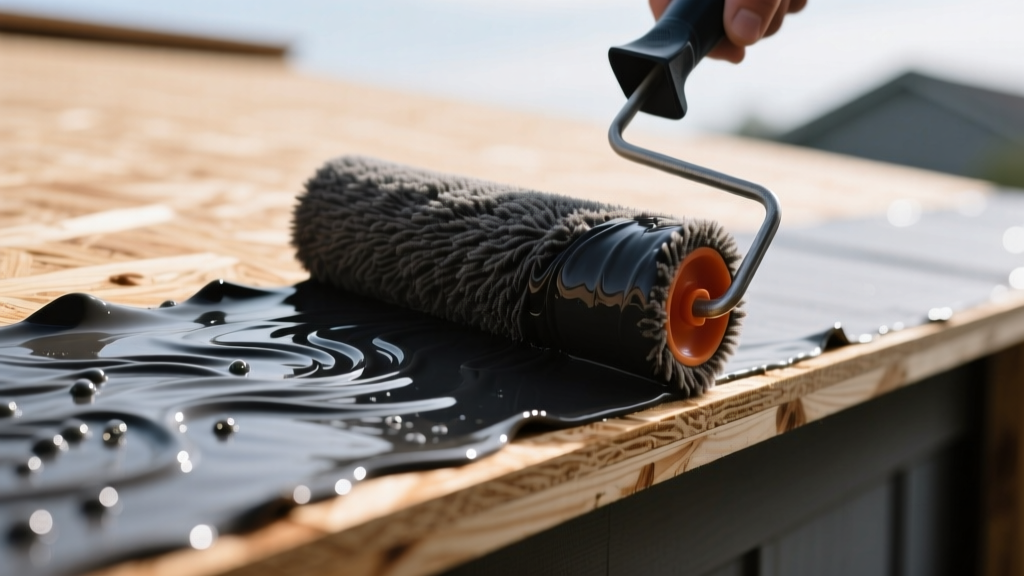
Fluid-applied systems like Prosoco R-Guard Cat 5 bridge the gap between commercial and high-end residential construction. Applied via a thick-nap roller or airless sprayer, these liquid membranes cure into a seamless, monolithic rubberized coating. Material costs hover around $1.85 per square foot, assuming a target wet mil thickness of 20 to 30 mils.
Substrate Preparation Costs: Fluid-applied membranes demand rigorous substrate prep. OSB or plywood joints must be treated with a compatible liquid flashing or mesh tape before the field coat is applied. If the sheathing is dusty, damp, or has high moisture content (above 19%), the coating will delaminate. Budget an additional $0.30 to $0.50 per square foot for joint detailing and substrate priming. However, the massive advantage is UV stability; Cat 5 can withstand 12 months of UV exposure, eliminating the frantic scheduling pressures associated with 120-day sheet wrap limits.
4. Penetrating Silane/Siloxane Sealers (Masonry & Concrete)
For above-grade masonry, CMU, and architectural concrete, film-forming membranes are disastrous because they trap vapor and cause spalling during freeze-thaw cycles. Instead, silane/siloxane penetrating sealers are the only viable breathable waterproof material. These chemicals react with the silica in the concrete to form a hydrophobic resin deep within the pores, repelling liquid water while leaving the vapor pathways completely open.
Coverage and Application: High-solids siloxane sealers cost about $350 to $450 per 5-gallon pail. Coverage rates vary wildly based on substrate porosity: dense concrete may yield 250 sq ft per gallon, while porous CMU may only yield 90 sq ft per gallon. Application is incredibly fast using a low-pressure HVLP sprayer, keeping labor costs below $0.90 per square foot.
Hidden Costs and Edge Cases in Breathable Membrane Installation
When budgeting for a breathable waterproof material, general contractors frequently overlook the ancillary components required to make the system warrantable. Ensure your estimates account for the following:
- Rough Opening Wraps: Pre-folded membrane wraps for windows and doors (e.g., DuPont FlexWrap) cost $3.50 to $5.00 per linear foot and are mandatory for maintaining drainage plane continuity.
- Transition Membranes: Self-adhered butyl or EPDM tapes used to tie the WRB to window flanges and concrete foundations cost $1.20 to $2.50 per linear foot.
- Scaffolding & Lift Time: Fluid-applied systems require meticulous visual inspection for pinholes and thin spots. This often necessitates an extra day of scaffolding rental or scissor lift time, adding $800 to $1,500 to mid-sized commercial projects.
- Wet Mil Thickness Gauges: For fluid-applied systems, contractors must use wet mil gauges during application to ensure the 20-mil minimum is met. Under-applying by even 5 mils can void the manufacturer's 10-year warranty.
ROI and Lifecycle Cost Analysis
While fluid-applied membranes and smart vapor retarders carry a 40% to 80% upfront premium over traditional house wraps, the lifecycle cost often favors the premium systems. Traditional sheet wraps are highly susceptible to wind tearing during construction delays and staple-hole degradation over decades. A fluid-applied membrane integrates directly with the sheathing, effectively eliminating the risk of billowing, tearing, and capillary wicking.
'Building envelope failures rarely occur in the center of the wall; they occur at the transitions and penetrations. Investing in fluid-applied or fully taped smart membranes shifts the budget away from cheap field materials and redirects it toward robust, monolithic detailing. The 2% increase in total construction cost easily pays for itself by preventing a single mold remediation event.' — Building Science Enclosure Consultant
Decision Framework: Which Breathable System Fits Your Budget?
Use this rapid decision matrix to select the optimal breathable waterproof material based on your project constraints:
Choose Sheet Wraps (Tyvek DrainWrap) if: You are building standard production housing, have tight material budgets, and possess a reliable framing crew trained in proper cap-nailing and taping sequences. Best for climates with moderate drying potential.
Choose Smart Membranes (INTELLO X) if: You are constructing a Passive House, utilizing dense-pack cellulose or interior rigid foam, or building in a mixed-humid climate where seasonal vapor drive reversals demand adaptive drying capacity.
Choose Fluid-Applied (R-Guard Cat 5) if: You are building complex geometries with numerous penetrations, anticipate long construction delays with high UV exposure, or are constructing commercial/multifamily buildings where airtightness and fire-rating continuity are paramount.
Choose Silane/Siloxane Sealers if: Your facade is brick, stone, stucco, or architectural concrete. Never use film-forming coatings on porous masonry, as the resulting trapped vapor will cause catastrophic surface spalling in freezing climates.
Written by
Sarah WhitfieldSarah Whitfield is a chartered quantity surveyor (MRICS) and construction cost analyst with 15 years of experience in material pricing, procurement strategy, and project budgeting. She earned her degree in Construction Management from the University of Reading (UK) and has worked on projects ranging from $2M custom homes to $180M mixed-use developments across North America and Europe. Sarah currently leads cost estimating for BuildMat Insight, maintaining a proprietary database of 4,000+ material price points updated quarterly. She is a frequent contributor to RSMeans cost data panels and has presented at the International Cost Engineering Council (ICEC) congress. Based in Denver, CO, Sarah is an avid trail runner and volunteer mentor for Women in Construction.
More from Sarah Whitfield
View all
Wood & Lumber
What Are the Different Types of Wood? A Builder's Guide
Compare structural softwoods, finish hardwoods, and engineered lumber. Analyze Janka ratings, MOE values, and 2026 pricing for construction.
Aug 4, 2026

Walls & Panels
Steel Framing vs Wood Framing: Corrosion and Moisture Defense
Compare steel framing vs wood framing for moisture resistance. Learn about galvanized coatings, condensation risks, and corrosion protection strategies.
Jul 21, 2026

Stone & Masonry
How to Cut Stone Veneer: Wet Saw vs Grinder Comparison
Compare the best tools for cutting stone veneer. We review wet saws, angle grinders, and chop saws to help you achieve clean, chip-free cuts.
Jul 21, 2026