Best Rooftop Waterproofing Materials for 2026: Review
We review the best rooftop waterproofing materials for 2026, comparing TPO, EPDM, and liquid polyurethane coatings with real costs and lifespans.

The 2026 Rooftop Waterproofing Landscape
Selecting the right rooftop waterproofing materials requires moving beyond generic membrane categories to evaluate specific product formulations, installation tolerances, and lifecycle costs. In 2026, supply chain stabilization has normalized pricing for synthetic polymers, but labor shortages continue to push the industry toward cold-applied liquid systems and mechanically fastened sheets that reduce installation time. According to lifecycle data from the Building Owners and Managers Association (BOMA), the total cost of ownership for commercial low-slope roofs is heavily dictated by seam integrity and UV resistance rather than just the initial material cost.
This product review evaluates three dominant, high-performance rooftop waterproofing materials currently on the market: reinforced Thermoplastic Polyolefin (TPO), liquid-applied polyurethane systems, and non-reinforced Ethylene Propylene Diene Monomer (EPDM). We analyze specific manufacturer models, exact installation parameters, and documented failure modes.
Carlisle SynTec Sure-Weld TPO (60-Mil)
TPO remains the most specified single-ply membrane in North America. The Carlisle SynTec Sure-Weld 60-mil TPO is the industry benchmark, featuring a polyester scrim reinforcement sandwiched between two layers of UV-stabilized polyolefin.
Specs & Pricing Snapshot
- Material Thickness: 60 mils (nominal)
- Reinforcement: Polyester scrim
- Seam Method: Hot-air welding (1000°F - 1100°F)
- 2026 Installed Cost: $5.50 - $8.50 per sq. ft.
- Expected Lifespan: 20 - 25 years
Performance & Installation Realities
The primary advantage of Sure-Weld TPO is its heat-welded seam technology. When fused correctly using an automatic hot-air welder (such as a Leister Triac or Robitron), the seams become monolithic, effectively eliminating the primary failure point of traditional adhered roofs. The 60-mil thickness provides adequate puncture resistance for standard foot traffic, though areas with heavy HVAC maintenance require walkway pads.
Pros and Cons
- Pro: High solar reflectance (SRI 100+ on white membranes) significantly reduces building cooling loads.
- Pro: Heat-welded seams are structurally stronger than the membrane itself.
- Con: Highly sensitive to installation temperature. Welding in ambient temperatures below 40°F requires specialized triage and slower welder speeds to prevent "false welds" (cold seams that peel under wind uplift).
Kemper System Kemperol V210 (Liquid-Applied Polyurethane)
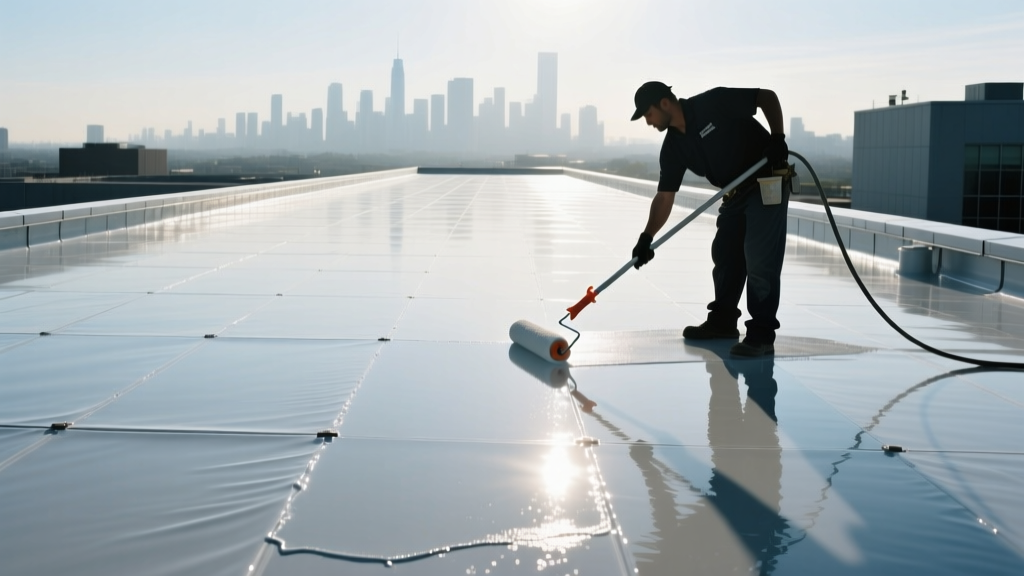
For roofs with complex geometries, numerous penetrations, or zero-tolerance substrates, liquid-applied systems are unmatched. Kemper System's Kemperol V210 is a two-component, moisture-triggered polyurethane resin reinforced with a proprietary fleece.
Specs & Pricing Snapshot
- Chemistry: 2K-PUR (Two-Component Polyurethane)
- Application: Cold-applied, roller/squeegee with fleece reinforcement
- Cure Time: Rain-safe in 2 hours; fully cured in 24 hours
- 2026 Installed Cost: $9.00 - $14.00 per sq. ft.
- Expected Lifespan: 25+ years
Performance & Installation Realities
Kemperol V210 cures via a chemical reaction with ambient moisture, making it uniquely tolerant of slightly damp substrates—a massive advantage over water-based acrylics. The fleece reinforcement (Kemperol 165) bridges dynamic cracks up to 2mm wide. The resulting membrane is fully adhered, meaning water cannot migrate laterally beneath the system if a puncture occurs.
Pros and Cons
- Pro: Completely seamless; wraps flawlessly around pipes, curbs, and irregular parapets without cutting or flashing tapes.
- Pro: Cold-applied process eliminates the fire hazard and insurance liabilities associated with hot asphalt or torch-down modified bitumen.
- Con: Strict pot life. Once the resin and hardener are mixed, applicators have roughly 20 to 30 minutes before the material gels in the bucket.
- Con: High material cost and requires certified installers to maintain the warranty.
Firestone RubberGard EPDM (60-Mil)
EPDM is the legacy workhorse of the flat roofing industry. Firestone's RubberGard 60-mil non-reinforced membrane remains a top choice for large, unobstructed commercial roofs and ballasted assemblies due to its proven multi-decade track record.
Specs & Pricing Snapshot
- Material Thickness: 60 mils (non-reinforced)
- Seam Method: Primer + Butyl lap sealant / QuickPrime Plus tape
- Attachment: Fully adhered, mechanically attached, or ballasted
- 2026 Installed Cost: $4.50 - $7.00 per sq. ft.
- Expected Lifespan: 25 - 30 years
Performance & Installation Realities
EPDM's molecular structure provides exceptional resistance to ozone, UV radiation, and extreme temperature cycling (-40°F to 300°F). The EPDM Roofing Manufacturers Association (ERMA) notes that black EPDM remains highly effective in colder climates where solar heat gain is desirable. However, the reliance on chemical adhesives and lap tapes for seams makes the installation quality highly dependent on the crew's meticulousness.
Pros and Cons
- Pro: Lowest initial material and installation cost among the three reviewed systems.
- Pro: Highly flexible; accommodates significant structural movement and substrate settling without tearing.
- Con: Black membranes have low solar reflectance, increasing HVAC costs in warm climates unless coated with a reflective topcoat.
- Con: Vulnerable to puncture from sharp objects due to the lack of internal scrim reinforcement.
Head-to-Head Comparison Matrix
| Feature | Carlisle TPO (60-mil) | Kemperol V210 (Liquid) | Firestone EPDM (60-mil) |
|---|---|---|---|
| Installed Cost (2026) | $5.50 - $8.50 / sq ft | $9.00 - $14.00 / sq ft | $4.50 - $7.00 / sq ft |
| Primary Weakness | Cold-weather seam failures | High material cost / Pot life | Lap sealant degradation |
| Best Application | Large, open commercial decks | Complex roofs, plazas, balconies | Ballasted roofs, cold climates |
| Wind Uplift Rating | FM 1-90 (Mechanically attached) | FM 1-120+ (Fully adhered) | FM 1-60 (Ballasted) |
Critical Installation Variables & Failure Modes
According to forensic data compiled by the National Roofing Contractors Association (NRCA), over 80% of premature rooftop waterproofing failures are attributed to installation errors and design flaws, not material degradation. Understanding the specific failure modes of your chosen material is critical for quality assurance during construction.
TPO: The "False Weld" Phenomenon
When ambient temperatures drop below 45°F, the surface of the TPO membrane cools rapidly after passing under the hot-air welder nozzle. If the welder speed is not reduced, the material appears fused but lacks molecular cross-linking. These "false welds" will pass initial visual inspections but will peel open under the first major wind uplift event or thermal contraction cycle. Mandate that contractors perform destructive peel tests every 100 linear feet during cold-weather applications.
Liquid Polyurethane: Mil-Thickness Starvation
Kemperol V210 requires a precise wet-film thickness to achieve the specified dry-film thickness (DFT). A common contractor error is "stretching" the resin over too large an area to save material, resulting in a DFT below the required 45 mils. This leads to micro-pinholes that allow water vapor transmission. Always require the applicator to use a wet-film mil gauge during application and document the readings.
EPDM: Lap Sealant Shrinkage
While the EPDM membrane itself can last 30 years, the butyl lap sealants and primers used to join the sheets have a shorter functional lifespan. Over 15 to 20 years, UV exposure and thermal cycling cause the lap sealant to shrink and crack, creating direct pathways for water ingress. To mitigate this, specify a fully adhered system using pressure-sensitive QuickPrime Plus tape rather than liquid lap sealants, and implement a mandatory 10-year seam inspection protocol.
Final Selection Framework
Do not default to the cheapest material. Base your specification on the physical characteristics of the roof deck and the building's operational constraints:
- Choose Liquid-Applied Polyurethane (Kemperol V210) IF: The roof has more than 15 penetrations (pipes, skylights, HVAC curbs), features complex parapet details, or requires a fully adhered system over an occupied, sensitive interior space where leak tracking is unacceptable.
- Choose Reinforced TPO (Carlisle 60-Mil) IF: You are waterproofing a large, unobstructed commercial roof (e.g., big-box retail or warehouse) in a warm climate where high solar reflectance (SRI) is required to meet local energy codes or LEED certification targets.
- Choose EPDM (Firestone 60-Mil) IF: The project has a strict initial budget constraint, the roof is suitable for a ballasted assembly (using river-washed stone or pavers), or the building is located in a northern climate where absorbing solar heat reduces winter heating loads.
By matching the specific material properties to the structural and environmental demands of your project, you ensure a watertight envelope that performs reliably through its entire lifecycle.
Written by
Sarah WhitfieldSarah Whitfield is a chartered quantity surveyor (MRICS) and construction cost analyst with 15 years of experience in material pricing, procurement strategy, and project budgeting. She earned her degree in Construction Management from the University of Reading (UK) and has worked on projects ranging from $2M custom homes to $180M mixed-use developments across North America and Europe. Sarah currently leads cost estimating for BuildMat Insight, maintaining a proprietary database of 4,000+ material price points updated quarterly. She is a frequent contributor to RSMeans cost data panels and has presented at the International Cost Engineering Council (ICEC) congress. Based in Denver, CO, Sarah is an avid trail runner and volunteer mentor for Women in Construction.
More from Sarah Whitfield
View all
Wood & Lumber
What Are the Different Types of Wood? A Builder's Guide
Compare structural softwoods, finish hardwoods, and engineered lumber. Analyze Janka ratings, MOE values, and 2026 pricing for construction.
Aug 4, 2026

Walls & Panels
Steel Framing vs Wood Framing: Corrosion and Moisture Defense
Compare steel framing vs wood framing for moisture resistance. Learn about galvanized coatings, condensation risks, and corrosion protection strategies.
Jul 21, 2026

Stone & Masonry
How to Cut Stone Veneer: Wet Saw vs Grinder Comparison
Compare the best tools for cutting stone veneer. We review wet saws, angle grinders, and chop saws to help you achieve clean, chip-free cuts.
Jul 21, 2026