Waterproof Breathable Material Guide: 4 WRB Types Compared
Compare top waterproof breathable material options for building envelopes. Analyze spunbond, woven, fluid-applied, and smart membranes.

The Physics of Vapor-Permeable Envelopes
When specifying a waterproof breathable material for a building envelope, architects and contractors face a fundamental paradox: the membrane must block bulk liquid water (rain and snow) while simultaneously allowing water vapor (gas) to escape. Trapped vapor within wall cavities leads to condensation, mold proliferation, and structural rot. The Pacific Northwest National Laboratory (PNNL) emphasizes that a properly installed Weather-Resistive Barrier (WRB) is the primary defense against moisture intrusion in framed construction.
To evaluate these materials, the industry relies on two critical metrics. First, water resistance is tested under ASTM D5147 or ASTM E331 to ensure the material can withstand wind-driven rain. Second, vapor permeability is measured in US Perms via ASTM E96. A true waterproof breathable material typically exhibits a perm rating above 10 (Class III vapor retarder or higher), allowing walls to dry to the exterior. Below, we compare the four dominant material classes available on the market, analyzing their chemical composition, real-world costs, and specific failure modes.
Material Comparison Matrix
| Material Class | Typical Perm Rating | UV Exposure Limit | Avg. Material Cost (per sq. ft.) | Best Application |
|---|---|---|---|---|
| Spunbond Polyolefin | 50 - 60 Perms | 120 - 180 Days | $0.60 - $0.85 | Standard residential, cedar siding (with caveats) |
| Woven Polypropylene | 10 - 16 Perms | 30 - 60 Days | $0.30 - $0.45 | Budget residential, quick-clad projects |
| Fluid-Applied Membrane | 18 - 28 Perms | N/A (Cures to solid) | $1.50 - $2.20 | Complex geometries, commercial, high-wind zones |
| Smart / Monolithic TEEE | Variable (1 - 38 Perms) | 90 - 120 Days | $1.20 - $1.60 | Passive House, unvented roofs, high-humidity zones |
Spunbond Polyolefin (e.g., DuPont Tyvek HomeWrap)
Spunbond polyolefin remains the industry benchmark for waterproof breathable material specifications. Manufactured by flash-spinning high-density polyethylene fibers, these membranes create a non-woven matrix with microscopic pores. These pores are small enough to block liquid water droplets but large enough to pass water vapor molecules. Standard DuPont Tyvek HomeWrap boasts a perm rating of 58, making it highly breathable.
Real-World Performance & Failure Modes
While highly effective, spunbond materials are vulnerable to surfactant leaching. Wood species like cedar and redwood contain natural tannins and extractives. When it rains, these extractives wash over the WRB, lowering the surface tension of the water. This soapy effect allows liquid water to bypass the microscopic pores, leading to wet sheathing. Furthermore, integrated WRB panels (like Huber ZIP System) utilize specialized coatings that bypass this issue, but traditional spunbond requires a rainscreen gap or a specific cedar-safe wrap (like Tyvek CommercialWrap) to mitigate surfactant failure.
Woven Polypropylene (e.g., Barricade Wrap, Typar)
Woven polypropylene wraps are constructed by weaving plastic threads into a tight grid, which is then coated with a micro-porous polyolefilm or acrylic layer to provide water resistance. They are the most cost-effective waterproof breathable material on the market, often priced 40% lower than spunbond alternatives.
Real-World Performance & Failure Modes
The primary vulnerability of woven wraps is UV degradation and physical tearing. Most budget woven wraps carry a UV warranty of only 30 to 60 days. If a project experiences framing delays and the wrap is left exposed to sunlight for four months, the polypropylene becomes brittle. During the siding installation phase, the mechanical friction from ladders and scaffolding can cause micro-tears in the degraded coating, compromising the waterproofing layer. Additionally, folding woven wraps around tight corners often causes the coating to crack, creating direct pathways for bulk water intrusion.
Fluid-Applied Membranes (e.g., PROSOCO R-Guard FastFlash, Henry Blueskin VP)
Fluid-applied membranes represent a paradigm shift in building envelope design. Applied via roller or airless sprayer, these liquid polymers cure into a continuous, monolithic, and fully adhered waterproof breathable material. Because they are liquid, they seamlessly bridge gaps, fastener holes, and complex architectural transitions without the need for taping seams.
Real-World Performance & Failure Modes
The efficacy of a fluid-applied membrane is entirely dependent on mil thickness and substrate preparation. PROSOCO R-Guard FastFlash, for example, requires a wet mil thickness of 10 to 12 mils to achieve its rated 18-perm breathability and waterproofing capabilities. If a contractor stretches the material too thin to save costs, the membrane will fail water-resistance tests. Conversely, applying it too thickly can trap solvents, delaying the curing process and leading to blistering.
Furthermore, fluid-applied products are highly sensitive to environmental conditions during installation. Applying these membranes over damp, frost-covered, or heavily dusted OSB sheathing will result in adhesion failure. The membrane will peel away from the substrate under negative wind pressure, creating massive water channels behind the cladding.
Smart Vapor-Variable Membranes (e.g., Pro Clima SOLITEX MENTO, INTELLO)
Originating in the European Passive House market, smart membranes utilize a monolithic TEEE (Thermoplastic Elastomer Ether) film. Unlike spunbond wraps that rely on physical pores, TEEE films are completely solid. They transport water vapor via a molecular chain-reaction mechanism (adsorption, diffusion, and desorption). Because there are no physical pores, smart membranes are entirely immune to surfactant leaching, making them the ultimate waterproof breathable material for problematic claddings like cedar or stone.
Real-World Performance & Failure Modes
Products like Pro Clima INTELLO are 'vapor-variable.' In winter, when indoor humidity is high and the risk of interstitial condensation is greatest, the membrane's polymer structure closes up (dropping to ~1 perm) to act as a vapor retarder. In summer, when the wall needs to dry outward, the structure opens (rising to ~38 perms). The primary drawback is cost and the learning curve. These membranes require specialized acrylic tapes (like Pro Clima TESCON VANA) rather than standard hardware store butyl tapes, increasing the total installed cost by roughly 15% compared to standard housewraps.
Critical Installation Failures & Troubleshooting
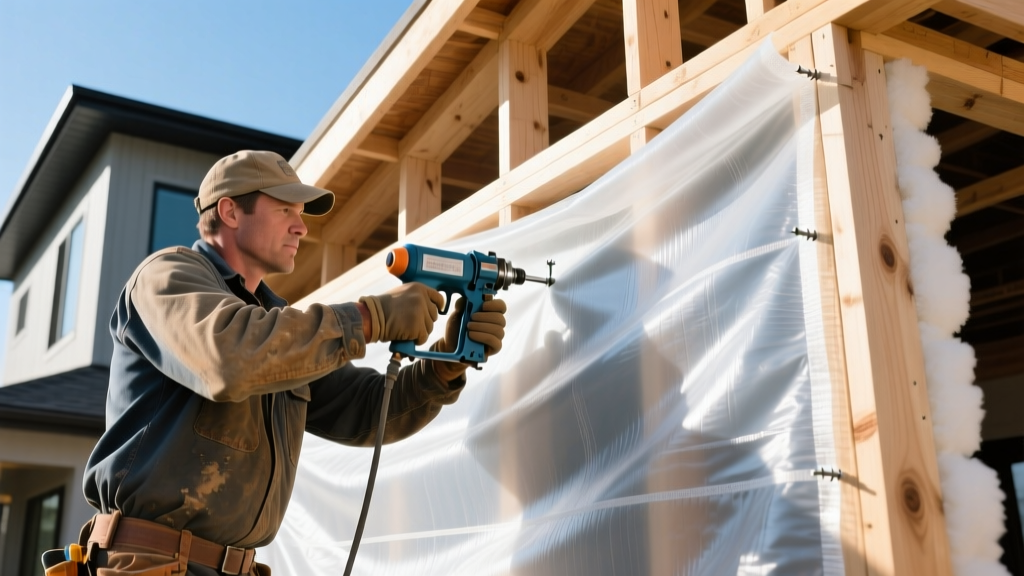
Even the most advanced waterproof breathable material will fail if the installation details are ignored. According to Building Science Corporation, the vast majority of moisture-related building failures stem from poor integration of the WRB with flashing and fenestrations, not the field of the membrane itself.
Do not mix and match membrane and tape brands without verifying chemical compatibility. Standard butyl flashing tapes can melt the acrylic coatings on certain woven wraps, while high-tack acrylic tapes may fail to adhere to dusty, unprimed spunbond surfaces. Always use the membrane manufacturer's specified tape system to maintain the warranty.
- Fastener Sealing: When using cap nails or staples to attach sheet-applied wraps, every penetration is a potential leak. High-performance builds utilize integrated tape patches over fastener lines or rely on the self-sealing properties of fluid-applied membranes to eliminate this risk.
- Shingle Lapping: All horizontal seams must be shingle-lapped (upper layer overlapping the lower layer by a minimum of 6 inches). Taping a lower sheet over an upper sheet creates a direct gutter for water to flow behind the WRB.
- Terminations: The WRB must be properly terminated into the window and door flashing systems using a continuous bead of compatible sealant or specialized transition tape, adhering strictly to ASTM E2556 standards for weather-resistive barriers.
Material Selection Framework
Choosing the correct waterproof breathable material requires aligning the membrane's properties with the project's specific climate zone, cladding type, and construction timeline. For standard residential builds with vinyl or fiber cement siding, spunbond polyolefin offers the best balance of cost and breathability. For projects facing long construction delays or utilizing high-tannin wood claddings, upgrading to a monolithic TEEE smart membrane or a fluid-applied system eliminates the risks of UV degradation and surfactant failure, ensuring the building envelope performs as designed for decades.
Written by
David NakamuraDavid Nakamura is a licensed architect (AIA) and construction technology writer focused on sustainable building methods, mass timber engineering, and high-performance building envelopes. He holds a Master of Architecture from the University of Washington and is a certified Passive House Consultant (CPHC). David spent eight years at the Seattle firm Mithun, where he led the design of three LEED Platinum projects, before founding his own practice specializing in net-zero residential design. He serves on the editorial advisory board of GreenBuilder Magazine and has authored peer-reviewed papers on cross-laminated timber (CLT) connections for the Journal of Structural Engineering. In his spare time, David teaches woodworking at Pratt Fine Arts Center and kayaks the Puget Sound.
More from David Nakamura
View all
Construction Cost
Labor Cost to Build a Deck Per Sq Ft: 2026 Installation Guide
Discover the exact labor cost to build a deck per sq ft in 2026. This installation guide breaks down contractor rates, complexity factors, and hidden fees.
Aug 4, 2026

Construction Cost
How Much Does It Cost to Build a 3 Bedroom House? Financing Guide
Learn exactly how much it costs to build a 3 bedroom house and explore 2026 financing options, construction loan types, and budget frameworks for your build.
Aug 4, 2026

Construction Cost
Cost to Build a Tennis Court: 2026 Guide
How much does it cost to build a tennis court in 2026? Breakdowns for asphalt, concrete, and synthetic surfaces plus fencing and lighting.
Jul 30, 2026