Waterproof Material Paint Cost Breakdown & Pricing Guide 2026
Detailed 2026 cost breakdown for waterproof material paint. Compare elastomeric, epoxy, and polyurethane pricing, labor rates, and top brand models.

The True Definition of 'Waterproof' Paint
In the construction and remodeling industry, the term waterproof material paint is frequently misused by consumers to describe standard water-resistant acrylic latex. True waterproofing coatings—technically classified as liquid-applied elastomeric membranes, two-part epoxy sealers, or polyurethane liquid barriers—possess the structural integrity to withstand hydrostatic pressure. Standard masonry paints merely shed surface water; waterproof material paints bridge dynamic cracks, resist negative-side water intrusion, and cure to a thick mil specification (typically 10 to 20 dry mils) to create a continuous, impermeable barrier.
Understanding the exact cost of these specialized coatings requires separating material expenses from the rigorous surface preparation required for adhesion. According to industry data tracked by Angi's 2026 waterproofing cost guide, homeowners and contractors often underestimate labor and prep costs, which routinely account for 60% to 75% of the total project budget.
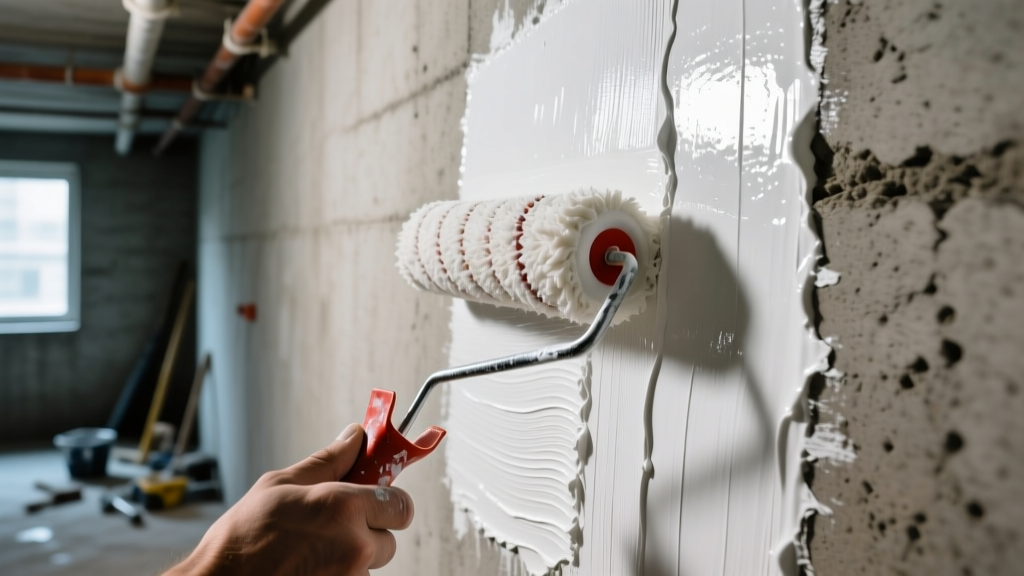
2026 Cost Matrix: Waterproof Coating Types
The following matrix breaks down the average installed costs per square foot for the three primary categories of waterproof material paint used on masonry, concrete, and stucco substrates. Prices reflect 2026 national averages for both materials and professional labor.
| Coating Type | Material Cost / Sq Ft | Labor & Prep / Sq Ft | Total Installed | Hydrostatic Pressure Rating |
|---|---|---|---|---|
| Acrylic Elastomeric | $1.20 - $1.80 | $2.50 - $4.00 | $3.70 - $5.80 | Up to 10 PSI |
| Polyurethane Hybrid | $2.10 - $3.00 | $3.00 - $4.50 | $5.10 - $7.50 | Up to 15 PSI |
| 2-Part Epoxy Sealer | $2.50 - $3.80 | $4.00 - $6.00 | $6.50 - $9.80 | 15+ PSI (Rigid) |
| Silicate Penetrant (Alternative) | $0.60 - $0.90 | $1.50 - $2.50 | $2.10 - $3.40 | N/A (Capillary block) |
Brand & Product-Specific Pricing
To budget accurately, you must look at specific product yields. Waterproof material paints are significantly more expensive per gallon than standard architectural paints, and their coverage rates drop drastically when applied at the manufacturer-required thickness.
1. UGL Drylok Extreme Masonry Waterproofer
Drylok Extreme remains a benchmark for interior negative-side waterproofing. Formulated to withstand 15 PSI of hydrostatic pressure (equivalent to a 33-foot head of water), it is a heavily fortified acrylic-elastomeric hybrid.
- 2026 Retail Price: $44.00 - $49.00 per gallon.
- Practical Coverage: 75 to 100 sq ft per gallon (requires two heavy coats to achieve the mandated mil thickness).
- Material Cost per Sq Ft: ~$1.10 (assuming two coats).
- Best Use Case: Interior basement walls, retaining walls, and elevator pits with minor to moderate seepage.
2. Ames Research Laboratories Super Elastomeric
Ames Super Elastomeric is a high-build, rubberized coating designed primarily for exterior applications, flat roofs, and above-grade masonry. It stretches up to 600% to bridge thermal expansion cracks.
- 2026 Retail Price: $62.00 - $68.00 per gallon.
- Practical Coverage: 50 sq ft per gallon (must be applied at 20 wet mils to cure to 10 dry mils).
- Material Cost per Sq Ft: ~$2.60.
- Best Use Case: Exterior stucco, parapet walls, and concrete decking where UV resistance and high elasticity are required.
3. Rust-Oleum WaterTite Flexible Crack Preventer
Unlike rigid cementitious coatings, this polyurethane-acrylic formula remains flexible. It is specifically engineered for substrates prone to micro-movements and hairline cracking.
- 2026 Retail Price: $38.00 - $42.00 per gallon.
- Practical Coverage: 90 sq ft per gallon.
- Material Cost per Sq Ft: ~$0.90.
- Best Use Case: Above-grade exterior foundation walls and stucco facades prior to backfilling or final finishing.
No liquid-applied waterproof material paint can withstand active, flowing water leaks or structural hydrostatic pressure exceeding its rated PSI. If water is actively pooling or flowing through a structural crack, paint will blister and fail within weeks. Active leaks must first be addressed with hydraulic cement, polyurethane crack injection, or exterior French drain systems before any coating is applied.
Hidden Costs: Surface Preparation & Priming
The most common cause of waterproofing paint failure is inadequate surface preparation. According to guidelines published by the Bob Vila expert network, applying elastomeric coatings over unprepared masonry guarantees delamination. Budget for the following mandatory prep steps:
The Efflorescence Tax
Efflorescence (the white, powdery salt deposit on concrete) destroys paint adhesion. It must be removed via mechanical wire brushing and chemical treatment with a mild muriatic acid or phosphoric acid solution.
- DIY Cost: $0.15 - $0.25 per sq ft for acid and neutralizing agents.
- Professional Cost: $0.75 - $1.50 per sq ft for mechanical abrasion, acid washing, and safe wastewater extraction.
Crack Routing and Injection
Any crack wider than 1/16th of an inch must be routed out with an angle grinder and filled with a flexible polyurethane sealant (such as Sikaflex-1a) before painting.
- Material Cost: $12.00 - $18.00 per 10.1 oz tube of polyurethane sealant.
- Labor Cost: $15.00 - $25.00 per linear foot for routing, cleaning, and injection.
Primer Requirements
Highly porous concrete or chalky cinder block requires a masonry conditioner or block filler to prevent the substrate from absorbing the binder in the waterproof paint. Block fillers (like Zinsser Block Filler) cost approximately $35 per gallon and cover 100 sq ft, adding roughly $0.35 per sq ft to the material budget.
Application Scenarios: Interior vs. Exterior
The cost and material selection shift dramatically depending on whether the application is positive-side (exterior, where water pushes the coating into the substrate) or negative-side (interior, where water pushes the coating away from the substrate).
Interior Basement Waterproofing (Negative-Side)
Interior applications require paints with high adhesion and high PSI ratings, as the water pressure is actively trying to push the coating off the wall. Two-part epoxies and specialized acrylic-elastomerics (like Drylok Extreme) are mandatory. Because interior work requires ventilation, drop-cloth protection, and often the relocation of HVAC equipment or drywall, labor costs skew higher, averaging $5.50 to $8.00 per sq ft installed.
Exterior Foundation & Masonry (Positive-Side)
Exterior applications benefit from positive-side pressure, which actually forces the coating tighter against the substrate. Highly elastic, UV-resistant polyurethanes and acrylics (like Ames Super Elastomeric) are preferred here to bridge thermal expansion joints. While the material is slightly more expensive, the lack of interior prep constraints keeps average installed costs between $4.00 and $6.50 per sq ft.
Decision Framework: Paint vs. Membrane Systems
Waterproof material paint is not a universal cure-all. Use the following framework to determine if a liquid coating is the correct investment, or if you need to upgrade to a physical sheet membrane system.
Choose Waterproof Paint When:
- Hydrostatic pressure is below 15 PSI.
- Moisture intrusion is limited to capillary seepage or dampness (no active flowing leaks).
- The substrate is structurally sound with only hairline shrinkage cracks.
- Budget constraints prohibit exterior excavation ($40-$80 per linear foot).
- You are treating above-grade stucco, parapets, or retaining walls.
Upgrade to Sheet Membranes When:
- Hydrostatic pressure exceeds 15 PSI or the water table is seasonally high.
- There are active, flowing leaks or structural settlement cracks wider than 1/8 inch.
- The foundation is subject to significant seasonal shifting or soil expansion.
- You are constructing a new-build foundation (exterior peel-and-stick rubberized asphalt is the code-mandated standard).
- The space will house highly sensitive finishes (e.g., a home theater or server room) where zero moisture tolerance is acceptable.
Maximizing the ROI of Your Coating Investment
To ensure your investment in waterproof material paint yields a 10- to 15-year lifespan, strict adherence to mil-thickness is non-negotiable. Contractors frequently thin coatings or apply them too sparingly to save on material costs. A wet mil gauge should be used during application to verify the coating is being applied at the manufacturer's specified thickness. Furthermore, ensure that the ambient temperature remains above 50°F (10°C) for at least 48 hours post-application; elastomeric polymers will fail to cross-link and cure properly in cold, damp conditions, resulting in a tacky film that offers zero hydrostatic resistance.
Written by
Elena RodriguezElena Rodriguez is a civil engineer and technical writer specializing in concrete technology, masonry systems, and ASTM/ACI compliance. She earned her B.S. in Civil Engineering from Texas A&M University and spent a decade at a materials testing laboratory, performing over 2,000 concrete compressive strength tests and masonry prism evaluations. Elena is an ACI-certified Field Testing Technician (Grade I) and a member of ASTM Committee C12 on Natural Building Stone. She currently consults on forensic engineering cases involving concrete failures and moisture intrusion. Based in San Antonio, TX, Elena is a proud member of the Society of Women Engineers (SWE) and coaches her daughter's FIRST Robotics team.
More from Elena Rodriguez
View all
Walls & Panels
Cost Analysis: Light Gauge Steel Framing Advantages and Disadvantages
Evaluate light gauge steel framing advantages and disadvantages through a strict cost analysis lens, comparing material, labor, and lifecycle expenses.
Aug 4, 2026

Walls & Panels
Gypsum Board Types: Exact Specifications, Thickness & Dimensions
Compare standard, Type X, and moisture-resistant gypsum board types. Get exact specifications, thicknesses, dimensions, and ASTM standards for your project.
Aug 4, 2026

Fire Resistance
Best Fire-Resistant Outdoor Decking Materials: 2026 Buyer Guide
Discover the best fire-resistant outdoor decking materials for 2026. Compare Class A PVC, aluminum, and hardwood options for WUI compliance and safety.
Aug 4, 2026