Best Materials for Waterproof Safety Signage in 2026
Discover the best materials for waterproof safety signage in 2026. Compare FRP, marine aluminum, and enamel substrates for wet and corrosive environments.
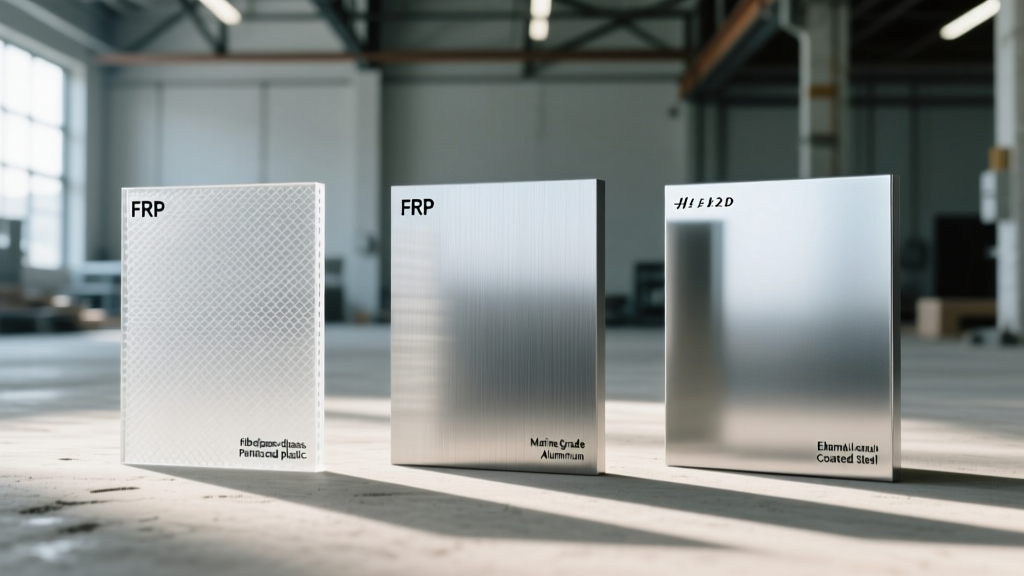
The Hidden Costs of Signage Failure in Wet Environments
When safety signage fails in wet, humid, or submerged environments, the consequences extend far beyond the $50 replacement cost of the sign itself. Faded text, delaminated overlays, and corroded mounting brackets lead to compliance violations and severe liability in the event of an accident. According to OSHA Standard 1910.145, accident prevention signs must remain legible and intact under the environmental conditions of their deployment. Yet, facility managers routinely specify interior-grade substrates for exterior or high-moisture applications, resulting in edge-wicking, UV degradation, and galvanic corrosion.
Selecting the best materials for waterproof safety signage requires evaluating the substrate, the graphic overlay, the ink chemistry, and the mounting hardware as a unified system. This guide breaks down the exact material specifications, costs, and failure modes for permanent and semi-permanent waterproof signage in 2026.
Material Matrix: Comparing the Best Substrates for Moisture Exposure
Not all waterproof materials perform equally across different chemical and moisture profiles. The following matrix compares the primary substrates used in industrial, marine, and municipal wet environments.
| Substrate Material | Optimal Environment | Avg. Cost (per sq ft) | Expected Lifespan | Primary Failure Mode |
|---|---|---|---|---|
| Marine Aluminum (5052-H38) | Coastal, high-humidity, exterior | $14 - $22 | 10 - 15 years | Galvanic corrosion, overlay blistering |
| Fiberglass (FRP) | Chemical plants, offshore, wastewater | $25 - $35 | 15 - 20 years | Edge-wicking, UV gel-coat chalking |
| Vitreous Enamel Steel | Submerged, extreme chemical, tunnel | $55 - $80 | 50+ years | Impact chipping, heavy weight sag |
| Closed-Cell PVC Foam | Temporary wet zones, indoor pools | $8 - $12 | 3 - 5 years | Thermal warping, physical tearing |
Deep Dive: Top-Tier Waterproof Substrates
Marine-Grade Aluminum (Alloy 5052-H38)
Standard 3003-H14 aluminum is common for street signs, but in highly corrosive, salt-spray, or constant-moisture environments, 5052-H38 marine-grade aluminum is the mandatory choice. The addition of magnesium (2.5%) provides superior resistance to chloride-induced pitting compared to standard alloys.
- Specification: 0.080-inch thickness for rigidity without excessive weight. Must be chromate pre-treated or anodized before graphic application.
- Cost: $14 to $22 per square foot (blank, pre-treated).
- Failure Mode: If the protective pre-treatment is scratched during routing or drilling, the exposed raw aluminum will oxidize. This oxidation creeps under the reflective overlay, causing it to blister and delaminate within 18 to 24 months.
Fiberglass Reinforced Plastic (FRP)
For chemical processing plants, offshore rigs, and wastewater treatment facilities, FRP offers unmatched resistance to both moisture and corrosive aerosols. Unlike metals, FRP is dielectric and entirely immune to galvanic corrosion, making it ideal for environments with stray electrical currents or high salinity.
- Specification: 1/8-inch isophthalic polyester resin with a 10-mil UV-inhibited gel coat surface. Isophthalic resins provide significantly better water resistance than cheaper orthophthalic alternatives.
- Cost: $25 to $35 per square foot.
- Edge Case: Routed or drilled edges expose the raw glass mat. These edges must be sealed with a marine-grade polyurethane (e.g., Sikaflex-291) to prevent capillary wicking of moisture into the laminate, which causes structural blooming and internal delamination.
Vitreous Enamel Steel
Vitreous enamel (porcelain-on-steel) is fired at 1,500°F, fusing a glass-like coating to a steel core. It is entirely impervious to water, UV radiation, and chemical solvents, making it the premier choice for subway tunnels, flood-prone municipal areas, and heavy industrial zones.
- Cost: $55 to $80 per square foot.
- Lifespan: 50+ years with zero maintenance.
- Limitation: High initial cost and heavy weight (approx. 3.5 lbs per sq ft at 16-gauge) require robust structural mounting and pre-planned load-bearing supports.
Overlays and Inks: Ensuring Legibility Through the Elements
A waterproof substrate is useless if the graphic overlay peels off or the ink washes away. For outdoor and high-moisture safety signage, standard calendared vinyl is unacceptable. You must specify cast vinyl films paired with high-intensity prismatic or microprismatic retroreflective sheeting, such as 3M Diamond Grade DG³ (ASTM D4956 Type XI).
The Federal Highway Administration's MUTCD guidelines on retroreflection dictate minimum luminance requirements that apply equally to industrial safety zones where artificial lighting is compromised by rain, fog, or mist.
When applying reflective sheeting to aluminum or FRP, the vinyl must be wrapped around the edges of the sign (edge banding) or sealed with a clear edge sealer. Moisture intrusion at the cut edge is the number one cause of overlay delamination in wet environments.
Ink Chemistry: UV-Curable vs. Solvent
For printed safety graphics, avoid solvent-based inks in high-humidity applications. Solvent inks can trap microscopic moisture pockets if not fully off-gassed before lamination, leading to post-installation blistering. UV-curable inks are superior for waterproof signage because they cure instantly via ultraviolet light, creating a hard, impermeable polymer layer that does not trap solvents or react with ambient humidity.
Mounting Hardware: The Weakest Link in Waterproof Signage
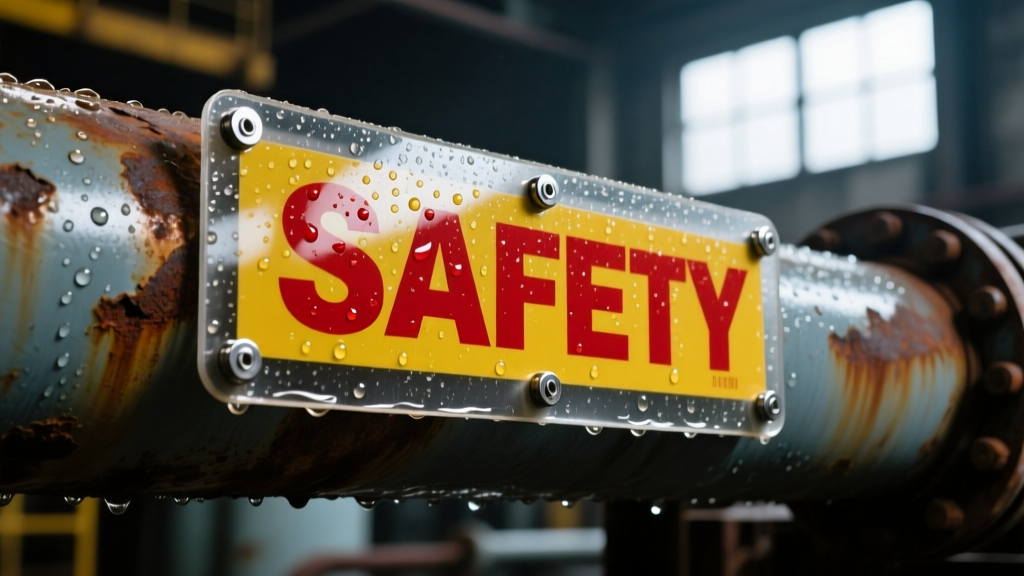
Specifying a $100 FRP sign and mounting it with zinc-plated steel screws is a critical engineering error. The hardware must match or exceed the substrate's corrosion resistance. In wet environments, galvanic corrosion occurs when dissimilar metals interact in the presence of an electrolyte (water).
| Hardware Material | Corrosion Resistance | Compatible Substrates | Cost Premium |
|---|---|---|---|
| Zinc-Plated Steel | Poor (rusts within months outdoors) | None (interior dry only) | Baseline |
| Type 304 Stainless Steel | Good (freshwater, mild humidity) | Aluminum, PVC, Interior FRP | +40% |
| Type 316 Stainless Steel | Excellent (saltwater, chemical aerosols) | Marine Aluminum, FRP, Enamel | +85% |
| Non-Metallic (Nylon/Fiberglass) | Perfect (immune to galvanic action) | FRP in highly corrosive zones | +20% |
Pro Tip: When mounting marine-grade aluminum (5052) to steel structures, always use Type 316 stainless steel fasteners paired with neoprene or EPDM isolation washers. This prevents direct metal-to-metal contact, halting the galvanic corrosion cycle before it begins.
Procurement Framework: Matching Material to Environment
Use this decision matrix to select the correct material based on the specific moisture and chemical profile of your facility:
- High Humidity / Freshwater Splash (e.g., Indoor Water Parks, Food Processing): Use 0.080" 3003-H14 Aluminum with Type 304 SS hardware and edge-banded cast vinyl. Budget: $18/sq ft installed.
- Coastal / Salt Spray (e.g., Marinas, Offshore Platforms): Use 0.080" 5052-H38 Marine Aluminum or 1/8" FRP. Mandate Type 316 SS hardware with EPDM washers. Budget: $30/sq ft installed.
- Chemical Aerosols / Acidic Moisture (e.g., Wastewater Treatment, Chemical Plants): Use 1/8" Isophthalic FRP with sealed edges and non-metallic fiberglass hardware. Budget: $38/sq ft installed.
- Submerged / High-Impact Wet Zones (e.g., Flood Gates, Transit Tunnels): Use 16-gauge Vitreous Enamel Steel with heavy-duty 316 SS structural brackets. Budget: $75/sq ft installed.
Compliance and Sizing for Low-Visibility Wet Zones
Water and moisture inherently reduce visual acuity. Rain on a sign face, combined with fog or mist in the surrounding air, scatters light and reduces the effective reading distance of safety signage. To compensate, OSHA and ANSI Z535 standards require larger signal words (DANGER, WARNING) in environments where visibility is chronically compromised.
For waterproof safety signage in low-visibility wet zones, increase the minimum letter height by 25% compared to standard dry-environment calculations. A sign that requires 2-inch lettering for a 50-foot viewing distance in a dry warehouse will require 2.5-inch lettering to achieve the same legibility in a misty, outdoor loading dock. Always pair high-contrast ANSI safety colors (e.g., OSHA Red for Danger, OSHA Yellow for Caution) with microprismatic reflective overlays to ensure the signage cuts through environmental moisture.
Written by
Elena RodriguezElena Rodriguez is a civil engineer and technical writer specializing in concrete technology, masonry systems, and ASTM/ACI compliance. She earned her B.S. in Civil Engineering from Texas A&M University and spent a decade at a materials testing laboratory, performing over 2,000 concrete compressive strength tests and masonry prism evaluations. Elena is an ACI-certified Field Testing Technician (Grade I) and a member of ASTM Committee C12 on Natural Building Stone. She currently consults on forensic engineering cases involving concrete failures and moisture intrusion. Based in San Antonio, TX, Elena is a proud member of the Society of Women Engineers (SWE) and coaches her daughter's FIRST Robotics team.
More from Elena Rodriguez
View all
Walls & Panels
Cost Analysis: Light Gauge Steel Framing Advantages and Disadvantages
Evaluate light gauge steel framing advantages and disadvantages through a strict cost analysis lens, comparing material, labor, and lifecycle expenses.
Aug 4, 2026

Walls & Panels
Gypsum Board Types: Exact Specifications, Thickness & Dimensions
Compare standard, Type X, and moisture-resistant gypsum board types. Get exact specifications, thicknesses, dimensions, and ASTM standards for your project.
Aug 4, 2026

Fire Resistance
Best Fire-Resistant Outdoor Decking Materials: 2026 Buyer Guide
Discover the best fire-resistant outdoor decking materials for 2026. Compare Class A PVC, aluminum, and hardwood options for WUI compliance and safety.
Aug 4, 2026