How to Waterproof Material Fabric for Architectural Enclosures
Master how to waterproof material fabric for tensile roofs and scaffolding. Includes exact hot-welding parameters, DWR coatings, and seam-sealing costs.

The Physics of Architectural Fabric Moisture Management
Understanding how to waterproof material fabric used in tensile architecture, scaffolding enclosures, and marine structures requires moving beyond consumer-grade spray cans. In construction, fabric waterproofing relies on two distinct mechanisms: hydrostatic resistance (the substrate's ability to stop water penetration under pressure) and hydrophobic surface tension (the Durable Water Repellent, or DWR, coating that causes water to bead and roll off). When either system fails, the structural integrity of the enclosure is compromised, leading to mold, steel corrosion, and membrane degradation.
Application Protocol: Heavy-Duty Canvas and Acrylic Blends
Acrylic canvas (e.g., Sunbrella) and polyester-cotton blends are heavily utilized for temporary site enclosures, awnings, and tensioned shade sails. These materials are not inherently waterproof; they rely on tight weaves that swell when wet, combined with topical coatings. Here is the exact field protocol for restoring and waterproofing these membranes.
Phase 1: Substrate Preparation and UV Degradation Removal
Applying a DWR over oxidized fibers or biological growth guarantees delamination. The fabric must be cleaned using a non-ionic surfactant. Avoid alkaline detergents, which strip the factory-applied fluoropolymer or silicone base.
- Cleaning Agent: Iosso Mold & Mildew Stain Remover or a diluted (1:10) solution of Gear Aid Revivex Pro Cleaner.
- Agitation: Use a medium-bristle polypropylene brush. Never use wire or stiff nylon, which will fray the yarns and reduce the fabric's hydrostatic head rating.
- Drying Metric: The fabric must reach a moisture content of less than 2% before coating. Use a pinless moisture meter; applying DWR to damp fabric traps water inside the weave, causing interior blistering.
Phase 2: Seam Sealing (The Critical Failure Point)
According to ASTM D751 testing standards for coated fabrics, hydrostatic failure almost always initiates at the needle holes of stitched seams. Thread wicking pulls water through the membrane.
For field repairs on acrylic and canvas, apply a continuous 3mm bead of a flexible, UV-stable polyurethane or silicone sealant. Gear Aid Seam Grip SIL (silicone-based) is the industry standard for silicone-treated fabrics, while Seam Grip WP (urethane-based) is required for standard acrylics. Apply the sealant using a syringe applicator directly over the stitch line, smoothing it with a spatula dipped in isopropyl alcohol to achieve a 1mm thickness. Allow 24 hours of curing at temperatures above 60°F (15°C).
Phase 3: PFC-Free DWR Application
Modern PFC-free DWRs (such as Nikwax Tent & Gear SolarProof or 303 Marine Aerospace Protectant) rely on silicone or wax emulsions. Unlike older aerosol fluoropolymers that could be sprayed from a distance, modern emulsions require mechanical friction to bond to the fibers.
- Apply the liquid evenly using a low-pressure pump sprayer at a rate of approximately 1 ounce per 10 square feet.
- Immediately work the liquid into the fabric using a damp sponge or microfiber cloth, ensuring the yarns are fully saturated.
- Wipe away any excess pooling. PFC-free formulas will leave a sticky, dirt-attracting residue if allowed to dry on the surface rather than curing inside the fiber matrix.
- Cure for 48 hours out of direct sunlight to prevent the emulsion from flash-drying before cross-linking.
Heat Welding Parameters for PVC and TPU Membranes
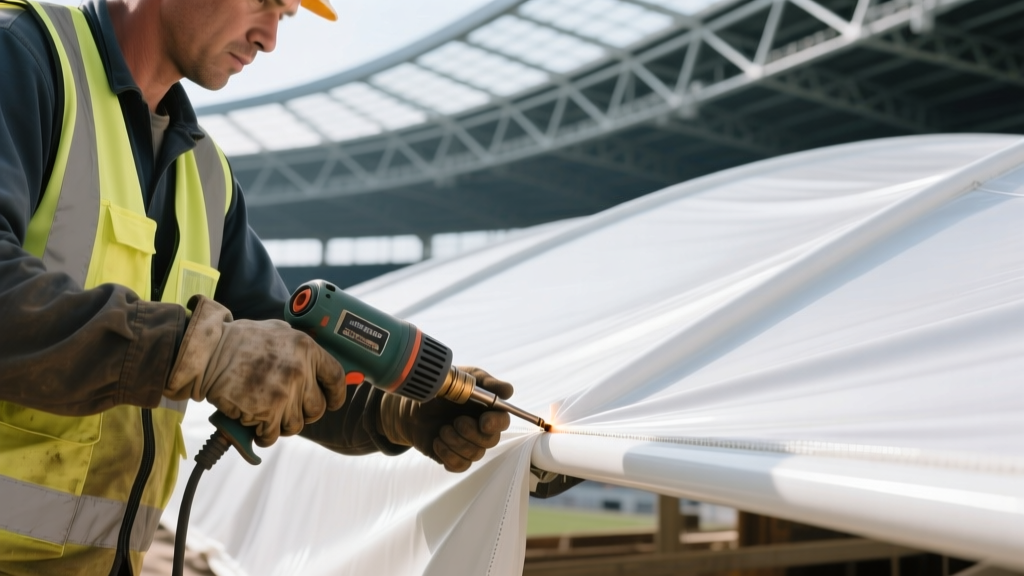
For permanent architectural structures, tensile roofs, and biogas enclosures, PVC (Polyvinyl Chloride) and TPU (Thermoplastic Polyurethane) membranes are the standard. These materials are inherently waterproof, meaning waterproofing is entirely dependent on the seam welding technique. Liquid sealants are ineffective here; seams must be thermally fused.
The Advanced Textiles Association emphasizes that ambient temperature and humidity dictate welding parameters. A weld that holds in 70°F weather may shatter in freezing temperatures if the heat input is not adjusted. Below is the baseline parameter matrix for field welding using a Leister Triac or automatic hot air wedge welder.
| Membrane Type | Thickness | Air Temperature | Weld Speed | Pressure / Roller Weight |
|---|---|---|---|---|
| PVC-Coated Polyester | 0.5mm - 0.9mm | 450°C - 550°C | 3 - 5 m/min | 20 - 30 kg (Wedge) |
| TPU (Ether-based) | 0.3mm - 0.6mm | 300°C - 380°C | 4 - 6 m/min | 15 - 25 kg (Wedge) |
| PVC (Cold Weather <40°F) | 0.5mm - 0.9mm | 550°C - 600°C | 2 - 3 m/min | 25 - 35 kg (Wedge) |
Pro-Tip for Field Verification: Perform a destructive peel test on a scrap weld every morning and after any significant change in ambient weather. The weld should exhibit "fiber tear" (the polyester scrim rips before the PVC coating separates). If the coating peels cleanly apart, the temperature is too low or the speed is too fast. For comprehensive installation guidelines, refer to the Sika Sarnafil synthetic membrane technical data sheets.
Cost Analysis: Maintenance vs. Professional Recoating
Budgeting for fabric waterproofing requires distinguishing between DIY maintenance and professional industrial recoating. The costs below reflect 2026 market rates for commercial architectural fabrics.
| Service Level | Material Type | Cost per Sq. Ft. | Expected Lifespan Extension |
|---|---|---|---|
| DIY DWR Reapplication | Acrylic Canvas / Shade Sails | $0.35 - $0.80 | 1 - 2 Years |
| Professional Seam Resealing | PVC Tensile Membranes | $1.50 - $3.00 | 5 - 7 Years |
| Industrial Liquid Topcoat | PVC / ETFE / PTFE | $4.00 - $8.50 | 10 - 15 Years |
| Full Membrane Replacement | All Architectural Fabrics | $15.00 - $45.00+ | 20+ Years |
Troubleshooting Common Waterproofing Failures
When an architectural enclosure leaks, misdiagnosing the failure mode leads to wasted labor and materials. Use this decision tree to identify the root cause.
Symptom: Water is pooling and dripping through the center of the fabric panels.
- Cause A (Hydrostatic Overload): The fabric lacks adequate slope. Architectural fabrics require a minimum 15% slope (or 3:12 pitch) to prevent water ponding. Ponding water exerts hydrostatic pressure that exceeds the fabric's mm rating, forcing water through the micro-pores.
- Fix A: Adjust the tensioning hardware (turnbuckles or ratchets) to increase the pre-stress and eliminate low spots. Do not apply more coating; fix the geometry.
- Cause B (UV Degradation): The PVC or polyurethane topcoat has chalked and eroded, exposing the base scrim.
- Fix B: Apply a two-part liquid polyurethane architectural topcoat (e.g., Sarnacol or equivalent liquid membrane system) via airless sprayer at 15-20 mils thickness.
Symptom: Water beads up on the surface, but leaks at the edges or structural connections.
- Cause (Capillary Wicking): The fabric is touching a solid surface (like a steel beam or glass facade), creating a capillary bridge that bypasses the DWR coating.
- Fix: Install a 1-inch EPDM foam backer rod or a specialized architectural drip edge to maintain a physical air gap between the fabric and the rigid structure.
Symptom: Seams are leaking despite appearing visually intact.
- Cause (Micro-fissures from Thermal Cycling): PVC and TPU expand and contract significantly with temperature swings. Rigid seam tapes or incompatible liquid sealants will develop micro-fissures invisible to the naked eye.
- Fix: For PVC, run a specialized hot air nozzle (400°C) over the existing weld to re-flow the top 0.2mm of the coating, fusing the micro-fissures shut. For canvas, strip the old urethane seam sealer with a wire brush and reapply a high-elongation silicone sealant capable of 400% stretch.
Mastering how to waterproof material fabric in a commercial setting is less about the liquid you spray and more about understanding the structural geometry, thermal dynamics, and chemical compatibility of the specific polymer you are working with. By adhering to strict preparation protocols and respecting modern PFC-free chemistry, you can extend the service life of architectural membranes by decades.
Written by
Marcus ChenMarcus Chen is a licensed structural engineer (PE) and building materials analyst with over 12 years of experience across residential, commercial, and industrial construction. He holds a Master of Science in Civil Engineering from UC Berkeley and spent six years at Thornton Tomasetti before transitioning to independent consulting and technical writing. Marcus specializes in material selection for seismic-prone regions, concrete reinforcement strategies, and lifecycle cost analysis. His work has been cited by the American Concrete Institute (ACI) and the Structural Engineers Association of California (SEAOC). When he is not on a job site or at his desk, you will find him hiking the Sierra Nevada or restoring a 1920s craftsman bungalow in Oakland, CA.
More from Marcus Chen
View all
Construction Cost
How Much Did the Eiffel Tower Cost to Build?
How much did the Eiffel Tower cost to build in 1889? We adjust for inflation and compare its budget to modern skyscraper construction.
Aug 4, 2026

Fire Resistance
What Is a Fire Resistant Material? Testing & Certification Guide
Discover what is a fire resistant material through ASTM and UL testing. Learn how fire ratings, certifications, and assemblies work in construction.
Aug 4, 2026

Construction Cost
How Much Did the Burj Khalifa Cost to Build?
How much did the Burj Khalifa cost to build? We break down the $1.5B project and extract 5 money-saving strategies for your next build.
Jul 30, 2026