IBC Code Requirements for Waterproof Shoe Material in Foundations
Explore IBC and ASTM code requirements for waterproof shoe materials used in foundation base flashing, coves, and pipe transitions.

In structural waterproofing, the term 'shoe' does not refer to construction footwear. It designates the critical transitional flashing detail—often a cove, base cant, or pipe penetration sleeve—that bridges horizontal and vertical membrane planes. Selecting the correct waterproof shoe material is one of the most heavily scrutinized aspects of below-grade and plaza deck inspections. When the wall-to-footing transition fails, hydrostatic pressure exploits the capillary break, leading to catastrophic substructure leaks. This guide details the International Building Code (IBC) mandates, ASTM performance standards, and material selection frameworks for specifying code-compliant base and penetration shoes.
Defining the Structural Waterproof Shoe Detail
The 'shoe' in a waterproofing assembly serves as the structural hinge between intersecting planes. Because buildings settle and concrete cures at different rates, the joint between a foundation wall and its footing is a primary location for differential movement and cracking. The waterproof shoe material must accommodate this movement while maintaining an impenetrable moisture barrier.
There are two primary shoe configurations in commercial and residential substructures:
- Base Shoe (Cove/Cant): A 45-degree or curved transition installed at the interior or exterior wall-to-footing joint. Standard dimensions are 2x2 inches or 3x3 inches, designed to prevent the membrane from making a brittle 90-degree turn.
- Pipe Shoe (Penetration Sleeve): A pre-formed or liquid-applied collar that wraps around plumbing, electrical, or structural penetrations through the below-grade slab or wall, tying into the primary field membrane.
IBC Chapter 18 Mandates for Below-Grade Transitions
The International Building Code addresses below-grade moisture protection in Chapter 18 (Soils and Foundations). The code strictly differentiates between dampproofing and waterproofing, and this distinction dictates the required performance of your waterproof shoe material.
Hydrostatic vs. Non-Hydrostatic Code Distinctions
Under IBC Section 1805.2.2, dampproofing is permitted only where the water table is maintained below the slab elevation and the soil is well-drained. If hydrostatic pressure is present, or if the soil is classified as poorly drained, IBC Section 1805.3 mandates a full waterproofing system.
IBC Section 1805.3.2 requires that waterproofing membranes be continuous and extend from the footing, up the foundation wall, and tie into the above-grade weather-resistant barrier. The waterproof shoe material at the base joint must possess a minimum tensile strength of 200 psi (per ASTM D412) and an elongation capacity of at least 300% to resist lateral hydrostatic shear without tearing during structural settlement.
For flood zones, the FEMA Technical Bulletin 2 further requires that any material used below the Base Flood Elevation (BFE) be classified as a Class 4 or Class 5 flood-resistant material, meaning it can withstand direct, prolonged contact with floodwater without sustaining significant damage. Highly modified polyurethanes and EPDM rubbers typically meet this threshold, whereas standard asphaltic cants do not.
ASTM Standards Governing Shoe Material Performance
Building inspectors and third-party envelope consultants rely on ASTM testing standards to verify that the specified waterproof shoe material will perform under stress. Specifiers must ensure product data sheets explicitly reference compliance with the following standards:
| ASTM Standard | Description | Relevance to Shoe Details |
|---|---|---|
| ASTM C836 | High-Solids Content, Cold Liquid-Applied Elastomeric Membranes | Governs liquid polyurethane and rubberized asphalt shoes; mandates crack-bridging capabilities over 1/16-inch substrate cracks. |
| ASTM D5295 | Guide for Selection of Water Vapor Retarders | Critical for interior base shoes tying into sub-slab vapor barriers; dictates perm ratings (Class I requires < 0.1 perms). |
| ASTM C1127 | Guide for Use of High Solids Content, Cold Liquid-Applied Elastomeric Membranes | Details substrate preparation and moisture limits prior to applying liquid shoe materials to green concrete. |
| ASTM D412 | Standard Test Methods for Vulcanized Rubber and Thermoplastic Elastomers | Measures the ultimate elongation and tensile strength of pre-formed EPDM and butyl pipe shoes. |
Material Selection Matrix: Liquid vs. Pre-Formed vs. Bentonite
Choosing the right waterproof shoe material depends on the substrate condition, the complexity of the penetration, and the project budget. Below is a comparative analysis of the three dominant material categories used in modern commercial construction.
1. Liquid-Applied Polyurethane Shoes
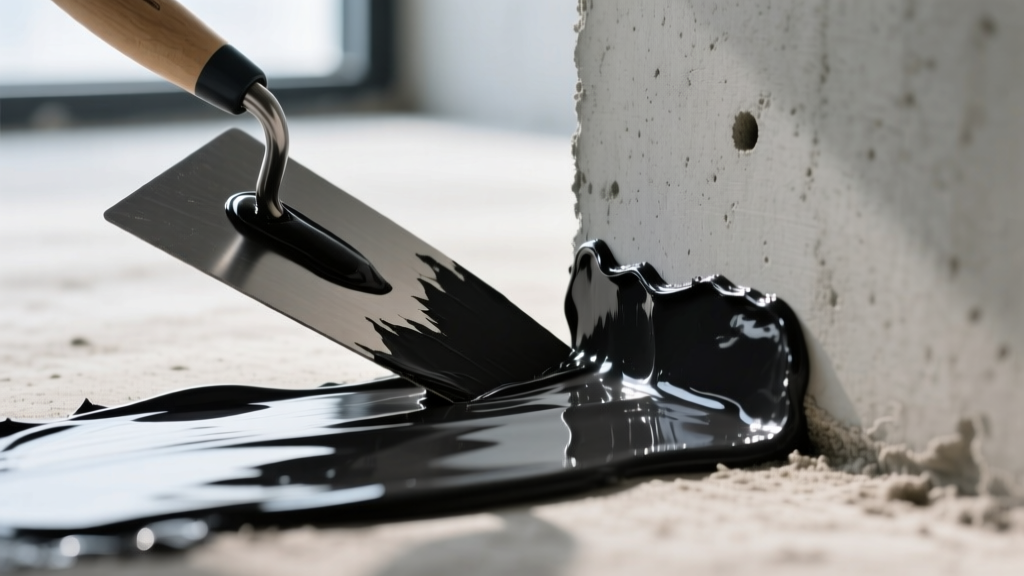
Liquid-applied systems (e.g., Tremco ExoAir TWF or Henry 212) are troweled or sprayed into the cove joint. They are the preferred choice for complex pipe clusters where wrapping a sheet membrane is impossible.
- Code Advantage: Seamless integration with the field membrane; eliminates lap seams at the most vulnerable joint.
- Application Requirement: Requires a 2-inch by 2-inch mortar cant strip installed prior to application. The liquid material must be applied at a minimum 60 mils wet thickness, often reinforced with a polyester fabric mesh embedded at the center of the cove.
- Cost Data: Material and labor typically range from $14.00 to $22.00 per linear foot for a standard reinforced cove detail.
2. Pre-Formed EPDM and Butyl Pipe Shoes
For standard pipe penetrations, pre-formed shoes (e.g., Link-Seal or proprietary EPDM collars) offer rapid installation. These are mechanically fastened or adhered using butyl adhesive tapes.
- Code Advantage: Factory-controlled thickness ensures consistent mil coverage, reducing the risk of inspector rejection due to thin spots common in liquid applications.
- Application Requirement: Must be secured with stainless steel hose clamps or termination rings. IBC requires the top edge of the shoe to be sealed with a compatible mastic and covered with a termination bar if exposed to backfill abrasion.
- Cost Data: $28.00 to $55.00 per unit, depending on pipe diameter (2-inch to 12-inch schedules).
3. Bentonite and Sheet Membrane Base Shoes
Products like Cetco Voltex DS utilize sodium bentonite encased in geotextile. When used as a base shoe, the material swells upon contact with water, creating a self-sealing, high-pressure gasket.
- Code Advantage: Meets IBC requirements for self-healing membranes in areas where minor concrete cracking is anticipated post-cure.
- Application Requirement: Must be installed in a continuous ribbon and mechanically pinned to the footing with concrete nails or powder-actuated fasteners at 8 inches on-center before the wall is poured.
- Cost Data: $6.50 to $9.50 per linear foot, making it highly cost-effective for large-footprint commercial slabs.
Common Code Violations and Inspection Failures
According to envelope commissioning data referenced by the Whole Building Design Guide (WBDG), transition details account for over 80% of below-grade waterproofing failures. Inspectors frequently reject base shoe installations for the following code violations:
- Inadequate Vertical Termination: The waterproof shoe material must not terminate at the finish grade line. IBC mandates that the membrane extend a minimum of 6 inches above the finished grade or plaza deck wearing surface. Terminating the shoe at the slab edge leaves the top of the footing exposed to surface water migration.
- Substrate Moisture Content Exceeding Limits: Applying liquid polyurethane shoe materials to 'green' concrete with a moisture content exceeding 5% (tested via ASTM F2170) traps vapor beneath the membrane. This causes blistering and eventual delamination under hydrostatic load. Inspectors will require a moisture-mitigating epoxy primer if the slab is poured on a tight schedule.
- Missing Fabric Reinforcement in Liquid Coves: A liquid shoe applied without a reinforcing fabric mesh (often referred to as a 'detail coat') lacks the tensile strength to bridge shrinkage cracks that develop in the concrete cant strip. Code-compliant specifications universally require a 4-inch wide fabric strip embedded in the wet liquid membrane at the exact apex of the 90-degree joint.
Specifying the correct waterproof shoe material requires moving beyond generic 'waterproofing' notes on architectural drawings. By explicitly referencing IBC Chapter 18 continuity mandates, ASTM elongation thresholds, and precise installation dimensions, structural engineers and architects can eliminate the most common failure points in below-grade envelope design.
For further reading on structural code adoption and material compliance, refer to the International Code Council's IBC resources to ensure your local jurisdiction's amendments are reflected in your project specifications.
Written by
Sarah WhitfieldSarah Whitfield is a chartered quantity surveyor (MRICS) and construction cost analyst with 15 years of experience in material pricing, procurement strategy, and project budgeting. She earned her degree in Construction Management from the University of Reading (UK) and has worked on projects ranging from $2M custom homes to $180M mixed-use developments across North America and Europe. Sarah currently leads cost estimating for BuildMat Insight, maintaining a proprietary database of 4,000+ material price points updated quarterly. She is a frequent contributor to RSMeans cost data panels and has presented at the International Cost Engineering Council (ICEC) congress. Based in Denver, CO, Sarah is an avid trail runner and volunteer mentor for Women in Construction.
More from Sarah Whitfield
View all
Wood & Lumber
What Are the Different Types of Wood? A Builder's Guide
Compare structural softwoods, finish hardwoods, and engineered lumber. Analyze Janka ratings, MOE values, and 2026 pricing for construction.
Aug 4, 2026

Walls & Panels
Steel Framing vs Wood Framing: Corrosion and Moisture Defense
Compare steel framing vs wood framing for moisture resistance. Learn about galvanized coatings, condensation risks, and corrosion protection strategies.
Jul 21, 2026

Stone & Masonry
How to Cut Stone Veneer: Wet Saw vs Grinder Comparison
Compare the best tools for cutting stone veneer. We review wet saws, angle grinders, and chop saws to help you achieve clean, chip-free cuts.
Jul 21, 2026