Acme Building Materials: Brick vs. Fiber Cement Siding Comparison
Compare Acme building materials like clay brick against fiber cement siding. Explore 2026 costs, ASTM standards, thermal mass, and installation specs.

Material Composition and Manufacturing Standards
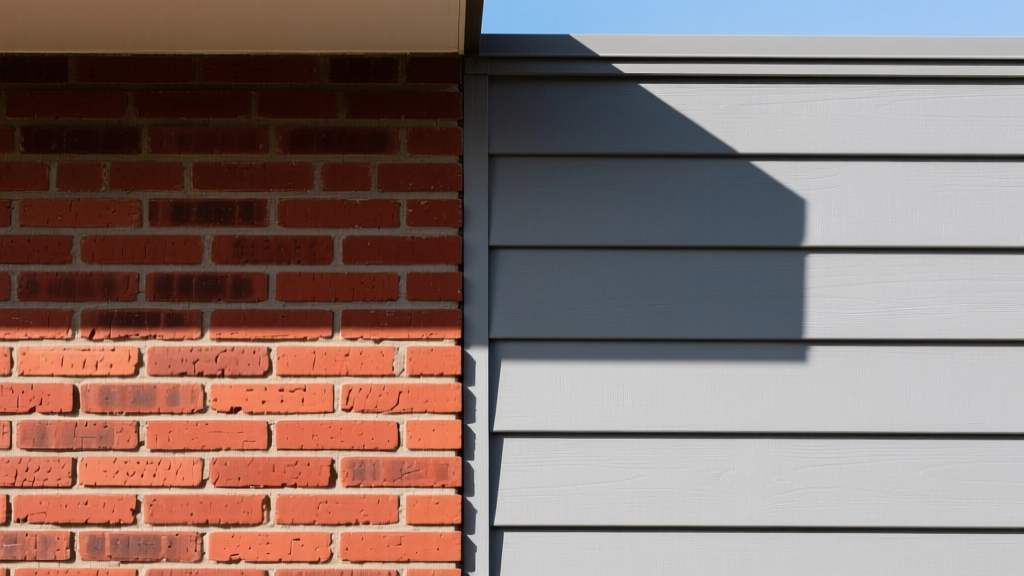
When specifying exterior cladding for commercial or high-end residential envelopes, architects and builders frequently weigh traditional masonry against modern manufactured alternatives. Evaluating Acme building materials—primarily represented by the Acme Brick Company, a Berkshire Hathaway subsidiary and one of the largest clay masonry manufacturers in North America—requires a direct technical comparison with premium fiber cement siding. Both materials meet rigorous building codes, but their material science, structural behavior, and lifecycle performance diverge significantly.
Acme Extruded and Molded Clay Brick
Acme’s standard face brick lines (such as their modular extruded series) are manufactured to meet or exceed ASTM C652 (Standard Specification for Hollow Brick) and ASTM C216 (Standard Specification for Facing Brick). A standard modular Acme brick measures 3-5/8" x 2-1/4" x 7-5/8". These units typically exhibit a compressive strength exceeding 3,400 psi and an initial rate of absorption (IRA) carefully controlled between 10 and 30 grams per 30 square inches per minute to ensure optimal mortar bond. The firing process at temperatures exceeding 2,000°F vitrifies the clay, rendering the material completely inorganic and immune to UV degradation.
Premium Fiber Cement Siding
Fiber cement cladding (e.g., James Hardie or Allura lines) is governed by ASTM C1186. It is composed of Portland cement, silica sand, and cellulose fibers, extruded or pressed into 5/16" thick lap boards. While highly resistant to rot and termites, the cellulose component makes it susceptible to prolonged moisture retention if installed incorrectly, and the cementitious matrix is inherently more brittle than fired clay under high-impact conditions.
2026 Installed Cost Matrix
Material costs alone provide an incomplete financial picture. Masonry requires specialized labor, scaffolding, and structural support, whereas fiber cement utilizes standard carpentry crews. The table below reflects national average installed costs for Q1 2026, assuming a standard two-story residential or low-rise commercial elevation.
| Cost Factor (Per Sq. Ft.) | Acme Clay Brick Veneer | Fiber Cement Lap Siding |
|---|---|---|
| Raw Material Cost | $3.80 - $5.50 | $3.20 - $5.00 |
| Mortar, Ties, & Flashing | $1.20 - $1.80 | $0.60 - $0.90 (Fasteners/Water Barrier) |
| Specialized Labor | $13.00 - $18.50 (Masonry Union/Certified) | $5.50 - $9.00 (Carpentry) |
| Scaffolding & Equipment | $2.50 - $4.00 | $1.00 - $2.00 |
| Total Installed Cost | $20.50 - $29.80 | $10.30 - $16.90 |
Note: Acme brick requires a masonry ledge on the foundation or structural shelf angles, adding marginal structural steel or concrete costs not included in the cladding totals above.
Durability, Lifespan, and Moisture Management
The longevity of the building envelope is dictated by how the material handles water intrusion and environmental stress.
- Impact Resistance: Acme brick is virtually impervious to hail, flying debris, and minor mechanical impacts. Fiber cement, while durable, will chip or crack when struck by heavy objects (e.g., baseballs, severe hail >2"), requiring board replacement.
- Moisture Management: Acme brick veneer operates as a drainage wall system. Water penetrating the brick is caught by flashing and weep holes (spaced at a maximum of 33 inches on center, per the Brick Industry Association). Fiber cement relies on a weather-resistive barrier (WRB) and rain screen gap; if the lap joints fail or capillary action draws water behind the boards, the underlying sheathing is at risk.
- Colorfastness: The color in Acme brick is fired into the clay body and will never fade, peel, or require painting. Fiber cement utilizes acrylic or cementitious coatings that typically require repainting or refinishing every 15 to 20 years to maintain aesthetic integrity and moisture resistance.
- Fire Rating: Both materials achieve a Class A fire rating. However, Acme brick provides a multi-hour fire-resistance rating for the entire wall assembly, whereas fiber cement primarily protects the exterior surface.
Thermal Mass and IECC Compliance
Under the latest International Energy Conservation Code (IECC) updates adopted through 2026, continuous insulation (ci) is heavily mandated. Fiber cement has virtually zero R-value (approx. R-0.15) and requires rigid foam ci behind the furring strips to meet code. Acme brick possesses high thermal mass. While its steady-state R-value is low, its ability to absorb, store, and slowly release heat creates a "time lag" effect of 6 to 8 hours. In climates with high diurnal temperature swings (e.g., the American Southwest), this thermal mass significantly reduces peak HVAC loads, a factor recognized in advanced energy modeling software like REM/Rate and EnergyPlus.
Reference: For detailed masonry energy code compliance data, consult the Brick Industry Association Technical Notes.
Structural Load and Installation Logistics
The physical weight of the cladding dictates the structural engineering of the project. Standard Acme modular brick weighs approximately 38 to 45 pounds per square foot. This dead load requires a continuous masonry ledge at the foundation and, for multi-story construction, structural steel shelf angles anchored to the floor slabs every 30 feet vertically to support the brick’s weight and transfer it back to the building frame.
Fiber cement weighs roughly 2.5 to 3.0 pounds per square foot. It attaches directly to wood or steel studs (16" or 24" on center) via blind nailing or face screwing over a rain screen mat. The logistical advantage of fiber cement is speed; a skilled carpentry crew can enclose a building envelope in a fraction of the time it takes a masonry crew to lay, tool, and clean brick. However, the 2026 construction labor market shows a critical shortage of certified masons, meaning lead times for Acme brick installation must be factored into the critical path of the project schedule months in advance.
Decision Framework: Specifying the Right Envelope
Choosing between Acme masonry and fiber cement is rarely about which material is universally "better," but rather which aligns with the project's structural, financial, and aesthetic parameters.
Specify Acme Building Materials (Brick Veneer) When:
- The project demands a 75+ year lifecycle with zero exterior maintenance budgets (e.g., institutional buildings, university campuses, luxury legacy homes).
- The architectural design requires deep shadow lines, varied mortar joint profiles (e.g., grapevine or weathered), and the authentic, irreplicable texture of fired clay.
- The building is located in a high-wind coastal zone or tornado alley where debris impact resistance is a primary life-safety concern.
- Acoustic isolation is required; a brick veneer wall assembly provides superior Sound Transmission Class (STC) ratings compared to lightweight siding.
Specify Fiber Cement Siding When:
- The project has strict upfront capital expenditure limits and cannot absorb the premium of masonry labor and structural shelf angles.
- The design calls for large-format horizontal lap profiles, shingle styles, or vertical board-and-batten aesthetics that are impossible to achieve with modular clay units.
- The building frame is light-gauge steel or wood-engineered to strict weight limits, precluding the 40+ PSF dead load of masonry.
- The construction schedule demands rapid enclosure to allow interior trades to begin work before winter weather sets in.
For comprehensive environmental enclosure design and integration of these materials with water-resistive barriers, review the cladding guidelines provided by the National Institute of Building Sciences (WBDG).
Frequently Asked Questions
Can Acme brick be installed directly over existing fiber cement or wood siding?
No. Acme brick veneer requires a minimum 1-inch (preferably 2-inch) air drainage cavity, corrosion-resistant metal wall ties anchored directly to the structural studs or masonry backup, and proper flashing. Installing brick directly over existing siding traps moisture, violates ASTM standards, and guarantees structural failure and mold growth.
Does Acme offer lighter-weight alternatives to standard clay brick?
Yes. For projects where the structural load of traditional clay is prohibitive, Acme and its parent company network supply thin brick veneers (typically 1/2" to 3/4" thick) and architectural concrete masonry units (CMUs) that mimic the aesthetic of fired clay while altering the weight and installation methodology.
How does the warranty compare between the two materials?
Acme Brick typically offers a 100-year limited warranty against structural failure and excessive fading for their residential face brick. Premium fiber cement manufacturers generally offer 30- to 50-year limited warranties, though these are often prorated after the first 15 years and strictly exclude issues arising from improper flashing, lack of a rain screen, or failure to repaint on schedule.
Written by
David NakamuraDavid Nakamura is a licensed architect (AIA) and construction technology writer focused on sustainable building methods, mass timber engineering, and high-performance building envelopes. He holds a Master of Architecture from the University of Washington and is a certified Passive House Consultant (CPHC). David spent eight years at the Seattle firm Mithun, where he led the design of three LEED Platinum projects, before founding his own practice specializing in net-zero residential design. He serves on the editorial advisory board of GreenBuilder Magazine and has authored peer-reviewed papers on cross-laminated timber (CLT) connections for the Journal of Structural Engineering. In his spare time, David teaches woodworking at Pratt Fine Arts Center and kayaks the Puget Sound.
More from David Nakamura
View all
Construction Cost
Labor Cost to Build a Deck Per Sq Ft: 2026 Installation Guide
Discover the exact labor cost to build a deck per sq ft in 2026. This installation guide breaks down contractor rates, complexity factors, and hidden fees.
Aug 4, 2026

Construction Cost
How Much Does It Cost to Build a 3 Bedroom House? Financing Guide
Learn exactly how much it costs to build a 3 bedroom house and explore 2026 financing options, construction loan types, and budget frameworks for your build.
Aug 4, 2026

Construction Cost
Cost to Build a Tennis Court: 2026 Guide
How much does it cost to build a tennis court in 2026? Breakdowns for asphalt, concrete, and synthetic surfaces plus fencing and lighting.
Jul 30, 2026