Cost Analysis of Alternative Building Materials in 2026
A detailed 2026 cost analysis of alternative building materials, comparing hempcrete, rammed earth, and SIPs against traditional framing.
The Baseline: Traditional Framing vs. The Alternative Premium
Evaluating alternative building materials requires moving past the sticker price of raw goods to analyze the total cost of assembly, labor specialization, and long-term thermal performance. In 2026, the baseline for residential wall assemblies remains advanced 2x6 stick framing with fiberglass batt insulation and OSB sheathing. Depending on regional lumber markets and union labor rates, this traditional assembly costs between $11.50 and $15.00 per square foot of wall area.
When builders pivot to alternative building materials, the initial capital expenditure almost always exceeds this baseline. However, this premium is rarely distributed evenly across materials and labor. Some alternatives shift costs heavily toward manufacturing (reducing on-site labor), while others rely on cheap raw materials but demand highly specialized, expensive artisan labor. Understanding this cost distribution is critical for accurate project budgeting and avoiding mid-build financial shortfalls.
Deep-Dive Cost Breakdown: Three Leading Alternatives
Hempcrete (Hemp-Lime Bio-Composite)
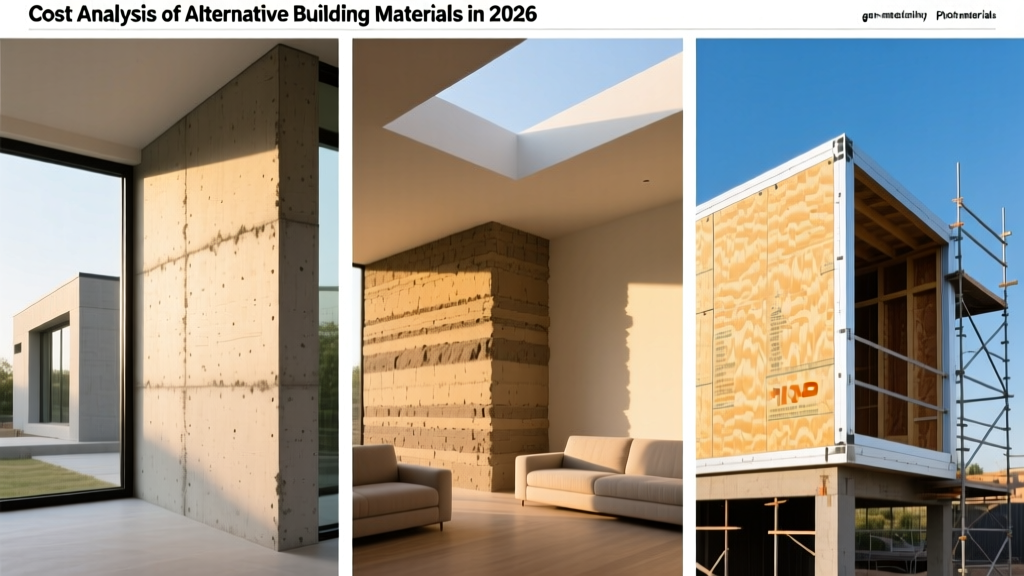
Hempcrete is a non-load-bearing bio-composite made from the woody core of the hemp plant (hurd) mixed with a lime-based binder and water. The standard volumetric mix ratio is 1 part binder, 1.5 parts water, and 4 parts hemp hurd. Because it is non-structural, it requires a secondary framing system—typically a timber frame or steel stud skeleton—which adds to the overall wall assembly cost.
The raw materials for hempcrete are remarkably inexpensive, costing roughly $3.50 to $5.00 per square foot. The financial bottleneck is labor. Casting or troweling hempcrete into formwork is highly manual. In 2026, specialized applicators charge between $14.00 and $19.00 per square foot for installation. Consequently, the total installed cost for a hempcrete wall assembly (including the internal timber frame) ranges from $18.00 to $24.00 per square foot. The material excels in moisture regulation and carbon sequestration (storing approximately 7,500 kg of CO2 per 100 square meters of wall), but it offers a modest R-value of roughly R-1.4 to R-1.8 per inch, necessitating thicker walls (typically 12 to 15 inches) to meet modern energy codes.
Structural Insulated Panels (SIPs)
Unlike hempcrete, Structural Insulated Panels (SIPs) shift the cost burden from the job site to the factory. A standard SIP consists of an expanded polystyrene (EPS) or polyisocyanurate foam core sandwiched between two structural facings, usually oriented strand board (OSB). A 6.5-inch EPS core panel yields a whole-wall R-value of R-24, significantly outperforming the R-19 nominal (but effectively R-14 due to thermal bridging) of a traditional 2x6 stud wall.
According to the U.S. Department of Energy, SIPs provide superior air tightness and can reduce energy consumption for heating and cooling by up to 50%. The panels themselves cost between $8.00 and $12.00 per square foot. However, because the panel integrates structure, insulation, and sheathing in a single step, framing labor is reduced by 40% to 50%. The total installed wall cost typically lands between $14.00 and $18.00 per square foot, making SIPs one of the few alternative building materials that can achieve cost parity with traditional framing on a purely upfront basis, while delivering vastly superior thermal performance.
Stabilized Rammed Earth (SRE)
Stabilized Rammed Earth (SRE) involves compacting a damp mixture of subsoil, aggregate, and a small percentage of Portland cement (usually 5% to 8% by weight) into heavy-duty, engineered formwork. The ideal soil mix is roughly 70% sand and gravel aggregate and 30% clay and silt. Once cured, the forms are stripped to reveal a solid, monolithic, load-bearing wall with a striking geological stratification.
The raw material cost for SRE is negligible—often less than $1.00 per square foot if suitable soil is sourced directly from the excavation site. The expense lies entirely in formwork engineering and pneumatic tamping labor. Building the reinforced aluminum or plywood forms, setting vertical rebar, and mechanically tamping the earth in 4-inch lifts requires specialized crews. Total installed costs for SRE range from $28.00 to $42.00 per square foot of wall. While expensive, SRE provides immense thermal mass, which, when paired with passive solar design, can reduce peak cooling loads by 15% to 20% in arid, high-diurnal-range climates.
When budgeting for alternative building materials, always apply a 20% to 30% labor contingency for the "learning curve tax." If your general contractor has never managed a hempcrete pour or a SIP crane-set, their initial labor estimates will be inaccurate. Crews will work slower, make sequencing errors, and require more supervision during the first project. This tax diminishes to near-zero by the contractor's third or fourth project using the same system.
2026 Comparative Cost Matrix
The following matrix compares the financial and performance metrics of traditional framing against the three alternative building materials analyzed above. All costs reflect national averages for residential wall assemblies in 2026.
| Material System | Material Cost / sq ft | Labor Cost / sq ft | Total Assembly Cost | Effective R-Value |
|---|---|---|---|---|
| 2x6 Advanced Framing | $5.50 - $7.00 | $6.00 - $8.00 | $11.50 - $15.00 | R-14 to R-16 |
| Hempcrete (12" thick) | $3.50 - $5.00 | $14.00 - $19.00 | $18.00 - $24.00 | R-17 to R-21 |
| SIPs (6.5" EPS Core) | $8.00 - $12.00 | $4.00 - $6.00 | $14.00 - $18.00 | R-24 to R-26 |
| Stabilized Rammed Earth | $1.00 - $3.00 | $25.00 - $40.00 | $28.00 - $42.00 | R-0.3 per inch (Mass) |
Lifecycle ROI: Where Alternative Materials Recoup Costs
Upfront construction costs only tell half the financial story. The EPA's green building guidelines emphasize that lifecycle assessment and operational energy savings are critical metrics for material selection. Alternative building materials often recoup their initial premium through downstream efficiencies.
- HVAC Downsizing: The extreme air tightness and continuous insulation of SIPs frequently allow engineers to downsize HVAC equipment by 25% to 30%. On a 3,000-square-foot custom home, this can save $8,000 to $12,000 in mechanical equipment costs, effectively neutralizing the SIP premium.
- Drywall Elimination: Both rammed earth and hempcrete (when finished with a lime plaster) eliminate the need for interior drywall, taping, and painting. This saves roughly $2.50 to $3.50 per square foot of interior wall area in finishing labor and materials.
- Maintenance and Durability: Rammed earth walls are virtually indestructible, immune to rot, termites, and fire. The 50-year maintenance cost for an SRE wall is effectively zero, compared to the recurring costs of repainting and repairing traditional siding and drywall.
Regional Supply Chain and Pricing Variances
The cost of alternative building materials is highly sensitive to regional supply chains and local climates. Research from the National Renewable Energy Laboratory (NREL) highlights that localized material sourcing is key to minimizing embodied carbon and transport costs.
Hempcrete is currently most cost-effective in the Pacific Northwest, Northeast, and parts of Canada, where hemp processing facilities are concentrated. Transporting dry hemp hurd across the country in the Midwest or South can add $1.50 to $2.50 per square foot in freight surcharges. Conversely, Rammed Earth is most economically viable in the American Southwest and parts of Australia. The arid climate allows for optimal curing without expensive weather-protection enclosures, and the native soils in regions like Arizona and New Mexico frequently meet the exact aggregate-to-clay ratios required for stabilization, eliminating import costs.
Frequently Asked Questions
Do banks finance homes built with alternative building materials?
Yes, but the appraisal process can create friction. Conventional lenders rely on comparable sales (comps) to determine loan amounts. Because alternative building materials like hempcrete or rammed earth are rare, appraisers often struggle to find local comps. To secure financing, builders must provide a detailed cost breakdown and energy modeling report to justify the premium. Using SIPs is generally the path of least resistance, as they are widely recognized by the secondary mortgage market (Fannie Mae and Freddie Mac) and appraisers are accustomed to valuing their energy efficiency.
How does insurance underwriting handle hempcrete or rammed earth?
Insurance underwriters evaluate risk based on fire, wind, and water resistance. Rammed earth and hempcrete are highly fire-resistant; hempcrete's lime binder makes it virtually non-combustible, and rammed earth has a 4-hour fire rating. However, because these systems lack decades of actuarial data in the U.S., some regional insurers may initially classify them as "non-standard construction," leading to higher premiums. Builders should engage with specialized green-building insurance brokers who understand the material science and can negotiate standard rates based on the materials' inherent resilience to fire and seismic activity.
Written by
Elena RodriguezElena Rodriguez is a civil engineer and technical writer specializing in concrete technology, masonry systems, and ASTM/ACI compliance. She earned her B.S. in Civil Engineering from Texas A&M University and spent a decade at a materials testing laboratory, performing over 2,000 concrete compressive strength tests and masonry prism evaluations. Elena is an ACI-certified Field Testing Technician (Grade I) and a member of ASTM Committee C12 on Natural Building Stone. She currently consults on forensic engineering cases involving concrete failures and moisture intrusion. Based in San Antonio, TX, Elena is a proud member of the Society of Women Engineers (SWE) and coaches her daughter's FIRST Robotics team.
More from Elena Rodriguez
View all
Walls & Panels
Cost Analysis: Light Gauge Steel Framing Advantages and Disadvantages
Evaluate light gauge steel framing advantages and disadvantages through a strict cost analysis lens, comparing material, labor, and lifecycle expenses.
Aug 4, 2026

Walls & Panels
Gypsum Board Types: Exact Specifications, Thickness & Dimensions
Compare standard, Type X, and moisture-resistant gypsum board types. Get exact specifications, thicknesses, dimensions, and ASTM standards for your project.
Aug 4, 2026

Fire Resistance
Best Fire-Resistant Outdoor Decking Materials: 2026 Buyer Guide
Discover the best fire-resistant outdoor decking materials for 2026. Compare Class A PVC, aluminum, and hardwood options for WUI compliance and safety.
Aug 4, 2026