Healthy Home Building Materials: Non-Toxic Selection Guide
Compare top healthy home building materials including low-VOC paints, formaldehyde-free insulation, and non-toxic flooring for safer indoor air.

Indoor air quality (IAQ) is a critical, often overlooked component of residential construction. According to the U.S. Environmental Protection Agency, indoor air can be two to five times more polluted than outdoor air, primarily due to off-gassing from standard building materials. Specifying healthy home building materials requires moving beyond marketing buzzwords and understanding the chemical binders, adhesives, and finishes that dictate a material's off-gassing half-life. This guide provides a technical overview of non-toxic material categories, specific product recommendations, and the certification frameworks necessary to verify manufacturer claims.
Decoding Health and Transparency Certifications
Before selecting specific products, builders and architects must understand the testing standards that validate 'healthy' claims. Self-reported zero-VOC labels are frequently misleading, as they often test only the base product, excluding chemical colorants or catalysts. Rely on third-party verifications.
| Certification | Issuing Body | Primary Focus | Technical Standard / Threshold |
|---|---|---|---|
| GREENGUARD Gold | UL Solutions | Low chemical emissions for sensitive environments (schools, healthcare). | Strict limits on over 360 VOCs; total VOC emissions must be < 0.22 mg/m³. |
| Declare Label | Intl. Living Future Institute | Ingredient transparency and end-of-life recycling. | Requires 100% ingredient disclosure down to 100 ppm; no Red List chemicals. |
| Cradle to Cradle (C2C) | Cradle to Cradle Products Innovation Institute | Material health, circularity, and social fairness. | Material Health Certificate requires inventorying 100% of materials by weight. |
| CARB Phase 2 / EPA TSCA Title VI | California Air Resources Board / EPA | Formaldehyde emissions from composite wood products. | Hardwood plywood limit: 0.05 ppm; Particleboard limit: 0.09 ppm. |
Expert Insight: While UL's GREENGUARD Certification is the gold standard for emissions, it does not guarantee ingredient transparency. A product can pass emission tests while still containing hazardous chemicals that are encapsulated. For total transparency, cross-reference GREENGUARD Gold products with the Declare Label database.
Category 1: Formaldehyde-Free Insulation
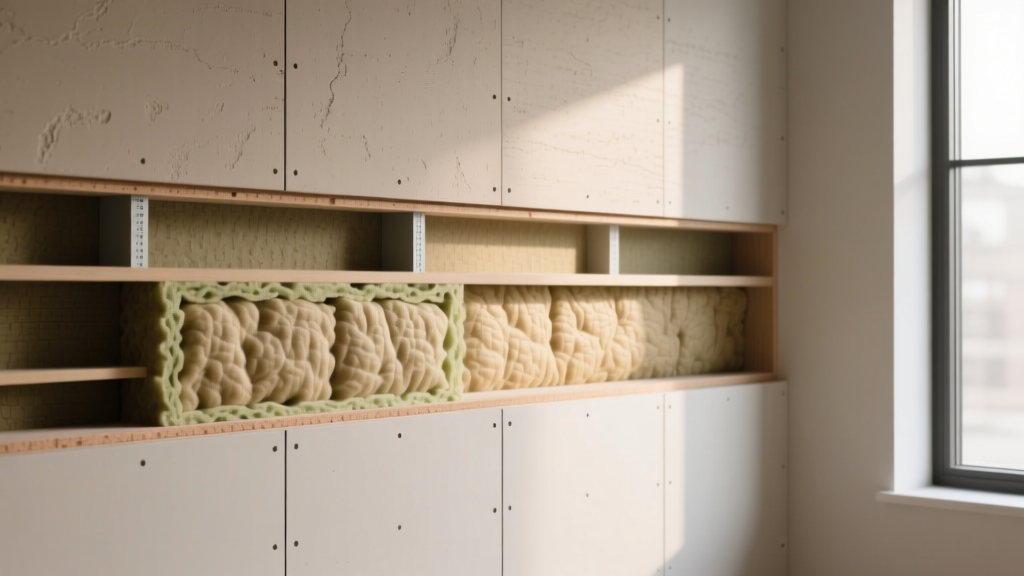
Traditional fiberglass batts historically used phenol-formaldehyde or urea-formaldehyde binders to hold the glass fibers together. While many manufacturers have phased these out, it remains critical to verify the binder chemistry on the technical data sheet (TDS).
Mineral Wool vs. Acrylic-Bound Fiberglass
- Mineral Wool (e.g., Rockwool Safe and Sound): Made from basalt rock and slag. It is inherently non-combustible and uses a phenol-free, formaldehyde-free binder. It offers superior acoustic dampening (STC 45-52 in standard 2x4 walls) and does not off-gas VOCs. Cost: $1.10 - $1.40 per sq. ft.
- Acrylic-Bound Fiberglass (e.g., Knauf EcoBatt): Utilizes an acrylic-based bio-binder rather than formaldehyde. It is lighter and easier to install than mineral wool but offers slightly lower acoustic performance. Cost: $0.60 - $0.85 per sq. ft.
- Recycled Denim (e.g., UltraTouch): Made from post-industrial cotton fibers treated with a borate solution for fire and pest resistance. It contains zero chemical binders but requires a separate vapor barrier as it is highly permeable. Cost: $1.50 - $1.80 per sq. ft.
Category 2: Paints, Primers, and the Colorant Loophole
The most common failure in specifying healthy paints is ignoring the colorant. A base paint may be certified Zero-VOC (< 5 g/L), but adding standard universal colorants (which rely on glycols and solvents) can spike the VOC content to over 100 g/L, especially in deep, saturated tones.
Specifying Truly Zero-VOC Coatings
To ensure the finished, tinted product remains non-toxic, specify manufacturers that utilize proprietary zero-VOC colorant systems:
- Benjamin Moore Aura / Regal Select: Uses the Gennex colorant system, which is water-based and contains zero VOCs, ensuring the paint maintains its zero-VOC status regardless of the color chosen.
- ECOS Paints: Specializes in zero-VOC, non-toxic paints with no added masking fragrances. Ideal for chemically sensitive occupants. Their primers are specifically formulated to seal off-gassing from underlying substrates.
- Romabio Mineral Paints: Potassium silicate-based paints that chemically bond to masonry and drywall. They are naturally mold-resistant without the use of biocides or mildewcides, which are common respiratory irritants in standard acrylic paints.
Warning on Biocides: Many standard interior paints add mildewcides (like carbendazim or diuron) to prevent mold in the can and on the wall. These chemicals continuously off-gas. For healthy homes, specify 'biocide-free' interior paints and manage moisture via HVAC and vapor-open assemblies instead.
Category 3: Non-Toxic Flooring and Subflooring
Flooring covers the largest continuous surface area in a home, making it a primary vector for VOCs and semi-volatile organic compounds (SVOCs) like phthalates.
Material Comparison Matrix
| Material Type | Health Profile & Chemical Risks | Recommended Product Lines | Estimated Installed Cost |
|---|---|---|---|
| Natural Linoleum | Excellent. Made from linseed oil, pine rosin, wood flour, and jute. No plasticizers or PVC. | Forbo Marmoleum (Sheet or Click) | $7.00 - $11.00 / sq. ft. |
| Engineered Hardwood | Variable. Must specify CARB2 / EPA TSCA Title VI compliant cores to avoid formaldehyde off-gassing from plywood glues. | Kahrs (Zero-Added Formaldehyde) | $9.00 - $15.00 / sq. ft. |
| Luxury Vinyl Plank (LVP) | Poor to Fair. PVC requires plasticizers. Must explicitly verify 'Phthalate-Free' and 'Ortho-phthalate free' certifications. | CoreTec (Phthalate-free lines) | $5.50 - $9.00 / sq. ft. |
| Polished Concrete | Excellent. Zero off-gassing if sealed with a penetrating silicate densifier rather than a high-VOC acrylic topical sealer. | Prosoco Consolideck (Silicate) | $6.00 - $12.00 / sq. ft. |
The Hidden Culprits: Adhesives, Caulks, and Sealants
Builders often spend thousands upgrading to healthy finishes, only to compromise the entire assembly by using standard solvent-based construction adhesives or high-VOC silicones. Adhesives have a much longer off-gassing half-life than paints; while paint VOCs dissipate in weeks, adhesive VOCs can off-gas for months or years because they are trapped between impermeable layers.
Actionable Specifications for Adhesives
- Subfloor Adhesive: Replace standard polyurethane subfloor glues with OSI Green Series Subfloor & Deck High-Performance Adhesive or ECOS Construction Adhesive. These meet CDPH Standard Method v1.2 for low emissions.
- Wood Flooring Adhesive: Use silane-modified polymer (SMP) adhesives like Bona Kemi R850T. SMP adhesives are solvent-free, isocyanate-free, and do not require a moisture vapor barrier primer, eliminating a major source of toxic epoxy off-gassing.
- Caulks and Sealants: Specify AFM Safecoat Caulking Compound or GE Advanced Silicone 2 (Kitchen & Bath), which is neutral-cure. Avoid acid-cure silicones (which smell strongly of vinegar and release acetic acid) and solvent-based acrylic latex caulks.
HVAC Integration: Dilution and Filtration
Selecting healthy home building materials is only half the equation. The mechanical system must be designed to handle the residual off-gassing that occurs even with the best materials.
Specify an Energy Recovery Ventilator (ERV) or Heat Recovery Ventilator (HRV) sized to provide a minimum of 0.35 air changes per hour (ACH) to the entire living space, per ASHRAE 62.2 standards. Furthermore, equip the primary air handler with a MERV 13 or higher filter to capture fine particulate matter (PM2.5) generated during the initial construction and occupancy phases. Ensure the home is slightly positively pressurized relative to the outdoors and attached garages to prevent the infiltration of soil gases (radon) and vehicle exhaust.
Written by
Elena RodriguezElena Rodriguez is a civil engineer and technical writer specializing in concrete technology, masonry systems, and ASTM/ACI compliance. She earned her B.S. in Civil Engineering from Texas A&M University and spent a decade at a materials testing laboratory, performing over 2,000 concrete compressive strength tests and masonry prism evaluations. Elena is an ACI-certified Field Testing Technician (Grade I) and a member of ASTM Committee C12 on Natural Building Stone. She currently consults on forensic engineering cases involving concrete failures and moisture intrusion. Based in San Antonio, TX, Elena is a proud member of the Society of Women Engineers (SWE) and coaches her daughter's FIRST Robotics team.
More from Elena Rodriguez
View all
Walls & Panels
Cost Analysis: Light Gauge Steel Framing Advantages and Disadvantages
Evaluate light gauge steel framing advantages and disadvantages through a strict cost analysis lens, comparing material, labor, and lifecycle expenses.
Aug 4, 2026

Walls & Panels
Gypsum Board Types: Exact Specifications, Thickness & Dimensions
Compare standard, Type X, and moisture-resistant gypsum board types. Get exact specifications, thicknesses, dimensions, and ASTM standards for your project.
Aug 4, 2026

Fire Resistance
Best Fire-Resistant Outdoor Decking Materials: 2026 Buyer Guide
Discover the best fire-resistant outdoor decking materials for 2026. Compare Class A PVC, aluminum, and hardwood options for WUI compliance and safety.
Aug 4, 2026