Comparing the Latest Building Materials for 2026 Projects
Compare the latest building materials for 2026, including CLT, hempcrete, self-healing concrete, and aerogel, with cost, R-value, and structural data.

The 2026 Shift: Why Material Innovation Matters Now
Specifying the latest building materials is no longer just about chasing LEED points; it is a critical strategy for mitigating supply chain volatility and meeting aggressive 2026 energy codes like the IECC. Traditional materials like standard fiberglass batts and Portland cement flatwork are increasingly outperformed by advanced composites and bio-based alternatives in both lifecycle cost and thermal efficiency. This comparison review evaluates four commercially viable, advanced materials currently reshaping residential and light-commercial construction.
Head-to-Head Matrix: Top 4 Latest Building Materials
| Material | Primary Application | Est. Cost (Installed) | Key Performance Metric | Typical Lead Time |
|---|---|---|---|---|
| Cross-Laminated Timber (CLT) | Structural floors, walls, roofs | $14 - $22 / sq ft | 2-hour fire rating (char layer) | 8 - 14 weeks |
| Prefab Hempcrete Blocks | Exterior infill, mass walls | $9 - $15 / sq ft | R-2.5/inch + high thermal mass | 4 - 6 weeks |
| Self-Healing Bio-Concrete | Foundations, flatwork, retaining | +$6 - $10 / cubic yard | Autogenous crack healing to 0.8mm | Standard batch (additive) |
| Silica Aerogel Blankets | Space-constrained retrofits | $5 - $8 / sq ft | R-10 per inch (10mm thickness) | 2 - 4 weeks |
Deep Dive: Cross-Laminated Timber (CLT)
Cross-Laminated Timber has transitioned from a niche architectural feature to a mainstream structural solution. Manufactured by gluing dimensional lumber in alternating, perpendicular layers (typically 3-ply, 5-ply, or 7-ply), CLT panels offer biaxial strength comparable to reinforced concrete slabs but at a fraction of the weight. A standard 5-ply panel measures 6.875 inches thick and can span up to 20 feet without intermediate support.
Structural Specs & Fire Performance
Contrary to intuition, mass timber performs exceptionally well in fire scenarios. The APA Engineered Wood Association notes that thick timber chars at a predictable rate of 1.5 inches per hour. This char layer insulates the inner core, allowing a 5-ply CLT panel to maintain structural integrity and achieve a 2-hour fire resistance rating without additional gypsum encapsulation.
Pros
- Reduces overall building weight by up to 30%, lowering foundation costs.
- Prefabrication cuts framing labor time by 40-50% compared to stick framing.
- Acts as a carbon sink, sequestering roughly 1 ton of CO2 per cubic meter.
Cons
- Requires precise MEP (Mechanical, Electrical, Plumbing) coordination before fabrication; field cutting is highly discouraged.
- Acoustic transmission (impact noise) requires specialized decoupling mats or concrete toppings.
Deep Dive: Prefabricated Hempcrete Blocks
While traditional cast-in-place hempcrete requires complex formwork and long curing times, the latest building materials in this space utilize prefabricated, kiln-dried hempcrete blocks. Composed of hemp hurd (the woody core of the plant) and a lime-based binder in a 4:1 volume ratio, these blocks are fully carbon-negative and highly vapor-permeable.
Thermal & Moisture Performance
Hempcrete does not rely solely on high R-value; its strength lies in thermal mass and moisture buffering. A 12-inch hempcrete wall yields an R-value of roughly R-30, but its ability to absorb and release ambient humidity prevents condensation within the wall assembly, effectively eliminating the need for synthetic vapor barriers in mixed-humid climates.
Pros
- Highly vapor-open, preventing mold and rot in timber-framed structures.
- Non-combustible; the lime binder and silica-rich hurd resist ignition.
- Blocks can be laid using standard masonry techniques or thin-set lime mortars.
Cons
- Low compressive strength (approx. 145 psi) means it cannot be used as a load-bearing structural element; requires a post-and-beam or CLT skeleton.
- Exterior finishes must be vapor-permeable (e.g., lime render); standard acrylic stuccos will trap moisture and cause failure.
Deep Dive: Self-Healing Bio-Concrete
Concrete cracking is inevitable due to shrinkage and tensile stress, leading to water ingress and rebar corrosion. Self-healing concrete addresses this by embedding biodegradable microcapsules containing Bacillus bacteria and calcium lactate. When a crack forms and water enters, the bacteria germinate, consume the calcium lactate, and excrete limestone (calcium carbonate), sealing cracks up to 0.8mm wide within 28 days.
Lifecycle Cost vs. Upfront Premium
The additive increases batch costs by roughly $6 to $10 per cubic yard. However, for below-grade foundations, retaining walls, and flatwork exposed to de-icing salts, this premium is offset by a drastic reduction in epoxy injection repairs and extended service life. The Portland Cement Association emphasizes that mitigating early-age cracking is the most effective way to ensure long-term durability, a metric where bio-concrete excels.
Pros
- Autonomous repair of micro-cracks without human intervention.
- Extends the lifespan of reinforced concrete by preventing chloride ion penetration to the rebar.
- Compatible with standard admixtures and standard pumping equipment.
Cons
- Cannot heal structural cracks wider than 0.8mm caused by severe overloading or differential settlement.
- Bacterial viability in the dry mix is typically guaranteed for up to 200 years, but requires specific storage conditions for the raw additive prior to batching.
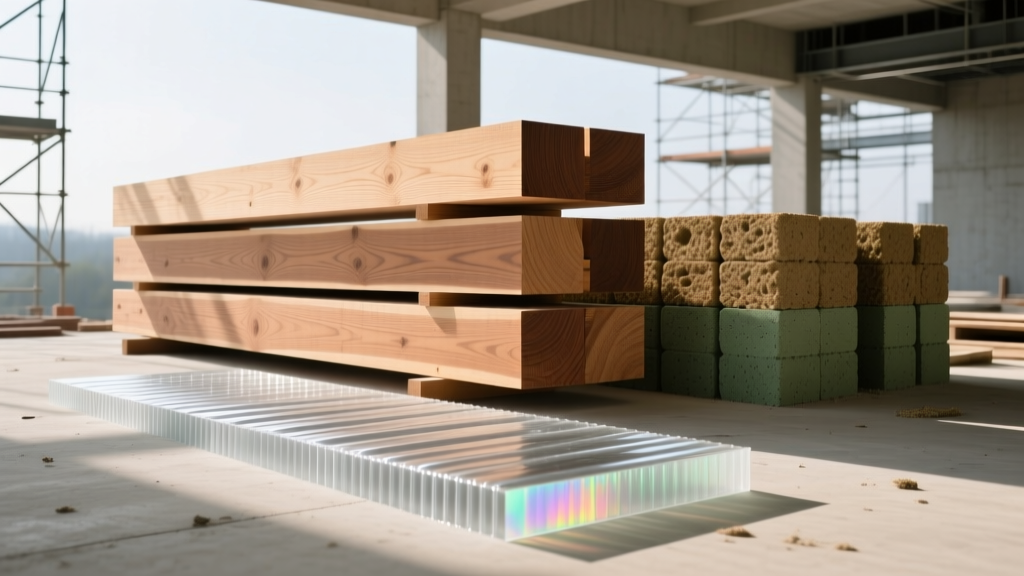
Deep Dive: Silica Aerogel Insulation Blankets
Aerogels, composed of over 90% air trapped in a nanoporous silica matrix, represent the pinnacle of space-saving thermal resistance. Products like Spaceloft aerogel blankets deliver an R-value of roughly R-10 per inch—more than double that of closed-cell spray foam and nearly triple that of fiberglass batts.
Space-Saving Thermal Resistance
According to research highlighted by Building Science Corporation, aerogel's true advantage emerges in space-constrained retrofits. In historical masonry buildings where adding 4 inches of rigid foam to the interior would destroy architectural detailing and reduce usable floor space, a 40mm (1.5-inch) layer of aerogel blanket provides the necessary R-15 thermal break to prevent interior condensation and meet modern energy codes without altering interior dimensions.
Pros
- Unmatched R-value per inch (R-10/inch).
- Hydrophobic yet vapor-permeable, allowing walls to dry to the interior or exterior.
- Flexible blanket format conforms to irregular surfaces, pipes, and complex framing.
Cons
- High material cost ($5 to $8 per square foot for the blanket alone).
- Requires careful handling; cutting aerogel generates fine silica dust that mandates PPE (N95 respirators and eye protection) during installation.
Decision Framework: Which Material Fits Your Build?
Selecting from the latest building materials requires aligning the material's physical properties with your project's primary constraints. Use this framework to guide your specification:
- Prioritizing Speed to Market & Biophilia: Specify CLT. The prefabrication allows the structural shell to be erected in weeks rather than months, and the exposed timber interior eliminates the need for drywall and paint trades.
- Targeting Net-Zero & Moisture Resilience: Specify Hempcrete Blocks. Ideal for custom residential builds in mixed-humid climates where managing vapor drive is more critical than achieving maximum theoretical R-values.
- Building Below-Grade or High-Exposure Flatwork: Specify Self-Healing Bio-Concrete. The slight upfront premium prevents catastrophic water intrusion and rebar corrosion in basements, podium decks, and driveways.
- Executing Historic Retrofits or Space-Constrained Additions: Specify Aerogel Blankets. When every inch of interior square footage counts, or when exterior insulation is prohibited by historic preservation boards, aerogel is the only viable code-compliant solution.
Sourcing and Supply Chain Realities
While these materials offer superior performance, procurement requires proactive planning. CLT and hempcrete blocks are heavily reliant on specialized regional manufacturers; securing a production slot often requires finalizing structural drawings 12 to 16 weeks before groundbreaking. Self-healing concrete additives must be ordered directly from specialized chemical suppliers and shipped to your local ready-mix batch plant for integration. Aerogel blankets, while more widely distributed through commercial insulation suppliers, frequently face backorders due to high demand from the commercial piping and industrial sectors. Engaging with suppliers during the schematic design phase, rather than waiting for the CD (Construction Documents) phase, is mandatory to avoid value-engineering these advanced materials out of your project.
Written by
Sarah WhitfieldSarah Whitfield is a chartered quantity surveyor (MRICS) and construction cost analyst with 15 years of experience in material pricing, procurement strategy, and project budgeting. She earned her degree in Construction Management from the University of Reading (UK) and has worked on projects ranging from $2M custom homes to $180M mixed-use developments across North America and Europe. Sarah currently leads cost estimating for BuildMat Insight, maintaining a proprietary database of 4,000+ material price points updated quarterly. She is a frequent contributor to RSMeans cost data panels and has presented at the International Cost Engineering Council (ICEC) congress. Based in Denver, CO, Sarah is an avid trail runner and volunteer mentor for Women in Construction.
More from Sarah Whitfield
View all
Wood & Lumber
What Are the Different Types of Wood? A Builder's Guide
Compare structural softwoods, finish hardwoods, and engineered lumber. Analyze Janka ratings, MOE values, and 2026 pricing for construction.
Aug 4, 2026

Walls & Panels
Steel Framing vs Wood Framing: Corrosion and Moisture Defense
Compare steel framing vs wood framing for moisture resistance. Learn about galvanized coatings, condensation risks, and corrosion protection strategies.
Jul 21, 2026

Stone & Masonry
How to Cut Stone Veneer: Wet Saw vs Grinder Comparison
Compare the best tools for cutting stone veneer. We review wet saws, angle grinders, and chop saws to help you achieve clean, chip-free cuts.
Jul 21, 2026