Lyndon Building Materials: A Sourcing Guide for Lyndon, KS Projects
Comprehensive guide to sourcing building materials in Lyndon, KS. Covers regional wind codes, rural delivery logistics, and local supply chains.

Navigating Osage County Building Codes & Climate Extremes
Constructing in Lyndon, Kansas, requires a precise understanding of the regional climate and structural mandates enforced in Osage County. The area is characterized by severe temperature fluctuations, expansive clay soils, and high-wind events. Sourcing the correct building materials begins with aligning your supply list to these environmental realities.
Wind Load and Structural Sheathing
Lyndon falls under the 115 mph Ultimate Design Wind Speed (Vult) zone for Risk Category II structures per ASCE 7-22 standards. This baseline dictates your sheathing and fastening requirements. When ordering structural panels from local suppliers, specify 7/16-inch OSB Structural I rather than standard oriented strand board. Structural I provides higher shear capacity. For roof sheathing in this wind zone, mandate 8d ring-shank nails (hot-dipped galvanized per ASTM A153) spaced at 6 inches on center at panel edges and 12 inches in the field. Standard smooth-shank nails will fail under cyclic wind uplift.
Frost Depth and Concrete Specifications
The frost line in Osage County is established at 30 inches. Footings for residential and light commercial builds must extend below this depth to prevent frost heave. When ordering ready-mix concrete from regional batch plants, specify a 4,000 PSI mix with 5% to 7% air-entrainment. The air-entrainment creates microscopic voids that allow water to expand during Kansas freeze-thaw cycles without spalling the concrete surface. Standard 3,000 PSI non-air-entrained mixes will degrade within three to five winters.
ICC 500 Storm Shelter Materials
Given the region's tornado risk, integrating an ICC 500 compliant safe room is a critical value-add for new builds. According to FEMA safe room guidelines, cast-in-place concrete or reinforced concrete masonry units (CMU) are the standard. Source 6-inch CMU blocks, #5 Grade 60 vertical rebar spaced at 32 inches on center, and high-slump grout to ensure complete consolidation within the block cells.
Core Material Sourcing: Local Yards vs. Regional Hubs
Procuring building materials in Lyndon involves a strategic choice between local lumber yards and big-box retailers in Topeka or Kansas City. Local suppliers offer distinct advantages for heavy, high-volume items, while regional hubs may be necessary for specialized architectural finishes.
| Material Category | Local Lyndon Supplier | Regional Hub (Topeka/KC) | Sourcing Strategy |
|---|---|---|---|
| Dimensional Framing Lumber | High availability, bundled delivery | High availability, requires self-pickup or high freight fees | Buy local to eliminate last-mile freight surcharges. |
| Post-Frame Treated Posts | Specialized stock (UC4B/UC4C) | Limited stock, often mislabeled as above-ground | Strictly local; verify AWPA treatment tags on-site. |
| Custom Cabinetry & Millwork | Limited selection, long lead times | Extensive showrooms, dedicated delivery routes | Source regionally for better pricing and design options. |
| Metal Roofing (Ag/Resi) | Standard profiles (29/26 ga) | Custom colors, standing seam fabrication | Local for exposed fastener; regional for standing seam. |
Post-Frame & Agricultural Construction Standards
Post-frame (pole barn) construction dominates the rural landscape surrounding Lyndon. The National Frame Building Association outlines strict material standards for these structures, particularly regarding wood decay and wind resistance. The most common material failure in rural Kansas ag buildings is post rot at the ground line.
Roofing Gauge Selection
For agricultural and storage buildings, 29-gauge Galvalume corrugated panels are frequently used due to lower upfront costs. However, for any structure housing livestock, expensive equipment, or serving as a primary workshop, upgrade to 26-gauge Galvalume. The 26-gauge steel offers a 30% increase in tensile strength, significantly reducing the risk of panel tearing at the fastener holes during 70+ mph straight-line winds common in late spring.
Rural Logistics & 'Last Mile' Delivery Realities
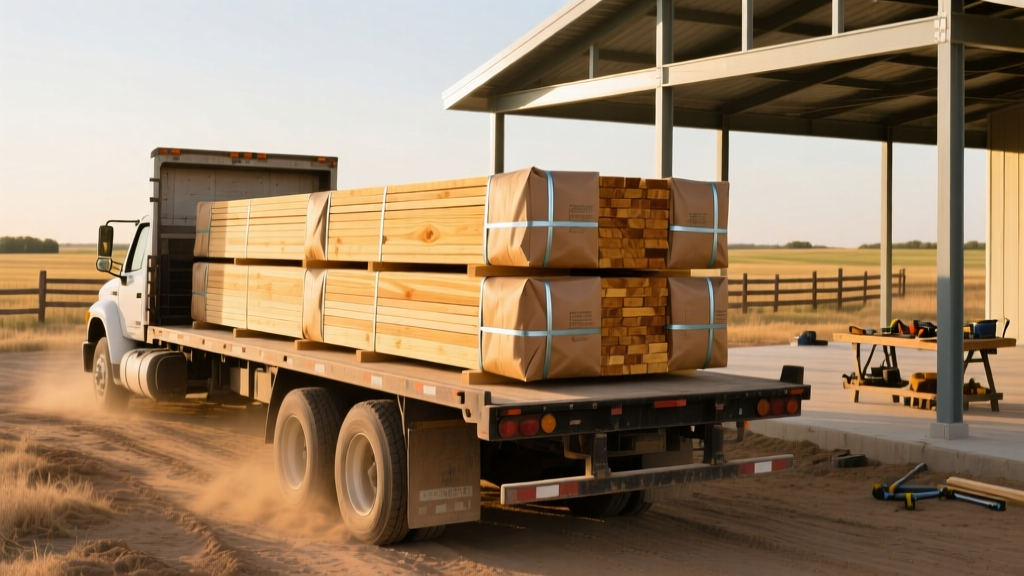
Sourcing the right materials is only half the battle; getting them to a rural Lyndon job site requires logistical foresight. Big-box delivery trucks are typically 53-foot semi-trailers or rigid box trucks that cannot navigate soft shoulders, tight county road turns, or unplowed rural routes.
- Site Access Preparation: Ensure a minimum 40-foot turning radius at the site entrance. If the driveway is newly graded, lay down a 4-inch base of crushed limestone (Class 5) to support the 80,000-pound gross vehicle weight of a loaded flatbed.
- Offload Equipment: Local building material yards typically use boom trucks (knuckleboom cranes) for offloading. Specify the exact drop zone on your site plan. Boom trucks generally have a 25- to 35-foot reach; placing your drop zone further away will require a separate telehandler or forklift on-site.
- Weather Delays: Tarping fees and load-securement protocols change during high-wind warnings. Schedule heavy lumber deliveries for early morning windows when Kansas wind speeds are historically lowest.
2026 Pricing Trends & Budgeting for Rural Builds
Material pricing in the Midwest has stabilized compared to the volatile pandemic years, but regional freight costs remain a significant factor for Lyndon projects. When budgeting your 2026 builds, use these baseline metrics to prevent cost overruns:
| Material | Specification | Estimated 2026 Unit Cost |
|---|---|---|
| Framing Lumber | #2 Grade SYP 2x4x8 | $3.85 - $4.40 per piece |
| Ready-Mix Concrete | 4,000 PSI, 5% Air (Delivered) | $145 - $165 per cubic yard |
| Architectural Shingles | Algae-Resistant, Class 4 Impact | $55 - $70 per square (100 sq ft) |
| Post-Frame Columns | 3-Ply 2x6 UC4B Treated (16ft) | $85 - $110 per column |
Note: Class 4 impact-resistant shingles (tested per UL 2218) are highly recommended in Osage County. While they carry a 20% premium over standard architectural shingles, many Kansas insurance providers offer substantial premium discounts that offset the material cost within three years.
Project Planning Checklist for Lyndon Builders
Execute this sequence to optimize your material procurement and site readiness:
- Verify Soil Borings: Before ordering concrete or foundation materials, confirm expansive clay presence. If clay is present, budget for a 4-inch void form or structural slab engineering.
- Lock in Lead Items: Custom trusses, specialized doors, and standing-seam metal roofing currently carry 4- to 8-week lead times in the Kansas market. Order these before breaking ground.
- Audit Treatment Tags: Upon delivery, physically inspect the AWPA tags on all pressure-treated lumber. Reject any ground-contact posts lacking the UC4B/UC4C designation.
- Coordinate Flatbed Access: Walk the delivery route with your site superintendent 48 hours before the first major material drop to identify low-hanging wires or soft ground.
Written by
Elena RodriguezElena Rodriguez is a civil engineer and technical writer specializing in concrete technology, masonry systems, and ASTM/ACI compliance. She earned her B.S. in Civil Engineering from Texas A&M University and spent a decade at a materials testing laboratory, performing over 2,000 concrete compressive strength tests and masonry prism evaluations. Elena is an ACI-certified Field Testing Technician (Grade I) and a member of ASTM Committee C12 on Natural Building Stone. She currently consults on forensic engineering cases involving concrete failures and moisture intrusion. Based in San Antonio, TX, Elena is a proud member of the Society of Women Engineers (SWE) and coaches her daughter's FIRST Robotics team.
More from Elena Rodriguez
View all
Walls & Panels
Cost Analysis: Light Gauge Steel Framing Advantages and Disadvantages
Evaluate light gauge steel framing advantages and disadvantages through a strict cost analysis lens, comparing material, labor, and lifecycle expenses.
Aug 4, 2026

Walls & Panels
Gypsum Board Types: Exact Specifications, Thickness & Dimensions
Compare standard, Type X, and moisture-resistant gypsum board types. Get exact specifications, thicknesses, dimensions, and ASTM standards for your project.
Aug 4, 2026

Fire Resistance
Best Fire-Resistant Outdoor Decking Materials: 2026 Buyer Guide
Discover the best fire-resistant outdoor decking materials for 2026. Compare Class A PVC, aluminum, and hardwood options for WUI compliance and safety.
Aug 4, 2026