Sourcing Salvage Building Materials in Winston Salem NC
Discover how to source, inspect, and price salvage building materials in Winston Salem NC, from reclaimed heart pine to historic brick.

The Architectural Heritage Driving the Local Salvage Market
Winston-Salem possesses a uniquely dense concentration of late 19th and early 20th-century industrial and residential architecture. From the expansive R.J. Reynolds tobacco warehouses to the historic Moravian settlements and the Victorian-era homes of the West End district, the city's built environment provides a continuous supply of high-grade, salvageable building materials. As adaptive reuse projects and historic renovations accelerate across Forsyth County in 2026, understanding the local salvage ecosystem is critical for contractors, architects, and homeowners seeking authentic materials that new manufacturing simply cannot replicate.
Salvaging materials in this region is not merely an aesthetic choice; it is a structural and environmental strategy. Reclaiming old-growth timber and locally fired masonry diverts thousands of tons of debris from the Hanes Road Landfill while preserving the embodied carbon of the original structures. According to the Building Materials Reuse Association, deconstruction and salvage can divert up to 90% of a building's materials from landfills, a metric that is increasingly driving municipal sustainability incentives.
Core Salvage Materials Available in the Triad Region
The Triad region yields specific material profiles dictated by its history. When hunting for salvage building materials in Winston Salem NC, these three categories dominate the market and require specialized knowledge to evaluate.
1. Longleaf Heart Pine (Pinus palustris)
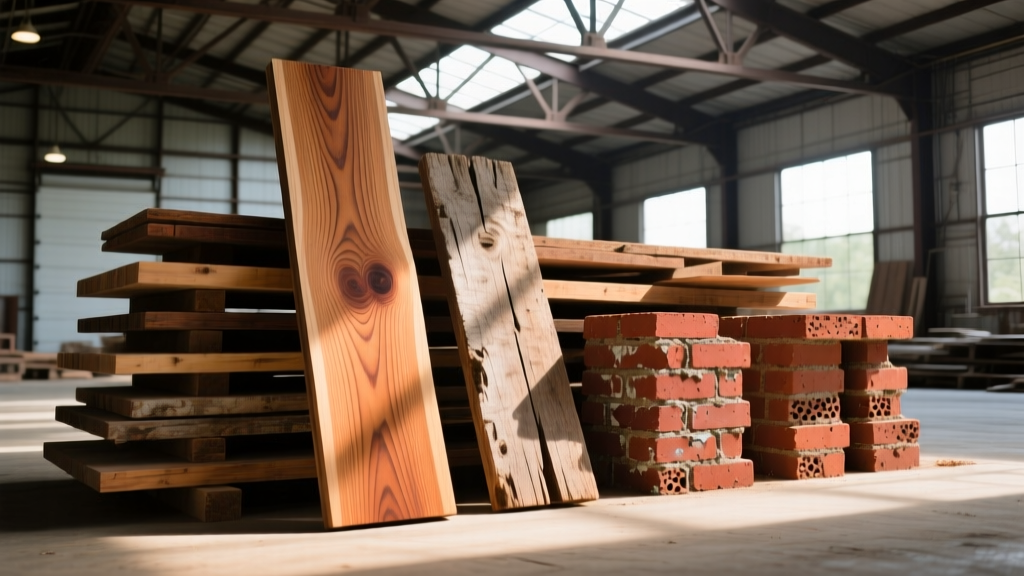
Sourced primarily from demolished textile mills, tobacco processing facilities, and early 1900s farmsteads, antique longleaf heart pine is the most sought-after reclaimed wood in North Carolina. True antique heart pine must exhibit a minimum of six to eight growth rings per inch and contain at least 65% heartwood. With a Janka hardness rating of 1,225 lbf, it is significantly harder and more dimensionally stable than modern southern yellow pine. When milled for flooring, salvaged heart pine offers a tight, vertical grain pattern and deep amber patina that new-growth timber cannot match.
2. Historic Moravian and Regional Clay Brick
Winston-Salem's early brick structures were built using locally sourced clay, fired in traditional beehive kilns. These soft-mud bricks are highly porous and possess a compressive strength ranging from 1,200 to 2,500 psi, which is substantially lower than modern extruded face brick (often exceeding 8,000 psi). Critical Edge Case: If you are sourcing salvaged brick for repointing or exterior repair, you must never use modern Portland cement-based mortars (Type S or N). The rigid cement will trap moisture and cause the soft historic bricks to spall and crack during freeze-thaw cycles. The National Park Service Preservation Brief on Repointing Mortar Joints mandates the use of Type O mortar or pure lime putty for historic masonry to allow for proper vapor transmission and flexibility.
3. Industrial Cast Iron and Architectural Hardware
The city's industrial boom left behind a wealth of heavy-duty architectural hardware. Salvage yards frequently stock cast-iron transom hinges, mortise locksets with brass or bronze faceplates, and heavy timber framing hardware (such as wrought-iron strap hinges and lag screws) pulled from warehouse conversions. These pieces are often sand-cast and feature machining tolerances that differ from modern stamped hardware, requiring custom carpentry adjustments during reinstallation.
Where to Source Salvage Building Materials in Winston Salem NC
Finding high-quality salvage requires moving beyond standard retail and tapping into local deconstruction networks. Here is the primary sourcing framework for the area:
- Habitat for Humanity ReStore: Located on Ogburn Ave, this facility handles high volumes of residential teardown materials. It is the best entry point for salvaged doors, vintage trim, cast-iron radiators, and basic dimensional lumber. Inventory turns over weekly, requiring frequent visits.
- Specialized Architectural Salvage Dealers: Regional dealers focus on premium extractions from commercial demolitions. They typically kiln-dry and metal-detect reclaimed flooring before sale, commanding a premium but saving contractors dozens of hours in prep work.
- Direct Demolition Networking: The most cost-effective method for sourcing bulk materials (like brick or heavy timber beams) is to establish relationships with local Forsyth County demolition contractors. By arriving on-site during the soft-strip phase of a teardown in neighborhoods like Ardmore or Buena Vista, you can negotiate direct purchase of materials before they are crushed or hauled away.
When contracting a demolition crew for a renovation, include a 'soft-strip preservation clause' in your agreement. This legally requires the crew to manually remove and stack specific materials (like heart pine subflooring or beadboard) using pry bars rather than heavy machinery, preserving the tongue-and-groove integrity for reuse.
Material Inspection and Remediation Framework
Salvaged materials carry inherent risks that must be mitigated before installation. Use this technical inspection framework to evaluate potential purchases.
Moisture and Biological Threats in Reclaimed Wood
Wood stored in unconditioned salvage yards will acclimate to ambient humidity. Before purchasing reclaimed flooring or structural beams, use a pinless moisture meter to verify the moisture content (MC). For interior installations in the humid North Carolina climate, the MC must be between 8% and 12%. Additionally, inspect end-grains for the frass (sawdust-like droppings) indicative of powderpost beetles, a common pest in southern pine that can emerge years after installation if the wood was not properly kiln-dried to 135°F for a minimum of 72 hours.
Lead Paint and Asbestos in Salvaged Goods
Any salvaged painted trim, doors, or windows originating from structures built before 1978 must be treated as lead-bearing. The EPA guidelines on lead paint and historic preservation recommend professional XRF (X-ray fluorescence) testing for bulk quantification, though 3M LeadCheck swabs are acceptable for basic presence testing. If lead is confirmed, the material must either be professionally stripped via chemical or infrared methods, or encapsulated. Never dry-sand or power-plane salvaged lead-painted wood on-site.
Cost Matrix: Reclaimed vs. New Reproduction Materials
Understanding the financial trade-offs between authentic salvage and modern reproductions is vital for project budgeting. The table below outlines average 2026 market rates for the Triad region.
| Material Type | Authentic Salvage Cost | New / Reproduction Cost | Primary Cost Driver for Salvage |
|---|---|---|---|
| Heart Pine Flooring (T&G) | $9.50 - $16.00 / sq ft | $4.50 - $7.50 / sq ft | De-nailing, kiln-drying, and milling waste |
| Soft-Mud Clay Brick | $0.85 - $1.40 / brick | $0.45 - $0.65 / brick | Manual mortar removal and palletizing |
| Solid Core Wood Doors (80x32) | $150 - $350 / door | $250 - $500 / door | Salvage is often cheaper; requires hinge mortise patching |
| Slate Roofing Tiles | $3.00 - $6.00 / sq ft | $12.00 - $18.00 / sq ft | High breakage rate during extraction; requires acoustic testing |
Navigating Forsyth County Building Codes with Salvaged Goods
When integrating salvage building materials in Winston Salem NC into permitted construction, Forsyth County Building Inspections enforces the North Carolina State Building Code. The primary regulatory hurdle involves structural lumber.
Under the International Existing Building Code (IEBC), which North Carolina adopts, reclaimed timber cannot be used for load-bearing structural framing (such as floor joists, headers, or roof rafters) unless it is visually stress-graded and stamped by an accredited lumber grading agency. Because most salvage yards do not employ certified graders, salvaged beams are generally restricted to non-structural, decorative applications (e.g., mantels, exposed faux beams, or interior cladding). If structural reuse is mandatory, you must hire a licensed structural engineer to perform in-situ stress testing and provide a stamped engineering letter to the local building inspector.
Frequently Asked Questions
Can I use salvaged brick for a structural foundation or retaining wall?
No. Historic soft-mud bricks lack the compressive strength and freeze-thaw durability required for below-grade structural applications or retaining walls. They should be strictly limited to above-grade veneer, interior accent walls, or non-load-bearing partitions.
How do I match salvaged trim to existing historic profiles?
If the salvage yard does not have the exact profile, take a 12-inch cross-section of the original trim to a custom millwork shop in the Triad. They will use a profile grinder to create custom router bits that perfectly replicate the historic ogee or bead profiles, allowing you to blend new and salvaged pieces seamlessly.
Is it safe to use salvaged plumbing fixtures?
Salvaged cast-iron clawfoot tubs and porcelain sinks are generally safe and highly durable. However, avoid salvaging vintage brass valves or galvanized steel supply lines, as they are prone to internal corrosion, lead leaching, and catastrophic failure under modern municipal water pressures (typically 60-80 psi in Winston-Salem).
Written by
Elena RodriguezElena Rodriguez is a civil engineer and technical writer specializing in concrete technology, masonry systems, and ASTM/ACI compliance. She earned her B.S. in Civil Engineering from Texas A&M University and spent a decade at a materials testing laboratory, performing over 2,000 concrete compressive strength tests and masonry prism evaluations. Elena is an ACI-certified Field Testing Technician (Grade I) and a member of ASTM Committee C12 on Natural Building Stone. She currently consults on forensic engineering cases involving concrete failures and moisture intrusion. Based in San Antonio, TX, Elena is a proud member of the Society of Women Engineers (SWE) and coaches her daughter's FIRST Robotics team.
More from Elena Rodriguez
View all
Walls & Panels
Cost Analysis: Light Gauge Steel Framing Advantages and Disadvantages
Evaluate light gauge steel framing advantages and disadvantages through a strict cost analysis lens, comparing material, labor, and lifecycle expenses.
Aug 4, 2026

Walls & Panels
Gypsum Board Types: Exact Specifications, Thickness & Dimensions
Compare standard, Type X, and moisture-resistant gypsum board types. Get exact specifications, thicknesses, dimensions, and ASTM standards for your project.
Aug 4, 2026

Fire Resistance
Best Fire-Resistant Outdoor Decking Materials: 2026 Buyer Guide
Discover the best fire-resistant outdoor decking materials for 2026. Compare Class A PVC, aluminum, and hardwood options for WUI compliance and safety.
Aug 4, 2026