Best Aerospace Composite Materials for Aircraft Manufacturing in 2026
Compare the best aerospace composite materials for aircraft manufacturing in 2026, including CFRP, CMC, and AFRP performance and cost data.

The Structural Shift in Modern Airframe Engineering
The transition from monolithic aluminum alloys to advanced composite structures represents the most significant materials engineering shift in commercial aviation history. Modern widebody platforms, such as the Boeing 787 and Airbus A350, utilize composite materials for over 50% of their primary structural weight. For aerospace manufacturing engineers and procurement specialists in 2026, selecting the optimal composite requires balancing specific strength, fatigue resistance, damage tolerance, and out-of-autoclave (OOA) processing viability. This review evaluates the premier aerospace composite materials currently dominating airframe, empennage, and hot-section manufacturing.
Performance Matrix: Primary Aerospace Composites
The selection of a composite system hinges on the specific mechanical and thermal demands of the aircraft zone. The matrix below outlines the baseline engineering properties of the four dominant material families used in modern aircraft manufacturing.
| Material Family | Tensile Strength (MPa) | Density (g/cm³) | Max Operating Temp (°C) | Primary Airframe Application |
|---|---|---|---|---|
| CFRP (Epoxy Matrix) | 2,100 - 2,800 | 1.55 - 1.62 | 120 - 180 | Fuselage barrels, wing skins, spars |
| CFRP (BMI Matrix) | 1,900 - 2,500 | 1.58 - 1.65 | 230 - 280 | Engine nacelles, pylons, hot-zone structures |
| AFRP (Aramid/Epoxy) | 1,400 - 1,800 | 1.35 - 1.40 | 150 - 175 | Radar domes, cabin flooring, impact zones |
| CMC (SiC/SiC) | 300 - 500 | 2.50 - 2.80 | 1,200 - 1,400 | Turbine shrouds, combustor liners, exhaust nozzles |
Carbon Fiber Reinforced Polymers (CFRP): The Airframe Standard
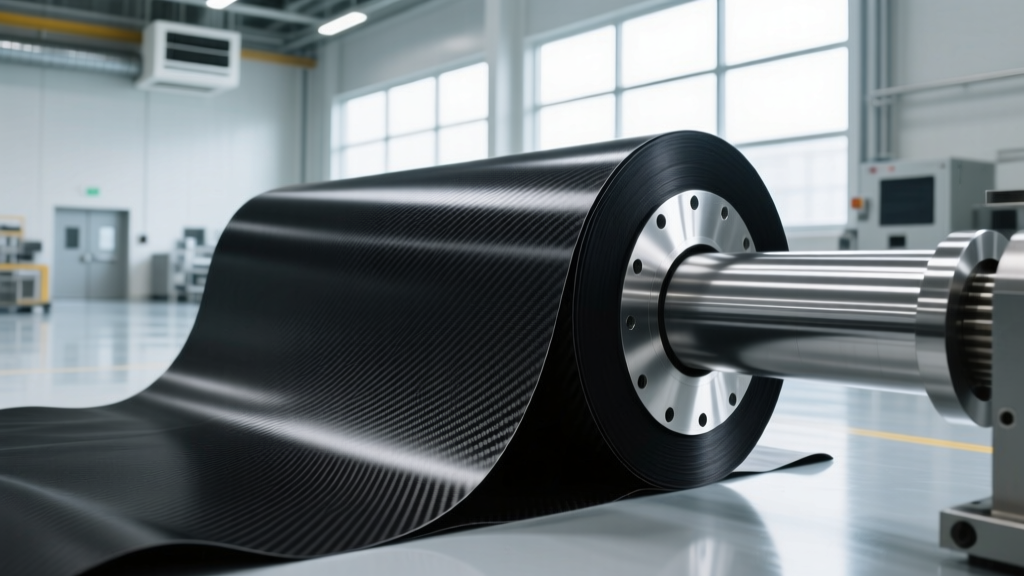
CFRP remains the undisputed baseline for primary load-bearing structures. The engineering focus in 2026 has shifted toward intermediate-modulus (IM) and high-strength (HS) continuous carbon fibers paired with toughened resin systems to improve impact damage resistance (BVID - Barely Visible Impact Damage).
Material Spotlight: Hexcel HexTow IM7 vs. Toray T800S
When specifying carbon fiber for wing spars and fuselage frames, manufacturers typically choose between Hexcel's IM7 and Toray's T800S. Both are intermediate-modulus fibers, but they exhibit distinct processing and mechanical behaviors.
- Hexcel HexTow IM7: Offers a tensile modulus of 276 GPa and exceptional compressive strength. It is the preferred choice for thick-section laminates where micro-cracking during the cure cycle is a primary concern. When paired with HexPly M21 toughened epoxy, it delivers industry-leading interlaminar fracture toughness.
- Toray T800S: Features a slightly higher tensile strength (5,880 MPa) compared to IM7, making it ideal for tension-dominated structures like fuselage skin panels. Its surface sizing is highly optimized for automated fiber placement (AFP) machines, reducing tack-loss during high-speed layup.
Aramid and Glass Fibers: Niche but Critical Applications
While carbon fiber handles primary loads, Aramid Fiber Reinforced Polymers (AFRP) and Glass Fiber Reinforced Polymers (GFRP) solve specific electromagnetic and impact challenges that CFRP cannot address.
AFRP for Electromagnetic Transparency and Impact
Carbon fiber is highly conductive, which interferes with radar and radio frequencies. For radomes and antenna enclosures, manufacturers rely on DuPont Kevlar 129 or Teijin Twaron. AFRP provides high specific strength while remaining completely transparent to electromagnetic waves. Furthermore, aramid's high energy-absorption capacity makes it the standard for cargo hold liners and engine containment rings to prevent uncontained rotor burst fragments from penetrating the cabin.
Aramid fibers are hygroscopic and can wick moisture along the fiber-matrix interface if exposed edges are not properly sealed. In 2026 manufacturing protocols, all AFRP components must be encapsulated with a polyurethane or fluoropolymer edge sealer to prevent hydrolytic degradation of the epoxy matrix during high-altitude humidity cycling.
S-2 Glass for Lightning Strike Protection (LSP)
Because CFRP fuselages lack the natural conductivity of aluminum, they require integrated Lightning Strike Protection. S-2 Glass fibers, woven with microscopic copper or bronze wires, are increasingly used in the outermost ply of the fuselage skin. This hybrid GFRP/metallic mesh dissipates the 200,000-ampere surge of a lightning strike without delaminating the underlying carbon plies.
Ceramic Matrix Composites (CMC): The Hot Section Revolution
The most aggressive material advancement in modern aerospace manufacturing is the integration of Ceramic Matrix Composites in the engine hot section. Traditional nickel-based superalloys reach their melting limits near 1,100°C, requiring heavy, parasitic cooling air that reduces engine efficiency.
Silicon Carbide fiber-reinforced Silicon Carbide matrix (SiC/SiC) composites operate continuously at 1,300°C to 1,400°C. According to FAA Advisory Circular 20-107B guidelines on advanced composite structures, the certification of CMCs requires rigorous environmental barrier coating (EBC) validation to prevent oxidation of the SiC fibers in high-velocity combustion gas streams.
Manufacturing Reality: CMCs are not laid up like polymer composites. They require Chemical Vapor Infiltration (CVI) or Polymer Infiltration and Pyrolysis (PIP). The manufacturing cycle for a single CMC turbine shroud can exceed 400 hours, making supply chain bottlenecks the primary constraint for next-generation jet engine production rates in 2026.
2026 Procurement and Cost Analysis
The pricing landscape for aerospace-grade prepregs has stabilized following the supply chain shocks of the early 2020s, but energy-intensive curing processes and raw polyacrylonitrile (PAN) precursor costs keep prices elevated.
| Material Specification | Estimated 2026 Cost (USD/kg) | Lead Time | Shelf Life (at -18°C) |
|---|---|---|---|
| Standard Modulus CFRP Prepreg (12K Tow) | $140 - $180 | 12 - 16 Weeks | 12 Months |
| Intermediate Modulus CFRP (Toughened Epoxy) | $220 - $290 | 16 - 24 Weeks | 6 - 9 Months |
| BMI Matrix Prepreg (High-Temp) | $350 - $450 | 20 - 30 Weeks | 6 Months |
| SiC/SiC CMC Preform (Raw) | $1,200 - $1,800 | 6 - 12 Months | Indefinite (Pre-infiltration) |
Procurement teams must also factor in the hidden costs of cold-chain logistics. Aerospace prepregs degrade rapidly at room temperature. The out-time (the cumulative hours the material spends above freezing before curing) must be strictly tracked via RFID sensors embedded in the shipping reels, a standard practice enforced by Tier 1 aerostructure manufacturers.
Decision Framework: Selecting the Optimal Composite System
Choosing the right material requires a systematic evaluation of the component's operational environment and manufacturing constraints. Use the following framework during the preliminary design phase:
- Define the Thermal Envelope: If the component operates below 120°C, standard toughened epoxy CFRP is the most cost-effective choice. If ambient temperatures exceed 180°C (e.g., near engine pylons or auxiliary power units), BMI or Polyetheretherketone (PEEK) thermoplastic matrices are mandatory.
- Assess Damage Tolerance Requirements: For lower fuselage panels prone to runway debris impact, specify high-strain-to-failure fibers (like Toray T1100G) paired with nano-toughened resins to maximize Compression After Impact (CAI) strength.
- Evaluate Manufacturing Geometry: Deep-draw components with complex double-curvature geometries are prone to fiber wrinkling during AFP layup. For these parts, consider transitioning to 3D-woven preforms infused via Resin Transfer Molding (RTM), which eliminates delamination risks in thick, complex joints.
- Analyze Certification Pathways: As noted in NASA's advanced materials research directives, novel thermoplastic composites face steeper certification hurdles than heritage thermoset epoxies due to a lack of long-term fatigue databases. Factor an additional 18-24 months into the program schedule for full-scale static and fatigue testing of non-standard material systems.
The mastery of aircraft manufacturing in 2026 is no longer just about laying down carbon fiber; it is about precision resin chemistry, automated layup kinematics, and rigorous thermal management during the cure cycle. By aligning specific fiber architectures with advanced matrix systems, engineering teams can push the boundaries of payload capacity and fuel efficiency far beyond the limits of traditional metallurgy.
Written by
Elena RodriguezElena Rodriguez is a civil engineer and technical writer specializing in concrete technology, masonry systems, and ASTM/ACI compliance. She earned her B.S. in Civil Engineering from Texas A&M University and spent a decade at a materials testing laboratory, performing over 2,000 concrete compressive strength tests and masonry prism evaluations. Elena is an ACI-certified Field Testing Technician (Grade I) and a member of ASTM Committee C12 on Natural Building Stone. She currently consults on forensic engineering cases involving concrete failures and moisture intrusion. Based in San Antonio, TX, Elena is a proud member of the Society of Women Engineers (SWE) and coaches her daughter's FIRST Robotics team.
More from Elena Rodriguez
View all
Walls & Panels
Cost Analysis: Light Gauge Steel Framing Advantages and Disadvantages
Evaluate light gauge steel framing advantages and disadvantages through a strict cost analysis lens, comparing material, labor, and lifecycle expenses.
Aug 4, 2026

Walls & Panels
Gypsum Board Types: Exact Specifications, Thickness & Dimensions
Compare standard, Type X, and moisture-resistant gypsum board types. Get exact specifications, thicknesses, dimensions, and ASTM standards for your project.
Aug 4, 2026

Fire Resistance
Best Fire-Resistant Outdoor Decking Materials: 2026 Buyer Guide
Discover the best fire-resistant outdoor decking materials for 2026. Compare Class A PVC, aluminum, and hardwood options for WUI compliance and safety.
Aug 4, 2026