What Is the Best Material for Kitchen Sink Builds? Technical Specs
Compare kitchen sink materials via technical specs. Analyze stainless steel gauges, fireclay thermal limits, and quartz composite load metrics.

The Metallurgy of Stainless Steel Sinks: Alloy and Gauge Metrics
When evaluating stainless steel, the critical specification is the alloy grade, not merely the finish. For kitchen environments, Type 304 (UNS S30400) is the mandatory baseline. This austenitic stainless steel contains 18% chromium and 8-10% nickel. The chromium forms a passive, self-healing oxide layer that prevents rust, while the nickel provides structural ductility and resistance to chloride-induced pitting—a common failure mode when sinks are exposed to hard water and dishwashing salts. Lower-tier alloys like Type 201 or Type 430 lack sufficient nickel and will inevitably develop micro-pitting and surface corrosion within 24 to 36 months in high-use environments. The Australian Stainless Steel Development Association details how the precise 18/8 ratio in Type 304 ensures long-term passivation in wet, chloride-rich settings.
Gauge Thickness and Deflection Tolerances
Gauge measures the thickness of the steel sheet before it is deep-drawn into the sink basin. The lower the gauge number, the thicker the steel. A 16-gauge sink measures 1.52mm (0.060 inches) thick, while an 18-gauge sink measures 1.27mm (0.050 inches). While a 0.25mm difference seems negligible, it drastically alters the moment of inertia and deflection resistance. When a 15-pound cast-iron skillet is dropped into an 18-gauge basin, the steel will visibly deflect and transmit acoustic energy into the cabinet cavity. A 16-gauge basin reduces this deflection by approximately 40%, maintaining structural rigidity under dynamic loads.
Ceramic Matrix Composites: Fireclay Vitrification
Fireclay is not simply painted ceramic; it is a vitrified composite. The manufacturing process blends kaolin clay, feldspar, and quartz, which is then fired in a kiln at temperatures exceeding 1600°C (2900°F). At this thermal threshold, the silica in the clay melts and fuses with the glaze, creating a single, non-porous, glass-like matrix. Unlike standard ceramic sinks where the glaze is a superficial coating prone to crazing and delamination, fireclay's surface is integral to the core.
Thermal Shock and Tensile Limitations
The primary technical advantage of fireclay is its extreme thermal shock resistance. The vitrified matrix can withstand a temperature differential (ΔT) of over 200°C without micro-fracturing, meaning pouring boiling pasta water directly over ice in the basin will not compromise the structural integrity. However, fireclay exhibits high compressive strength but low tensile strength. Its failure mode is brittle fracture from point-impact. Dropping a heavy, localized load (like the corner of a cast-iron Dutch oven) on the unsupported drain rim can exceed the material's tensile limit, resulting in catastrophic cracking rather than denting.
Quartz Composite: Polymer Resin Thresholds
Quartz composite sinks are engineered from approximately 80% crushed quartz sand and granite dust, bound together by 20% acrylic resin (typically Polymethyl Methacrylate, or PMMA). The quartz provides a Mohs hardness rating of 6 to 7, making the surface highly resistant to abrasion from steel wool and scouring pads. The PMMA resin provides the tensile flexibility that pure stone lacks, allowing the sink to absorb minor impacts without shattering.
The Glass Transition Vulnerability
The critical technical limitation of quartz composite is the thermal threshold of the PMMA binder. PMMA has a glass transition temperature (Tg) of approximately 105°C (221°F). If a roasting pan removed from a 230°C (450°F) oven is placed directly into a dry quartz sink, the localized heat exceeds the Tg of the resin. The acrylic softens, and the thermal expansion mismatch between the quartz aggregate and the resin causes permanent micro-cracking and surface whitening (often mistaken for hard water stains). Always run cold water to create a thermal buffer before introducing extreme heat.
Material Performance Matrix
The following matrix compares the core physical specifications of the four dominant kitchen sink materials. Data assumes a standard 30-inch single-bowl configuration.
| Material | Core Composition | Mohs Hardness | Max Thermal Shock (ΔT) | Avg. Weight | Cabinet Reinforcement |
|---|---|---|---|---|---|
| Type 304 Stainless (16ga) | 18% Cr / 8% Ni Austenitic | 5.5 | Unlimited | 18 lbs | None |
| Fireclay | Vitrified Kaolin / Feldspar | 6.0 | 200°C+ | 115 lbs | Mandatory (Plywood) |
| Quartz Composite | 80% Quartz / 20% PMMA | 6.5 | 105°C (Resin Limit) | 35 lbs | Recommended |
| Enameled Cast Iron | Gray Iron / Fused Silica | 5.0 (Enamel) | 150°C (Enamel Limit) | 125 lbs | Mandatory (Plywood) |
Enameled Cast Iron: Porcelain Fusion and Impact Tolerance
Cast iron sinks are manufactured using ASTM A48 Class 20 or 30 gray iron, chosen for its excellent vibration dampening and compressive strength. The enamel coating is not paint; it is a porcelain slip (silica, feldspar, borax, and clay) sprayed onto the iron and fired at 800°C to 850°C. This creates a chemical bond where the porcelain actually fuses into the microscopic pores of the iron.
According to the National Association of Home Builders (NAHB), enameled cast iron components boast a life expectancy exceeding 50 years, largely due to the incredible thickness of the underlying iron core. However, the enamel surface is highly susceptible to spalling. Because porcelain is essentially glass, it possesses high compressive strength but low tensile strength. An impact to the edge of the sink creates a tensile wave that exceeds the enamel's structural limit, causing it to chip and expose the underlying iron to rapid oxidation.
Technical Decision Framework: Matching Sink to Substructure
Selecting the optimal material requires aligning the sink's physical specifications with your cabinet's load-bearing capacity and your plumbing's vibration profile. The National Kitchen & Bath Association (NKBA) emphasizes that structural support planning must precede material selection to prevent long-term deflection and plumbing joint failure.
Substructure Verification Checklist
- Particleboard Cabinet Boxes: Restrict selection to 16-gauge stainless steel or lightweight quartz composites. Particleboard lacks the sheer strength to support the 100+ lb dead load of fireclay or cast iron, especially when combined with a garbage disposal's dynamic torque.
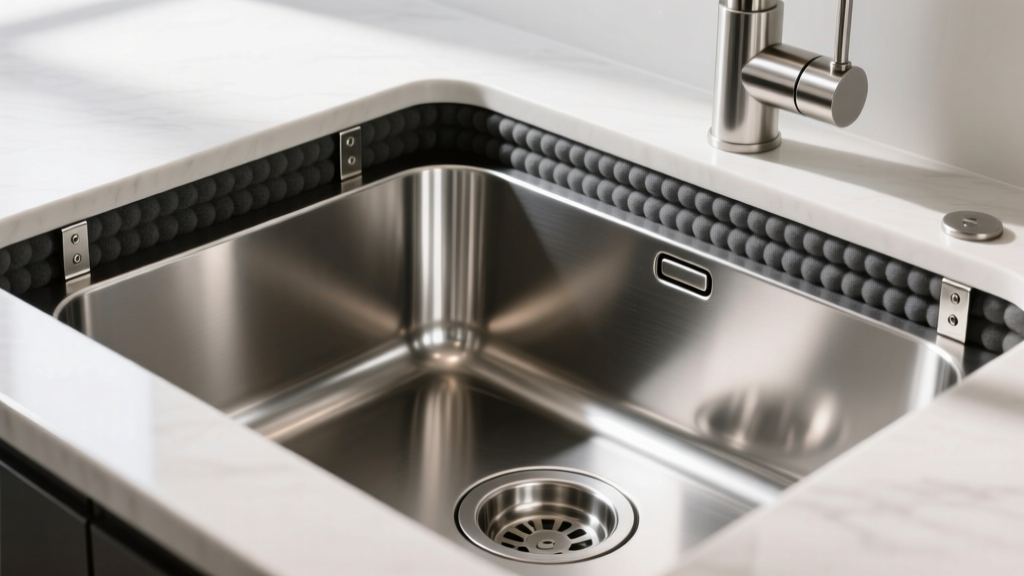
- Plywood or Solid Wood Boxes: Required for fireclay and cast iron. You must install a 3/4-inch plywood support ring or heavy-duty steel sink brackets directly into the cabinet's vertical stiles to transfer the load to the floor, bypassing the countertop entirely.
- Countertop Integration: For undermount installations of heavy materials, the countertop material must have high flexural strength. Quartz and granite are suitable, but laminate or thin marble will fracture under the sheer weight of a loaded fireclay basin.
- Plumbing Vibration: If installing an insulated garbage disposal, avoid thin 18-gauge stainless steel, which will act as a sounding board and amplify low-frequency motor hum. Opt for 16-gauge steel with spray-on sound-deadening undercoating, or transition to cast iron, which naturally dampens acoustic resonance.
Written by
Sarah WhitfieldSarah Whitfield is a chartered quantity surveyor (MRICS) and construction cost analyst with 15 years of experience in material pricing, procurement strategy, and project budgeting. She earned her degree in Construction Management from the University of Reading (UK) and has worked on projects ranging from $2M custom homes to $180M mixed-use developments across North America and Europe. Sarah currently leads cost estimating for BuildMat Insight, maintaining a proprietary database of 4,000+ material price points updated quarterly. She is a frequent contributor to RSMeans cost data panels and has presented at the International Cost Engineering Council (ICEC) congress. Based in Denver, CO, Sarah is an avid trail runner and volunteer mentor for Women in Construction.
More from Sarah Whitfield
View all
Wood & Lumber
What Are the Different Types of Wood? A Builder's Guide
Compare structural softwoods, finish hardwoods, and engineered lumber. Analyze Janka ratings, MOE values, and 2026 pricing for construction.
Aug 4, 2026

Walls & Panels
Steel Framing vs Wood Framing: Corrosion and Moisture Defense
Compare steel framing vs wood framing for moisture resistance. Learn about galvanized coatings, condensation risks, and corrosion protection strategies.
Jul 21, 2026

Stone & Masonry
How to Cut Stone Veneer: Wet Saw vs Grinder Comparison
Compare the best tools for cutting stone veneer. We review wet saws, angle grinders, and chop saws to help you achieve clean, chip-free cuts.
Jul 21, 2026