What Is the Best Material for Mortar and Pestle? A Materials Guide
Discover what is the best material for mortar and pestle by comparing granite, basalt, and ceramic hardness, porosity, and abrasion resistance.

The Intersection of Culinary Arts and Material Science
When evaluating what is the best material for mortar and pestle, the answer lies not in culinary tradition alone, but in geology and material science. A mortar and pestle is fundamentally a manual milling device. Its efficiency depends entirely on the compressive strength, abrasion resistance, and surface porosity of the stone or ceramic used to construct it. For professionals in the building materials and construction sectors, the metrics used to evaluate kitchen mortars—such as the Mohs hardness scale, water absorption rates, and mineral composition—are identical to those used when specifying natural stone for high-traffic commercial flooring or heavy-duty laboratory countertops.
Selecting the optimal material requires balancing surface friction against structural integrity. If the mortar material is softer than the spices or pigments being ground, the tool will degrade, shedding microscopic grit into the final product. Conversely, a material that is too dense and polished will fail to generate the necessary shear forces to fracture cellular walls in botanical ingredients. This comprehensive guide analyzes the geological properties of the most common mortar materials to determine their ideal applications.
Core Material Metrics: Hardness, Porosity, and Reactivity
Before comparing specific stones, it is critical to understand the three physical properties that dictate milling performance. According to Britannica's Mohs Hardness Scale, minerals are ranked from 1 (talc) to 10 (diamond). Black peppercorns and dried cumin seeds possess a surprisingly high structural resistance; grinding them effectively requires a mortar with a Mohs rating of at least 6.
Material Comparison Matrix
The following matrix contrasts the physical properties of the five most common materials used in mortar and pestle manufacturing. Data points reflect standard geological averages for unsealed, natural-state specimens.
| Material | Mohs Hardness | Porosity (Water Absorption) | Compressive Strength | Acid Reactivity |
|---|---|---|---|---|
| Granite (Quartz-heavy) | 6.0 - 7.0 | 0.1% - 0.5% | 180 - 250 MPa | Non-Reactive |
| Basalt (Vesicular) | 5.0 - 6.0 | 3.0% - 8.0% | 250 - 350 MPa | Low Reactivity |
| Marble (Calcite) | 3.0 - 4.0 | 0.5% - 2.0% | 100 - 150 MPa | Highly Reactive |
| High-Fired Ceramic | 6.5 - 7.5 | < 0.5% (Vitrified) | 300 - 500 MPa | Non-Reactive (Glazed) |
| Hardwood (Olive/Teak) | 1.5 - 2.5 | Variable (Hygroscopic) | 40 - 80 MPa | Non-Reactive |
Deep Dive: Evaluating the Top Contenders
1. Granite: The Heavy-Duty Standard
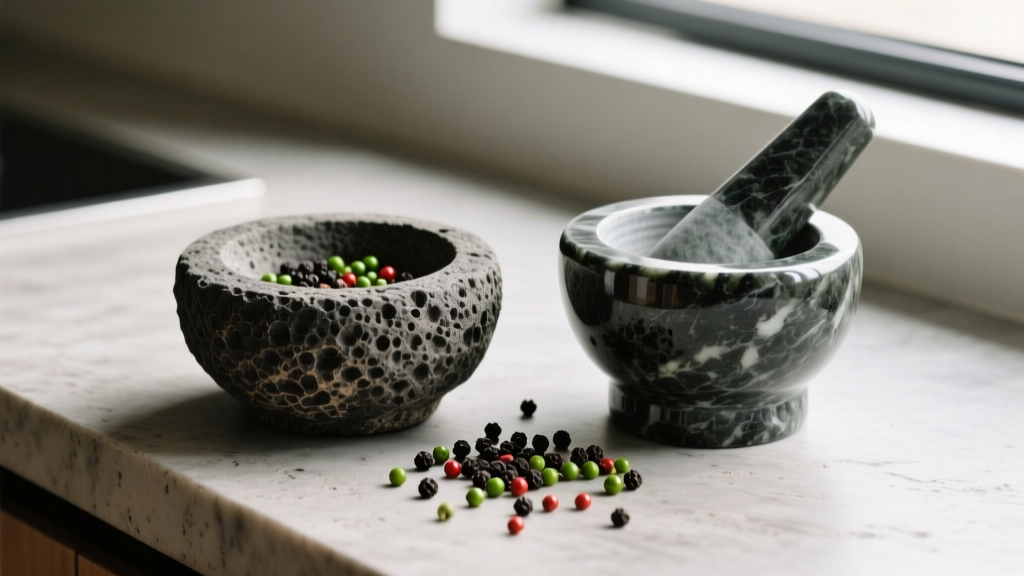
Granite is an igneous rock composed primarily of quartz and feldspar. Because quartz registers at a 7 on the Mohs scale, granite mortars easily outlast the botanical ingredients they crush. Thai-style granite mortars, often sourced from regions with high-quartz deposits, feature a deeply pitted, unpolished interior bowl that acts like a rasp. This texture creates immense shear force, making granite the undisputed champion for dry, fibrous, or exceptionally hard spices like nutmeg, cloves, and star anise. Its exceptionally low porosity (typically under 0.5%) means it resists oil absorption and bacterial harboring, aligning with FDA guidelines for safe food contact surfaces.
2. Basalt: The Traditional Vesicular Powerhouse
Basalt is a fine-grained volcanic rock. When used in traditional Mexican molcajetes, the basalt is highly vesicular, meaning it contains numerous small cavities formed by trapped gas bubbles during rapid cooling. These vesicles create a naturally rough, micro-serrated surface that is exceptional for grinding wet ingredients, tomatoes, and chilies into cohesive pastes. However, the high porosity of vesicular basalt requires rigorous 'seasoning' before first use to dislodge loose grit and seal the deepest pores. Structurally, basalt boasts higher compressive strength than granite, making it nearly indestructible under manual force.
3. Marble: Aesthetic Appeal with Chemical Vulnerabilities
Marble is a metamorphic rock composed of recrystallized carbonate minerals, primarily calcite. While visually stunning and heavy enough to remain stable on a countertop, marble is geologically unsuited for heavy milling. With a Mohs hardness of only 3 to 4, aggressive grinding of hard spices will slowly ablate the stone, introducing calcium carbonate grit into your food. Furthermore, calcite is highly reactive to acids. Natural Stone Institute guidelines explicitly warn that acidic compounds will etch calcium-based stones. Grinding lemon zest, sumac, or tomatoes in a marble mortar will chemically degrade the bowl's surface over time.
4. Advanced Ceramics and Porcelain
Modern high-fired ceramics, particularly alumina-toughened zirconia (ATZ) or fully vitrified porcelain, offer a non-porous, chemically inert alternative to natural stone. The vitrification process involves firing clay at temperatures exceeding 1,200°C, transforming it into a glass-like matrix with near-zero water absorption. Ceramic mortars often feature molded ridges on the interior to compensate for the lack of natural stone texture. They are ideal for pharmaceutical compounding, grinding toxic pigments, or processing highly acidic culinary ingredients where natural stone reactivity is a concern.
Never use a mortar with a lead-based or improperly fired decorative glaze. For culinary or chemical applications, ensure the ceramic is certified food-safe and features a hard, unglazed, textured milling surface (often called a 'bisque' finish) to provide adequate friction.
Porosity Management and the Seasoning Protocol
Any natural stone mortar with a porosity rating above 1% (such as basalt or lower-grade sandstone) requires surface stabilization before use. In construction, we seal natural stone facades to prevent spalling and water ingress. In the kitchen, we 'season' the stone using an abrasive sacrificial material.
- Initial Wash: Scrub the unseasoned mortar with warm water and a stiff natural-bristle brush. Do not use soap, as the porous stone will absorb the surfactants.
- Abrasive Milling: Add 1/4 cup of hard, cheap white rice to the bowl. Grind the rice in a circular motion, applying firm downward pressure with the pestle for 10 to 15 minutes.
- Inspection: Discard the rice flour. If the flour is gray or speckled with dark grit, the stone is still shedding loose mineral particles. Repeat the milling process with fresh rice until the resulting powder is pure white.
- Oil Sealing (Optional for Basalt): For highly vesicular basalt, grinding a few cloves of garlic and a pinch of coarse salt, followed by a light wipe with food-grade mineral oil, will condition the micro-pores and prevent flavor cross-contamination.
Expert Selection Framework: Which Material Should You Specify?
To determine the exact tool required for a specific workflow, apply the following decision matrix based on the material properties outlined above:
- For Dry, Hard Spices & Roots (Turmeric, Nutmeg, Peppercorns): Specify Unpolished Granite. The high quartz content prevents tool degradation, and the low porosity ensures volatile essential oils are not trapped in the stone matrix.
- For Wet Pastes, Salsas, and Emulsions (Curry Pastes, Guacamole): Specify Vesicular Basalt. The micro-cavities grip wet ingredients, preventing them from slipping away from the pestle, while the sheer mass of the stone keeps emulsions stable.
- For Acidic Compounds & Pharmaceutical/Chemical Milling: Specify Vitrified Ceramic (Bisque finish). Total chemical inertness guarantees no off-gassing, etching, or mineral contamination, regardless of the pH level of the milled substance.
- For Light-Duty Aromatic Bruising (Mint, Basil, Cardamom): Specify Hardwood (Olive or Teak). Wood is soft enough to bruise delicate cellular structures without shredding the leaves, preventing the release of bitter chlorophyll compounds.
Final Material Verdict
There is no single universal material; the optimal choice is strictly dictated by the physical properties of the target ingredient. However, if forced to select a single, highly versatile material that bridges the gap between heavy-duty dry milling and moderate wet pastes, high-density, unpolished granite remains the superior geological choice. Its unmatched Mohs hardness, minimal water absorption, and structural resilience make it the most reliable and sanitary natural stone for rigorous, daily milling applications.
Written by
David NakamuraDavid Nakamura is a licensed architect (AIA) and construction technology writer focused on sustainable building methods, mass timber engineering, and high-performance building envelopes. He holds a Master of Architecture from the University of Washington and is a certified Passive House Consultant (CPHC). David spent eight years at the Seattle firm Mithun, where he led the design of three LEED Platinum projects, before founding his own practice specializing in net-zero residential design. He serves on the editorial advisory board of GreenBuilder Magazine and has authored peer-reviewed papers on cross-laminated timber (CLT) connections for the Journal of Structural Engineering. In his spare time, David teaches woodworking at Pratt Fine Arts Center and kayaks the Puget Sound.
More from David Nakamura
View all
Construction Cost
Labor Cost to Build a Deck Per Sq Ft: 2026 Installation Guide
Discover the exact labor cost to build a deck per sq ft in 2026. This installation guide breaks down contractor rates, complexity factors, and hidden fees.
Aug 4, 2026

Construction Cost
How Much Does It Cost to Build a 3 Bedroom House? Financing Guide
Learn exactly how much it costs to build a 3 bedroom house and explore 2026 financing options, construction loan types, and budget frameworks for your build.
Aug 4, 2026

Construction Cost
Cost to Build a Tennis Court: 2026 Guide
How much does it cost to build a tennis court in 2026? Breakdowns for asphalt, concrete, and synthetic surfaces plus fencing and lighting.
Jul 30, 2026