Selecting the Best Material for a Scarf Joint in Timber Framing
Discover the best material for a scarf joint in structural timber framing, including top wood species, adhesives, and mechanical fastener specifications.

The Structural Role of Scarf Joints in Modern Timber Framing
In heavy timber construction and architectural millwork, continuous structural members often exceed the maximum available lengths of harvested lumber. To bridge this gap, engineers rely on the scarf joint—a specialized splicing technique that joins two timber ends at an angle to transfer axial, shear, and bending forces. When structural engineers and master framers evaluate the best material for a scarf joint, they are not looking at a single product. Instead, they must specify a tripartite material system: the timber substrate, the structural adhesive, and the mechanical reinforcement.
Selecting the wrong combination of these materials leads to catastrophic delamination under tensile loads or localized crushing under compression. As of 2026, the American Wood Council's National Design Specification (NDS) outlines strict parameters for timber splicing, demanding materials that maintain structural integrity across decades of hygrothermal cycling.
Wood Species Selection: The Foundation of a Strong Scarf
The timber substrate dictates the geometry, adhesive penetration, and fastener holding power of the scarf joint. High-density species offer superior shear resistance but complicate adhesive bonding due to tight grain structures and natural extractives.
| Species | Specific Gravity (SG) | Adhesive Compatibility | Best Structural Application |
|---|---|---|---|
| Douglas Fir-Larch | 0.50 | Excellent (PRF, Epoxy) | Primary roof trusses, tension splices |
| Southern Yellow Pine (SYP) | 0.55 | Good (Requires surface prep) | Heavy floor beams, compression posts |
| White Oak | 0.68 | Fair (High tannin/acid content) | Architectural millwork, historic restoration |
| Glulam (SPF/Douglas Fir) | 0.42 - 0.50 | Excellent (Factory PRF bonded) | Long-span commercial arches and beams |
Expert Insight: When scarfing Southern Yellow Pine, the high resin content can create a weak boundary layer. Best practice dictates wiping the mating surfaces with a fast-evaporating solvent like acetone immediately before adhesive application to remove surface exudates that would otherwise compromise the bond line.
Adhesives: Bonding Agents for Structural Splicing
The adhesive is the most critical material in a scarf joint. It must possess a shear strength equal to or greater than the wood itself (typically 1,500 to 2,500 psi for structural softwoods) while maintaining enough flexibility to accommodate the differential expansion between the timber and mechanical steel fasteners.
Phenol-Resorcinol-Formaldehyde (PRF)
PRF remains the undisputed gold standard for structural timber splicing. According to the USDA Forest Products Laboratory Wood Handbook, PRF adhesives produce bond lines that are highly resistant to water, heat, and chemical degradation. They routinely achieve 100% wood failure in shear testing, meaning the wood will splinter before the glue line fails. PRF requires tight joinery tolerances (gaps no larger than 1/32-inch) and significant clamping pressure (100-150 psi).
Structural Epoxies
For retrofit work, timber restoration, or site-built scarf joints where perfect clamping pressure is impossible, 100% solids structural epoxies (such as System Three T-88 or RotFix) are the best material choice. Epoxies are gap-filling (up to 1/4-inch) and do not require high clamping pressure. However, they are sensitive to temperature during the curing phase; in 2026, most structural epoxies require ambient temperatures above 50°F (10°C) to achieve full cross-linking.
Never use standard Polyvinyl Acetate (PVA) 'yellow carpenter's glue' or basic polyurethane glues for structural scarf joints. PVAs exhibit 'creep' under sustained structural loads and will slowly deform, leading to joint slippage and eventual structural failure in tension splices.
Mechanical Fasteners and Reinforcement Materials
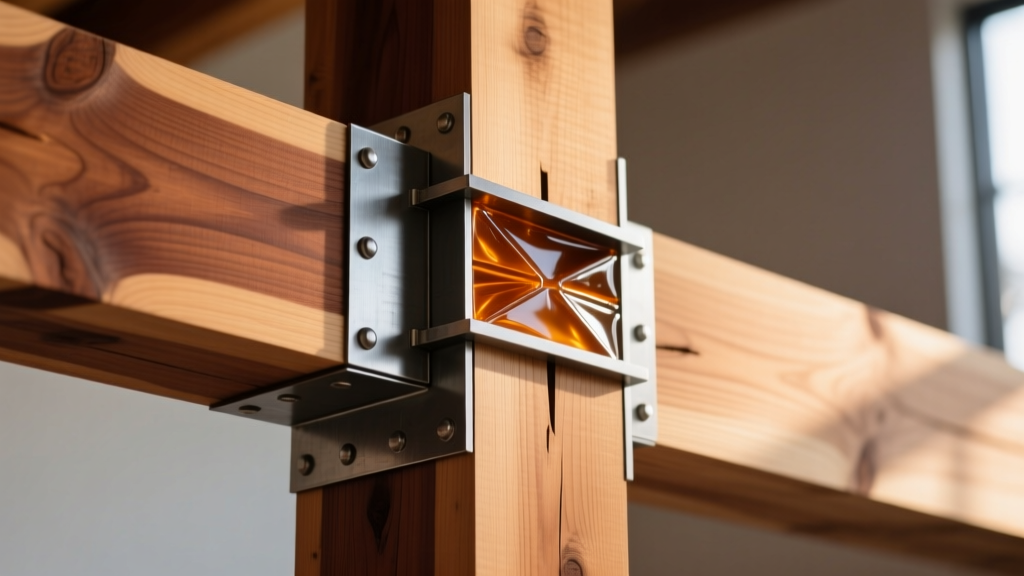
While adhesives handle shear and compression forces, mechanical fasteners are required to resist tensile forces and provide redundancy. The selection of steel hardware must account for the corrosive nature of certain wood treatments and the natural acidity of species like Oak.
| Fastener Type | Material / Grade | Load Capacity Profile | Installation Requirement |
|---|---|---|---|
| 4-inch Shear Plates | ASTM A36 Steel (Hot-Dip Galvanized) | High shear, moderate tension | Requires specialized grooving tools and 3/4-inch through-bolts |
| Threaded Rod (Dywidag) | Grade 460 High-Strength Steel | Exceptional tension resistance | Grouted into pre-drilled epoxy-filled ducts |
| Carbon Fiber (FRP) Wraps | Unidirectional Carbon/Epoxy Matrix | High tensile reinforcement, zero corrosion | Surface-bonded using structural laminating epoxy |
Cost Analysis: For a standard 12x12 timber splice, utilizing two 4-inch shear plates with through-bolts adds approximately $85 to $120 in material costs per joint in 2026. Conversely, wrapping the joint in structural Carbon Fiber Reinforced Polymer (FRP) can push material costs to $350+ per joint, though it eliminates the need for heavy steel plates and preserves the aesthetic continuity of the timber.
Geometry and Slope Ratios: Material Efficiency vs. Structural Integrity
The physical geometry of the scarf dictates how much timber material is consumed in the splice. The NDS defines specific slope ratios based on the primary stress the joint will endure:
- Tension Splices (1:12 Slope): For every 1 inch of timber depth, the scarf must extend 12 inches in length. A 12-inch deep beam requires a 144-inch (12-foot) splice. This massive material overlap is necessary to distribute tensile forces gradually across the glue line.
- Compression Splices (1:5 to 1:8 Slope): Because wood is exceptionally strong in compression parallel to the grain, the scarf can be much steeper. A 1:5 slope on a 10-inch beam requires only a 50-inch overlap.
- Bending Splices (1:10 to 1:12 Slope): Typically placed near the inflection points of a beam where bending moments transition, requiring a compromise between tension and compression geometries.
The 'Nibbed' Scarf Variation
To reduce the reliance on pure adhesive shear strength, modern framers frequently utilize a nibbed scarf joint. This involves cutting a small, square abutment (the 'nib') into the center of the angled slope. The nib acts as a mechanical stop, transferring compressive forces directly through wood-to-wood bearing rather than relying entirely on the adhesive. When designing a nibbed scarf, the best material practice is to ensure the nib depth is exactly 1/6th of the total timber depth, maximizing bearing area without creating a severe stress concentration point that could initiate a split.
Best Practices for On-Site vs. Shop Fabrication
The environment in which the scarf joint is assembled drastically alters the material selection matrix.
Shop Fabrication (Controlled Environment)
In a climate-controlled shop, tolerances can be held to 1/64th of an inch using CNC timber routers. Here, PRF adhesives paired with steel shear plates are the optimal material combination. The tight CNC tolerances allow for the thin, structurally superior bond lines that PRF requires, and hydraulic presses can apply the necessary 150 psi of clamping pressure evenly across the entire 12-foot splice length.
On-Site Assembly (Variable Conditions)
Field splicing introduces moisture, temperature fluctuations, and imperfect clamping. If a beam must be scarfed on-site, shift the material specification to structural gap-filling epoxy and threaded rod reinforcement. The epoxy will bridge any gaps caused by hand-cutting or chainsaw milling inaccuracies, while the epoxy-grouted threaded rods provide immediate mechanical tension resistance, acting as a fail-safe while the adhesive cures in unpredictable weather.
Summary of Material Specifications
Specifying the correct materials for a timber scarf joint requires aligning the wood species, adhesive chemistry, and mechanical hardware with the specific structural loads and fabrication environment. By adhering to NDS slope ratios and avoiding non-structural adhesives, builders ensure that spliced timbers perform identically to continuous members, maintaining the structural integrity and longevity of heavy timber architecture.
Written by
David NakamuraDavid Nakamura is a licensed architect (AIA) and construction technology writer focused on sustainable building methods, mass timber engineering, and high-performance building envelopes. He holds a Master of Architecture from the University of Washington and is a certified Passive House Consultant (CPHC). David spent eight years at the Seattle firm Mithun, where he led the design of three LEED Platinum projects, before founding his own practice specializing in net-zero residential design. He serves on the editorial advisory board of GreenBuilder Magazine and has authored peer-reviewed papers on cross-laminated timber (CLT) connections for the Journal of Structural Engineering. In his spare time, David teaches woodworking at Pratt Fine Arts Center and kayaks the Puget Sound.
More from David Nakamura
View all
Construction Cost
Labor Cost to Build a Deck Per Sq Ft: 2026 Installation Guide
Discover the exact labor cost to build a deck per sq ft in 2026. This installation guide breaks down contractor rates, complexity factors, and hidden fees.
Aug 4, 2026

Construction Cost
How Much Does It Cost to Build a 3 Bedroom House? Financing Guide
Learn exactly how much it costs to build a 3 bedroom house and explore 2026 financing options, construction loan types, and budget frameworks for your build.
Aug 4, 2026

Construction Cost
Cost to Build a Tennis Court: 2026 Guide
How much does it cost to build a tennis court in 2026? Breakdowns for asphalt, concrete, and synthetic surfaces plus fencing and lighting.
Jul 30, 2026