Best Materials for Sculptures: 2026 Comparison Guide
Compare the best materials for sculptures in 2026. Expert review of bronze, Corten, stainless steel, and UHPC with costs, grades, and structural data.

The Engineering of Public and Private Art
Commissioning or fabricating large-scale sculpture requires balancing aesthetic vision with brutal environmental realities. The best materials for sculptures are not chosen merely for their visual appeal, but for their tensile strength, corrosion resistance, and long-term maintenance profiles. In 2026, supply chain stabilization has normalized pricing for specialized alloys and advanced cementitious composites, allowing artists and landscape architects to specify high-performance materials without the extreme premiums seen in previous years. This comparison review evaluates the top structural and finish materials used in contemporary sculpture, providing exact alloy grades, cost metrics, and failure-mode analysis for outdoor and indoor installations.
Material Comparison Matrix
| Material | Specific Grade / Alloy | Est. Cost (2026) | Tensile / Compressive Strength | Primary Failure Mode |
|---|---|---|---|---|
| Silicon Bronze | Alloy 655 (Everdur) | $4.50 - $6.00 / lb | 70,000 psi (Tensile) | Bronze disease (chloride attack) |
| Weathering Steel | ASTM A588 (Corten) | $1.50 - $2.20 / lb | 70,000 psi (Yield) | Runoff staining, crevice corrosion |
| Stainless Steel | 316L (Marine Grade) | $3.50 - $5.00 / lb | 70,000 psi (Tensile) | Pitting in high-chloride zones |
| UHPC | Steel Micro-fiber Reinforced | $180 - $250 / cu ft | 21,000+ psi (Compressive) | Micro-cracking from improper curing |
| GFRC | AR-Glass Fiber Matrix | $90 - $130 / cu ft | 4,000 psi (Compressive) | Fiber degradation (if non-AR glass) |
Metals: Alloys and Weathering Steels
Silicon Bronze (Alloy 655 / Everdur)
For traditional cast and fabricated metal sculptures, silicon bronze remains the gold standard. Unlike standard brass or commercial bronze (which is actually brass), Alloy 655 contains roughly 96% copper, 3% silicon, and 1% manganese. The silicon acts as a deoxidizer during casting, resulting in a denser, more fluid pour with fewer micro-voids. From a conservation standpoint, silicon bronze develops a highly stable, protective cuprous oxide patina. Actionable Spec: Always specify Alloy 655 over Alloy 220 (commercial bronze) for outdoor works. To prevent 'bronze disease'—a destructive cycle of cuprous chloride formation triggered by high humidity and salt—apply a microcrystalline wax (such as Renaissance Wax) mixed with a UV inhibitor, reapplying every 18 to 24 months in coastal environments.
Weathering Steel (ASTM A588 Corten)
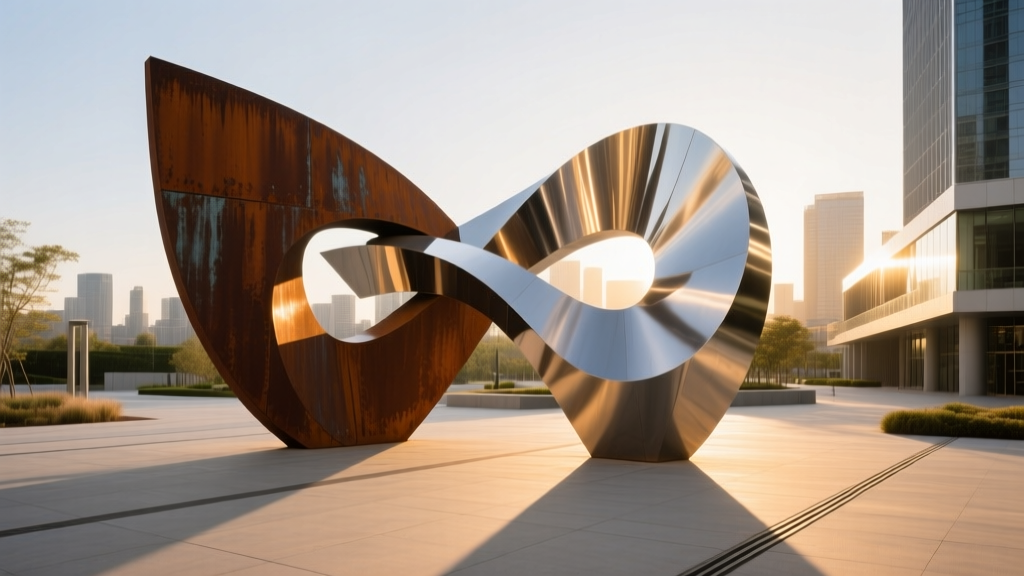
Weathering steel is favored for monumental, monolithic sculptures due to its rugged texture and zero-maintenance finish. The alloying elements (copper, chromium, nickel, and phosphorus) cause the surface to oxidize into a dense, adherent rust layer that halts further atmospheric corrosion. According to the American Institute of Steel Construction (AISC), weathering steel performs exceptionally well in environments with alternating wet and dry cycles. Failure Mode Warning: Corten requires a minimum 1/16-inch thickness to account for the sacrificial rust layer. The most common failure in landscape architecture is runoff staining; the initial oxidation process leaches iron tannins that will permanently stain adjacent limestone, concrete, or light-colored paving. Mitigate this by designing hidden gravel French drains directly beneath the sculpture's footprint or pre-weathering the steel in a controlled yard using a dilute hydrogen peroxide and salt spray solution before installation.
Marine-Grade Stainless (316L vs. 304)
Stainless steel offers high reflectivity and immense structural rigidity, making it ideal for kinetic or highly polished abstract forms. However, specifying 304 stainless for outdoor public art is a critical error in most climates. 304 lacks molybdenum, making it highly susceptible to chloride pitting and crevice corrosion from de-icing salts or sea spray. Actionable Spec: Mandate 316L (low carbon) stainless steel for any exterior application. 316L contains 2-3% molybdenum, pushing its Pitting Resistance Equivalent Number (PREN) above 32, which provides robust defense against localized corrosion. For welded sculptural joints, the 'L' designation prevents carbide precipitation (weld decay) in the heat-affected zones, ensuring the welds do not rust before the base metal.
Advanced Cementitious and Composite Materials
Ultra-High Performance Concrete (UHPC)
UHPC has revolutionized large-scale cast stone sculptures, allowing for impossibly thin, gravity-defying geometries that would shatter in traditional concrete. By eliminating coarse aggregate and utilizing a dense matrix of steel or synthetic micro-fibers, UHPC achieves compressive strengths exceeding 21,000 psi (145 MPa) and exhibits significant post-cracking ductility. The Federal Highway Administration notes UHPC's near-zero permeability, making it virtually immune to freeze-thaw spalling and chloride ingress. Cost & Fabrication: While material costs hover around $200 per cubic foot (roughly 10x standard concrete), the reduction in armature steel and shipping weight (due to thinner cross-sections) often balances the overall project budget. Specify proprietary mixes like Ductal for guaranteed matrix consistency in complex sculptural molds.
Glass Fiber Reinforced Concrete (GFRC)
For sculptures requiring the aesthetic of carved stone or cast bronze but with strict weight limitations (such as rooftop installations or suspended interior pieces), GFRC is the optimal choice. GFRC relies on alkali-resistant (AR) glass fibers to provide tensile strength, allowing the material to be cast in hollow, 3/4-inch thick shells. Critical Edge Case: Never use standard E-glass fibers in a cementitious matrix; the high alkalinity of Portland cement will dissolve standard glass fibers within 3 to 5 years, leading to catastrophic brittle failure. Always verify the use of zirconia-rich AR-glass fibers in the mix design.
Environmental Decision Framework
Site-Specific Material Selection
- Coastal / Marine (Within 5 miles of ocean): 316L Stainless Steel or UHPC. Avoid Corten (salt prevents stable patina formation) and standard bronzes without rigorous waxing schedules.
- Urban / Industrial (High SO2 pollution): Silicon Bronze or 316L Stainless. Acid rain accelerates the degradation of standard concrete and can cause uneven, streaky patinas on weathering steel.
- Heavy Freeze-Thaw Zones: UHPC or heavily air-entrained GFRC. Avoid porous cast stones and ensure any steel armatures are fully encapsulated with a minimum 2 inches of concrete cover to prevent rust-jacking.
Structural Anchoring and Base Integration
The longevity of a sculpture is frequently dictated not by the material itself, but by the structural connection to its foundation. The Smithsonian American Art Museum emphasizes that water infiltration at the base connection is the leading cause of public art degradation.
- Threaded Rods and Epoxy: For heavy bronze or UHPC pieces, embed 316 stainless steel threaded rods into the concrete foundation using a high-modulus, moisture-insensitive epoxy grout (such as Simpson SET-XP). Do not use mechanical wedge anchors in exterior sculptural bases, as they introduce point-stresses and potential water channels.
- Isolation Pads: Never set metal sculptures directly onto concrete pads. The alkaline environment of curing concrete promotes galvanic corrosion. Use high-density polyethylene (HDPE) or structural neoprene isolation pads between the base plate and the concrete plinth.
- Wind and Seismic Loading: Tall, slender sculptures act as cantilevered beams. Require a structural engineer to calculate the overturning moment based on local ASCE 7-22 wind load criteria, ensuring the internal armature extends at least one-third of the way up the sculpture's center of gravity to prevent fatigue cracking at the base weld.
Final Specification Directives
Choosing the best materials for sculptures requires moving beyond aesthetic preference into the realm of materials science. Specify Alloy 655 for traditional longevity, ASTM A588 for monumental massing (with strict runoff management), 316L for modern reflectivity in harsh climates, and UHPC for complex, thin-shell geometries. By matching the precise metallurgical or cementitious grade to the micro-climate of the installation site, commissioners and artists ensure the work survives intact for generations.
Written by
Sarah WhitfieldSarah Whitfield is a chartered quantity surveyor (MRICS) and construction cost analyst with 15 years of experience in material pricing, procurement strategy, and project budgeting. She earned her degree in Construction Management from the University of Reading (UK) and has worked on projects ranging from $2M custom homes to $180M mixed-use developments across North America and Europe. Sarah currently leads cost estimating for BuildMat Insight, maintaining a proprietary database of 4,000+ material price points updated quarterly. She is a frequent contributor to RSMeans cost data panels and has presented at the International Cost Engineering Council (ICEC) congress. Based in Denver, CO, Sarah is an avid trail runner and volunteer mentor for Women in Construction.
More from Sarah Whitfield
View all
Wood & Lumber
What Are the Different Types of Wood? A Builder's Guide
Compare structural softwoods, finish hardwoods, and engineered lumber. Analyze Janka ratings, MOE values, and 2026 pricing for construction.
Aug 4, 2026

Walls & Panels
Steel Framing vs Wood Framing: Corrosion and Moisture Defense
Compare steel framing vs wood framing for moisture resistance. Learn about galvanized coatings, condensation risks, and corrosion protection strategies.
Jul 21, 2026

Stone & Masonry
How to Cut Stone Veneer: Wet Saw vs Grinder Comparison
Compare the best tools for cutting stone veneer. We review wet saws, angle grinders, and chop saws to help you achieve clean, chip-free cuts.
Jul 21, 2026