Best Packing Material for Fragile Items: 2026 Cost Analysis
Compare costs of the best packing material for fragile items in construction. Analyze ROI, breakage rates, and pricing for glass and tile.

The Hidden Cost of Material Breakage in Construction Logistics
When general contractors and custom builders evaluate transit protection, the definition of 'fragile items' extends far beyond standard consumer goods. In commercial and high-end residential construction, fragile shipments include electrochromic smart glass, book-matched natural stone slabs, heritage architectural salvage, and pre-wired smart home control racks. The financial impact of a single breakage event in 2026 is rarely limited to the replacement cost of the material itself; it triggers a cascade of liquidated damages, expedited freight surcharges, and idle labor costs.
Selecting the best packing material for fragile items requires a rigorous cost-benefit analysis. Standardizing on cheap polyethylene bubble wrap might save $40 on a palletized shipment, but it increases the risk of a $15,000 delay penalty. This analysis breaks down the unit economics, transit simulation data, and true ROI of construction-grade protective packaging.
Material Matrix: Standard vs. Construction-Grade Protection
The packaging market has evolved significantly, with sustainable and high-performance engineered materials disrupting traditional foam and bubble wrap. Below is a comparative matrix of the most viable options for protecting high-value, fragile building materials.
1. Polyethylene Bubble Roll (Standard Grade)
Cost: $0.04 - $0.06 per square foot.
Best For: Low-risk, non-structural finishes like standard ceramic tiles or lightweight PVC trim.
Failure Mode: Punctures easily under the point-load of heavy stone or glass edges. Loses up to 20% of its air volume during long-haul trucking due to vibration and temperature shifts.
2. HexcelPack / Ranpak Geami (Honeycomb Kraft Paper)
Cost: $0.11 - $0.15 per square foot.
Best For: Surface protection of polished stone, brushed metal fixtures, and custom cabinetry.
Advantage: Expands to create a 3D interlocking cushion. It provides excellent surface scratch protection and is fully curbside recyclable, aligning with 2026 LEED v5 material management credits.
3. Instapak Quick RT (Expanding Polyurethane Foam)
Cost: $2.85 - $3.50 per bag (yields approx. 1.5 cubic feet).
Best For: Irregularly shaped heritage salvage, custom plumbing manifolds, and smart home server racks.
Advantage: Expands to form a custom-molded cradle that locks the item in place, neutralizing drop and vibration shocks. Requires minimal warehouse storage space before activation.
4. Sealed Air Korrvu (Suspension Packaging)
Cost: $1.20 - $2.50 per unit (depending on custom sizing).
Best For: High-end architectural hardware, smart thermostats, and fragile lighting pendants.
Advantage: Uses a low-sliding, high-retention film to suspend the item between two corrugated frames. According to Sealed Air's protective packaging data, suspension packaging reduces shock transmission by up to 70% compared to traditional loose-fill.
Calculating the True ROI: The Multiplier Effect of Job Site Delays
To accurately determine the best packing material for fragile items, procurement teams must calculate the Total Landed Risk (TLR). The TLR formula is:
TLR = (Material Replacement Cost) + (Expedited Freight Surcharge) + (Idle Labor Cost) + (Liquidated Damages)
Scenario A: Importing Electrochromic Smart Glass
A commercial facade project requires 40 custom electrochromic glass panels shipped from a European manufacturer to a site in Chicago. Each panel costs $3,200. The lead time for a replacement is 8 weeks.
- Standard Packing (Wooden Crate + Foam Edge Protectors): Saves $150 per crate in packaging costs. However, edge-impact vibration causes micro-fractures in 2% of the panels. Replacing two panels costs $6,400, plus $1,200 in air freight. The 8-week delay halts the facade sealing, triggering $3,500/week in HVAC inefficiency and delay penalties. Total Loss: $42,600.
- Engineered Packing (Custom U-Channel Foam + Korrvu Suspension Base): Adds $450 per crate in packaging costs ($18,000 total). Breakage rate drops to 0.1%. Total Risk Exposure: $1,500.
In this scenario, spending an additional $18,000 on premium packing materials yields a net risk savings of over $24,000, proving that high-performance packaging is an insurance policy, not a sunk cost.
Breakage Rates and Transit Simulation Data
The International Safe Transit Association (ISTA) sets the global benchmark for packaging performance. The ISTA 3A standard simulates the rigors of parcel delivery systems, including random vibration, drop impacts, and atmospheric conditioning. Below is a breakdown of simulated breakage rates for heavy, fragile construction materials (e.g., large-format porcelain and glass) based on ISTA 3A testing parameters.
| Packing Material Configuration | Drop Impact Survival (36-inch) | Random Vibration Dampening | Estimated Breakage Rate (Heavy Fragile) |
|---|---|---|---|
| Standard Bubble Wrap (1/2" bubble) + Corrugated Box | 45% | Poor (Bottoming out common) | 8.5% - 12.0% |
| Honeycomb Kraft Paper (2 layers) + Edge Boards | 65% | Moderate (High surface friction) | 4.0% - 6.5% |
| EPS Molded Foam (Custom fit) + Double Wall Box | 92% | Good (Rigid transfer) | 1.5% - 2.5% |
| Instapak Expanding Foam + Heavy Duty Crate | 98% | Excellent (Full void fill) | 0.2% - 0.8% |
Material-Specific Packing Frameworks
There is no universal 'best' material. The optimal choice depends entirely on the physical properties of the building component. Use this decision framework to standardize your site logistics.
1. Large-Format Porcelain and Natural Stone Slabs
The Threat: Point-load stress and edge chipping. Stone and porcelain have high compressive strength but near-zero tensile strength. Vibration causes slabs to rub together, leading to edge micro-chips that ruin the book-match aesthetic.
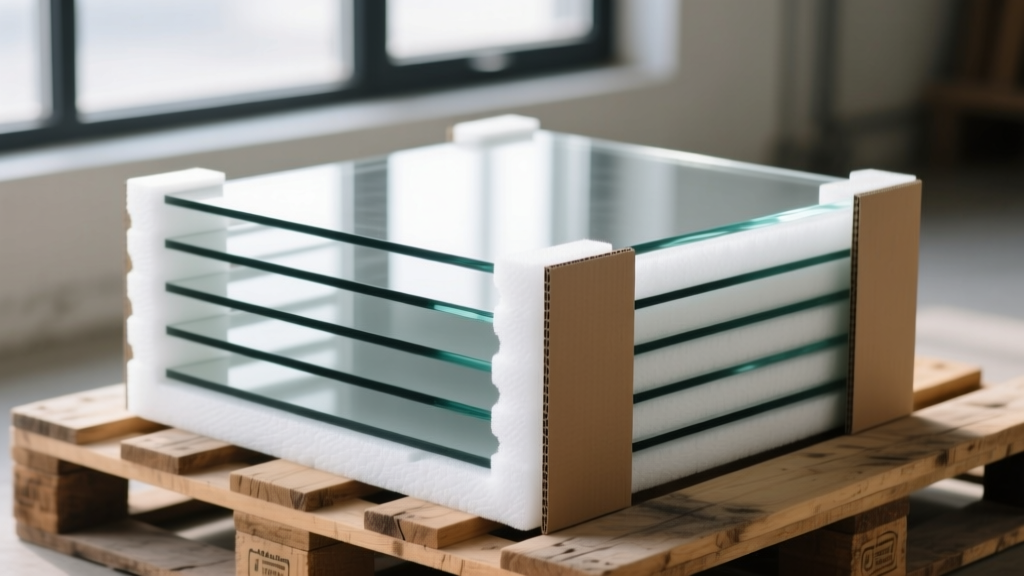
The Solution: Do not use bubble wrap. Use high-density polyethylene (HDPE) foam sheeting (minimum 1/8" thickness) interleaved between every slab, combined with rigid U-channel foam edge protectors. Secure the bundle with tensioned PET strapping, never steel strapping, which will shatter the stone edges under tension.
2. Smart Home Electronics and Control Panels
The Threat: Electrostatic discharge (ESD) and drop shock. Standard foams and honeycomb paper generate static electricity when peeled off sensitive circuit boards.
The Solution: Wrap components in anti-static pink poly bags first. Then, utilize Korrvu suspension packaging or anti-static Instapak foam to suspend the unit in the center of the shipping box, ensuring at least 2 inches of clearance from all exterior corrugated walls.
3. Heritage Architectural Salvage (e.g., Cast Iron, Carved Wood)
The Threat: Irregular geometries make standard boxing impossible. Protruding details snap off under lateral G-forces.
The Solution: Instapak Quick RT expanding foam is mandatory here. Place the item in an oversized heavy-duty crate, activate the foam bags, and place the item into the rising foam. The foam will map every contour of the irregular salvage piece, providing 360-degree structural support that prevents lateral shifting.
Sourcing and Bulk Procurement Strategies for 2026
As sustainability mandates tighten across commercial construction in 2026, the EPA's guidelines on sustainable management of packaging heavily incentivize the reduction of single-use expanded polystyrene (EPS) and non-recyclable plastics. General contractors are increasingly penalized by municipal waste ordinances for excessive EPS disposal on job sites.
To optimize both cost and compliance:
- Transition to Honeycomb Paper: For surface protection, replace bubble wrap with Ranpak Geami or HexcelPack. While the per-square-foot cost is roughly 2.5x higher, it eliminates plastic waste disposal fees and accelerates site cleanup times.
- On-Demand Foam Systems: Instead of ordering pre-molded EPS (which requires massive warehouse footprint and high minimum order quantities), invest in an on-demand dispensing system for expanding polyurethane. This allows your logistics team to pack any irregular item instantly, reducing inventory holding costs by up to 60%.
- Reusable Crating with Modular Inserts: For recurring shipments of standard fragile items (like commercial lighting fixtures), invest in heavy-duty reusable wooden crates with modular, velcro-attached foam inserts. The amortized cost per trip drops below $2.00 after the fifth use.
Summary: Optimizing Your Logistics Budget
Determining the best packing material for fragile items in construction requires looking past the initial invoice price of the packaging supplies. By calculating the Total Landed Risk and aligning your material choices with the specific failure modes of your building components, you transform packaging from a discretionary expense into a critical risk-mitigation asset. In 2026, the most profitable contractors are those who leverage engineered suspension and expanding foam technologies to guarantee that high-value, long-lead-time materials arrive on the job site intact, on schedule, and ready for installation.
Written by
David NakamuraDavid Nakamura is a licensed architect (AIA) and construction technology writer focused on sustainable building methods, mass timber engineering, and high-performance building envelopes. He holds a Master of Architecture from the University of Washington and is a certified Passive House Consultant (CPHC). David spent eight years at the Seattle firm Mithun, where he led the design of three LEED Platinum projects, before founding his own practice specializing in net-zero residential design. He serves on the editorial advisory board of GreenBuilder Magazine and has authored peer-reviewed papers on cross-laminated timber (CLT) connections for the Journal of Structural Engineering. In his spare time, David teaches woodworking at Pratt Fine Arts Center and kayaks the Puget Sound.
More from David Nakamura
View all
Construction Cost
Labor Cost to Build a Deck Per Sq Ft: 2026 Installation Guide
Discover the exact labor cost to build a deck per sq ft in 2026. This installation guide breaks down contractor rates, complexity factors, and hidden fees.
Aug 4, 2026

Construction Cost
How Much Does It Cost to Build a 3 Bedroom House? Financing Guide
Learn exactly how much it costs to build a 3 bedroom house and explore 2026 financing options, construction loan types, and budget frameworks for your build.
Aug 4, 2026

Construction Cost
Cost to Build a Tennis Court: 2026 Guide
How much does it cost to build a tennis court in 2026? Breakdowns for asphalt, concrete, and synthetic surfaces plus fencing and lighting.
Jul 30, 2026