What Material Would You Use to Build Countertops? 2026 Cost Guide
Discover what material you would use to build countertops based on our 2026 cost analysis. Compare quartz, granite, laminate, and porcelain pricing.

The Economics of Countertop Selection in 2026
When homeowners and contractors ask what material you would use to build countertops, the answer is rarely a single product. It is a mathematical equation balancing upfront fabrication costs, long-term maintenance, and resale value. In 2026, the countertop market has shifted dramatically. Supply chain stabilizations have lowered the cost of imported natural stones, while advancements in sintered stone and high-definition laminate have disrupted the traditional mid-tier market.
This cost analysis bypasses generic aesthetic advice to focus strictly on the financial realities of countertop materials. We break down material costs, fabrication variables, and the 15-year Total Cost of Ownership (TCO) to help you make a data-driven decision.
2026 Countertop Material Cost Matrix
The following table reflects national averages for material and professional installation, based on a standard 30-square-foot kitchen layout with basic edge profiles.
| Material Category | Material Cost (per sq. ft.) | Installed Cost (per sq. ft.) | 15-Year Maintenance Cost | ROI at Resale |
|---|---|---|---|---|
| High-Pressure Laminate | $15 - $30 | $25 - $45 | $0 | Low (10-20%) |
| Solid Surface (Acrylic) | $40 - $65 | $65 - $100 | $150 (Buffing) | Medium (40%) |
| Engineered Quartz | $55 - $110 | $85 - $150 | $0 | High (60-80%) |
| Natural Granite (Level 1-3) | $40 - $75 | $70 - $120 | $450 (Sealing) | Medium (50%) |
| Sintered Porcelain Stone | $70 - $130 | $110 - $190 | $0 | High (70%) |
The Premium Tier: Quartz vs. Sintered Porcelain
Engineered Quartz: The Market Standard
Quartz remains the default answer for what material you would use to build countertops in mid-to-high-end residential builds. Brands like Cambria and Caesarstone dominate the 2026 market. The primary cost driver for quartz is not the raw slab, but the resin composition and branding. Premium lines featuring dramatic, continuous veining (such as Caesarstone's Excava or Cambria's Brittanicca) command a 30% to 40% premium over solid or lightly speckled patterns.
From a fabrication standpoint, quartz is highly predictable. CNC routers and standard diamond blades cut quartz cleanly, keeping labor costs relatively stable. However, quartz is susceptible to thermal shock. Placing a 450°F cast-iron pan directly on the surface can scorch the polymer resins, resulting in permanent discoloration that requires professional polishing or slab replacement.
Sintered Porcelain: The High-Labor Challenger
Sintered stone, led by brands like Dekton and Neolith, is manufactured by subjecting raw minerals to extreme heat and pressure, mimicking the earth's crust. While the material cost per square foot is comparable to mid-tier quartz, the installed cost is significantly higher.
Despite the higher installation cost, sintered stone offers unparalleled UV resistance and thermal tolerance, making it the only premium material suitable for both indoor kitchens and outdoor summer kitchens without voiding the manufacturer warranty.
The Natural Stone Tier: Granite Economics
The narrative that granite is obsolete is financially inaccurate. According to industry data tracked by Bob Vila's home cost guides, Level 1 and Level 2 granites (such as Uba Tuba, Santa Cecilia, and Baltic Brown) remain some of the most cost-effective natural surfaces available, often undercutting mid-tier quartz by $15 to $25 per square foot installed.
The true cost of granite lies in its porosity. To maintain the warranty and prevent bacterial ingress or oil staining, granite requires a penetrating sealer application every 18 to 24 months. Professional sealing costs between $150 and $300 per visit. Over a 15-year period, this adds $1,000 to $2,000 to the Total Cost of Ownership. If you are evaluating what material you would use to build countertops for a rental property or high-traffic commercial space, the maintenance liability of natural stone often disqualifies it despite the lower upfront cost.
The Budget & Mid-Tier: Laminate and Solid Surface
High-Pressure Laminate (HPL)
Modern laminate has shed its cheap reputation through high-definition printing and textured finishes. Formica's 180fx series and Wilsonart's HD laminates replicate the depth of natural stone with remarkable accuracy. At $25 to $45 per square foot installed, laminate is the undisputed champion of budget renovations. The critical failure point for laminate is the substrate. If moisture breaches the seams or the underside edge, the particleboard core will swell and delaminate. Always specify a marine-grade plywood substrate or ensure the fabricator applies a moisture-barrier backing for an additional $3 to $5 per square foot.
Solid Surface (Acrylic/Polyester)
Materials like Corian offer a unique financial advantage: infinite reparability. Unlike quartz or granite, where a deep scratch or chip requires a costly epoxy fill or slab replacement, solid surface can be sanded and buffed back to factory condition with basic orbital sanders. This makes it highly cost-effective for heavy-use environments, though it lacks the structural rigidity for long, unsupported spans (like a breakfast bar overhang) without corbel reinforcement.
Hidden Fabrication Variables That Destroy Budgets
When researching what material you would use to build countertops, most estimates only account for the raw slab and basic installation. The following line items frequently cause 20% to 35% budget overruns if not negotiated upfront:
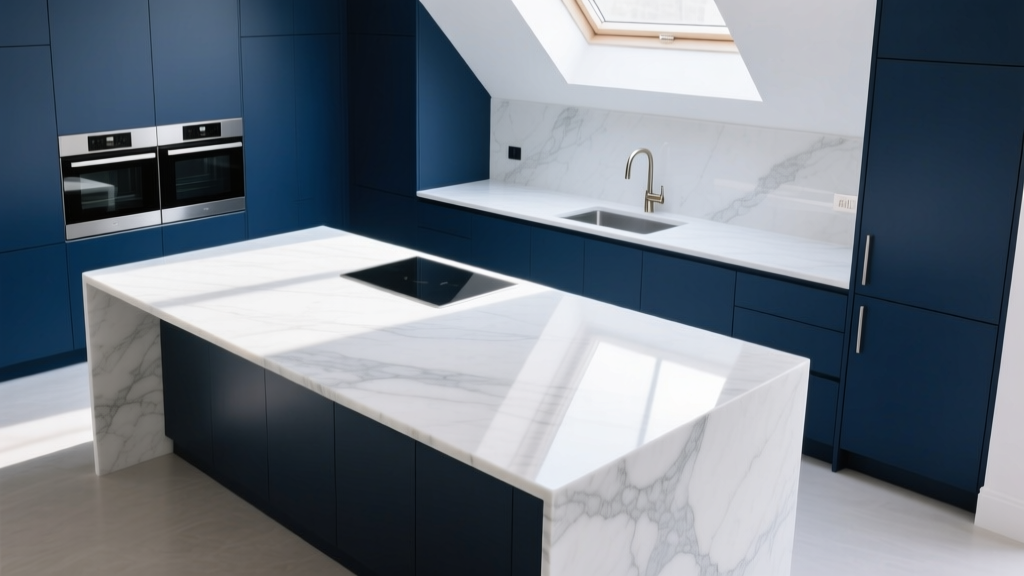
- Mitered Apron Edges: Creating the illusion of a 3-inch thick countertop using a 2cm slab requires precise 45-degree mitering and epoxy bonding. This adds $35 to $60 per linear foot to fabrication.
- Undermount Sink Cutouts: While a drop-in sink requires a simple straight cut, an undermount sink requires a polished interior edge and precise routing. Expect a $150 to $250 surcharge per cutout.
- Cooktop Cutouts: Similar to sinks, but often requires specialized cooling strips or metal support rails to prevent thermal cracking in quartz or granite, adding $100 to $200.
- Tear-Out and Disposal: Removing existing tile or stone countertops and hauling away the debris typically costs $4 to $8 per square foot. If the existing substrate (plywood/MDF) is water-damaged, replacement adds $15 to $25 per square foot.
- Plumbing Disconnect/Reconnect: Countertop fabricators are not licensed plumbers. You must budget $250 to $450 for a licensed plumber to disconnect the garbage disposal and water lines before template day, and reconnect them 24 hours after installation.
Total Cost of Ownership (TCO) Decision Framework
To definitively answer what material you would use to build countertops, apply this 15-year TCO framework based on your specific property profile:
- The Investment Flip (Holding period < 3 years): Use High-Definition Laminate or Level 1 Granite. The goal is maximum visual impact with minimal capital expenditure. Avoid premium quartz, as you will not recoup the $4,000+ material premium in the sale price.
- The Forever Home (Holding period 10+ years): Use Engineered Quartz or Sintered Porcelain. The zero-maintenance requirement and high resistance to staining justify the higher initial capital outlay. According to the Architectural Digest material guidelines, quartz consistently yields the highest satisfaction ratings for long-term homeowners due to the elimination of sealing routines.
- The Heavy-Duty Rental (High tenant turnover): Use Solid Surface (Corian) or dark, patterned Level 2 Granite. Solid surface allows you to buff out tenant abuse (burn marks, deep cuts) between leases for under $200, preserving the asset without requiring full slab replacement.
"The biggest mistake consumers make is evaluating countertop materials solely on the per-square-foot slab price. The true cost is determined by the complexity of the kitchen's geometry, the edge profile selected, and the long-term maintenance required to keep the surface hygienic and visually intact." — National Kitchen and Bath Association (NKBA) Design Trends Report
Ultimately, the optimal material is the one that aligns with your specific financial timeline and risk tolerance. By mapping out the hidden fabrication costs and projecting the 15-year maintenance liabilities, you can move beyond aesthetic preferences and make a structurally and financially sound investment in your property.
Written by
Sarah WhitfieldSarah Whitfield is a chartered quantity surveyor (MRICS) and construction cost analyst with 15 years of experience in material pricing, procurement strategy, and project budgeting. She earned her degree in Construction Management from the University of Reading (UK) and has worked on projects ranging from $2M custom homes to $180M mixed-use developments across North America and Europe. Sarah currently leads cost estimating for BuildMat Insight, maintaining a proprietary database of 4,000+ material price points updated quarterly. She is a frequent contributor to RSMeans cost data panels and has presented at the International Cost Engineering Council (ICEC) congress. Based in Denver, CO, Sarah is an avid trail runner and volunteer mentor for Women in Construction.
More from Sarah Whitfield
View all
Wood & Lumber
What Are the Different Types of Wood? A Builder's Guide
Compare structural softwoods, finish hardwoods, and engineered lumber. Analyze Janka ratings, MOE values, and 2026 pricing for construction.
Aug 4, 2026

Walls & Panels
Steel Framing vs Wood Framing: Corrosion and Moisture Defense
Compare steel framing vs wood framing for moisture resistance. Learn about galvanized coatings, condensation risks, and corrosion protection strategies.
Jul 21, 2026

Stone & Masonry
How to Cut Stone Veneer: Wet Saw vs Grinder Comparison
Compare the best tools for cutting stone veneer. We review wet saws, angle grinders, and chop saws to help you achieve clean, chip-free cuts.
Jul 21, 2026