What Material Is Best for a Bathtub? Pro Guide to Top Options
Discover what material is best for a bathtub. Compare acrylic, cast iron, and stone resin with pro installation tips and structural requirements.

The Core Question: What Material Is Best for a Bathtub?
When architects, contractors, and homeowners ask what material is best for a bathtub, the answer is never a single product. The 'best' material is dictated by the intersection of structural capacity, thermal retention requirements, budget, and maintenance tolerance. A 350-pound cast iron tub requires fundamentally different floor joist engineering than a 75-pound acrylic unit, while a matte stone resin tub demands entirely different cleaning protocols than enameled steel.
Below is a professional decision matrix evaluating the four primary bathtub materials used in modern residential construction, based on empty weight, thermal performance, and lifecycle costs.
| Material | Avg Empty Weight | Heat Retention | Avg Installed Cost | Surface Repairability |
|---|---|---|---|---|
| Acrylic (Fiberglass Reinforced) | 75 - 110 lbs | Moderate | $800 - $1,800 | High (Buffable) |
| Cast Iron (Porcelain Enameled) | 300 - 500 lbs | Excellent | $1,500 - $3,500 | Low (Requires Pro Refinishing) |
| Enameled Steel | 120 - 160 lbs | Poor | $600 - $1,200 | Very Low (Chips Easily) |
| Solid Surface / Stone Resin | 200 - 350 lbs | Excellent | $2,500 - $6,000+ | Very High (Sanded/Polished) |
Acrylic & Fiberglass: The Builder-Grade Standards
Acrylic dominates the North American market, accounting for the vast majority of new construction and mid-tier remodels. It is manufactured by vacuum-forming a sheet of Lucite acrylic over a mold, which is then backed with sprayed fiberglass resin for rigidity.
Acrylic: The Value-to-Performance Sweet Spot
High-grade acrylic offers a non-porous, warm-to-the-touch surface that resists mildew and staining. From an installation perspective, its lightweight nature allows a single installer to maneuver it up narrow stairwells—a critical logistical advantage in multi-story renovations. However, acrylic is highly susceptible to point-load failure. If a 250-pound occupant steps directly into the center of an unsupported acrylic tub, the floor can flex, leading to stress fractures in the gel coat or acrylic shell.
Never install an acrylic tub directly on the subfloor relying solely on its factory feet or perimeter lip. Best practice dictates a full-coverage mortar bed (using a mix like USG StructoLite or a sand-cement mix) placed under the tub while wet. As the tub is pressed into the mortar and weighted, it cures to the exact contour of the shell, eliminating flex and extending the tub's lifespan by decades.
Fiberglass: The Budget Compromise
Often confused with acrylic, pure fiberglass (gel-coated) tubs are the cheapest option on the market ($300-$500). They are constructed by spraying polyester resin and glass fibers into a mold. They are highly prone to scratching, fading, and cracking. For any project intended to last longer than five years, fiberglass should be bypassed in favor of acrylic.
Cast Iron & Enameled Steel: The Heavyweight Contenders
For heritage restorations and high-end traditional builds, metal tubs coated in porcelain enamel remain the gold standard. The manufacturing process involves casting molten iron into sand molds, then fusing a glass-based enamel frit to the surface at temperatures exceeding 1,400°F, as detailed in Kohler's cast iron specifications.
Cast Iron: The Heritage Choice
Cast iron offers unmatched acoustic dampening (water filling the tub is nearly silent) and superior heat retention due to the thermal mass of the iron. The enamel surface is virtually impervious to household chemicals, meaning owners can use harsh abrasive cleaners without degrading the finish. The primary drawback is structural weight. A standard 60-inch cast iron alcove tub weighs roughly 320 pounds empty. When filled with 32 gallons of water (267 lbs) and a 180-pound occupant, the total point load exceeds 750 pounds.
- Standard Joists: 2x10 dimensional lumber at 16 inches on-center (OC) is the minimum requirement for cast iron.
- Supplemental Blocking: Install solid 2x10 blocking between joists directly beneath the tub's drain and overflow ends to distribute the concentrated load.
- Older Homes: If installing cast iron on existing 2x8 joists spanning more than 10 feet, sistering the joists or adding a mid-span beam is mandatory to prevent floor deflection.
Enameled Steel: The Mid-Century Workhorse
Stamped from a single sheet of heavy-gauge steel and coated in enamel, these tubs are lighter and cheaper than cast iron. However, steel is a highly efficient thermal conductor, meaning it pulls heat out of the bathwater rapidly. Furthermore, the enamel coating is under high tension; dropping a heavy showerhead on the rim can cause the glass enamel to chip, exposing the raw steel to rapid oxidation and rust. They are best reserved for budget-conscious commercial projects or secondary guest bathrooms.
Solid Surface & Stone Resin: The Modern Luxury Tier
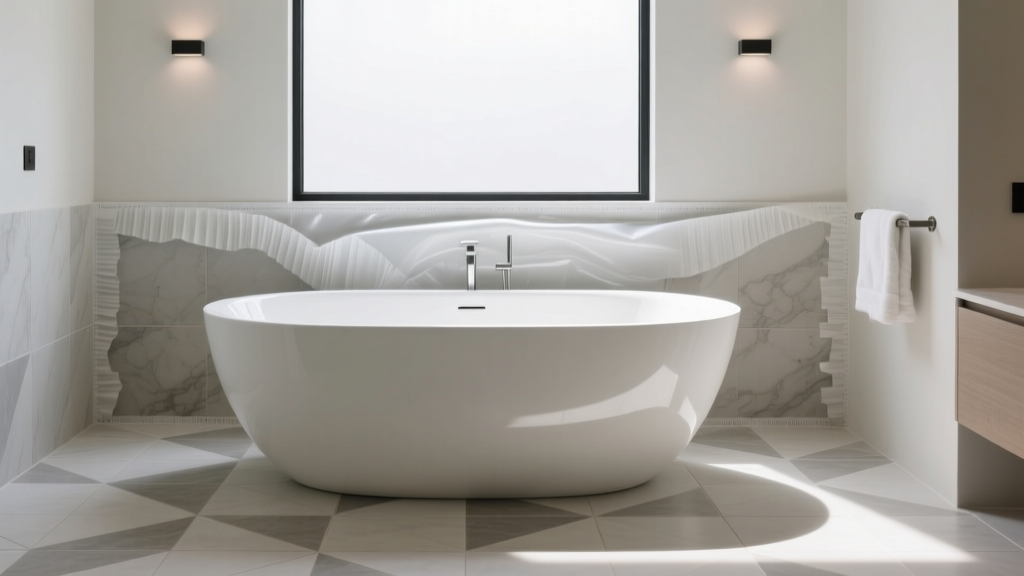
When evaluating what material is best for a bathtub in a luxury master suite, solid surface and engineered stone resin have emerged as the premier choices for contemporary design. These materials allow for seamless integration, matte finishes, and organic, freestanding shapes that metal and acrylic cannot easily achieve.
Engineered Stone Resin
Brands like Victoria + Albert manufacture tubs from a proprietary composite of crushed volcanic limestone and high-performance resin. The resulting material is incredibly dense, offering heat retention that rivals cast iron but at roughly half the weight. The matte finish feels like natural stone and is highly resistant to staining.
- Exceptional thermal mass retains water heat.
- Matte finish hides water spots and soap scum.
- Deep scratches can be sanded out with 400-grit sandpaper.
- High material cost ($3,000 - $6,000+).
- Heavy (250+ lbs); requires reinforced flooring.
- Susceptible to etching from acidic cleaners (vinegar, bleach).
Solid Surface (Acrylic-Polymer Composites)
Similar to Corian countertops, solid surface tubs are made from a blend of acrylic polymer and natural minerals. They are completely non-porous and can be fabricated with integrated drainboards or seamless cove corners where the tub meets the surrounding deck. While slightly less rigid than stone resin, they offer superior repairability; any burn mark or deep gouge can be routed out and polished back to a factory finish.
Structural Best Practices for Bathtub Installation
Selecting the right material is only half the battle; improper installation voids warranties and causes catastrophic water damage. Regardless of whether you choose acrylic or stone resin, the following installation protocols must be followed.
1. Ledger Board Support for Alcove Tubs
For alcove installations (tubs surrounded by three walls), never rely solely on the tub's front apron or leveling feet to support the perimeter. Install a pressure-treated 2x4 ledger board directly into the wall studs. The back flange of the tub should rest securely on this ledger, transferring the weight of the water and occupants directly into the structural framing rather than the drywall or backer board.
2. Waterproofing the Flange Transition
The most common failure point in a tub surround is the joint where the cement board meets the tub's nailing flange. According to Schluter Systems waterproofing guidelines, the cement board should overlap the tub flange, and a waterproof membrane (such as Schluter Kerdi-Band) must be applied over the flange and up the wall. This ensures that water migrating behind the tile is directed into the tub basin, not into the wall cavity.
3. Expansion Gaps and Sealants
Acrylic and solid surface materials expand and contract with temperature fluctuations. Leave a 1/8-inch gap between the tub rim and the wall tile. This gap must be filled with a high-quality, 100% silicone caulk (not acrylic latex or grout), which possesses the elastomeric properties to stretch without tearing as the tub flexes under load.
Expert Verdict: Matching Material to Project Scope
Ultimately, determining what material is best for a bathtub requires aligning the material properties with the specific goals of the build. The National Kitchen & Bath Association (NKBA) emphasizes that material selection must always balance client lifestyle with structural realities.
The Quick Flip / Rental
Choose: Acrylic (Fiberglass Reinforced).
Why: Low material cost, lightweight for easy installation, and easily repaired if tenants damage the surface. Pair with a mortar bed for longevity.
The Forever Home (Traditional)
Choose: Cast Iron.
Why: Unmatched durability, acoustic superiority, and a lifespan that exceeds the building itself. Ensure floor joists are reinforced prior to delivery.
The Luxury Master Suite
Choose: Engineered Stone Resin.
Why: Delivers the sculptural, matte aesthetic of modern design with the thermal mass of cast iron, without requiring extreme structural reinforcement.
Written by
Sarah WhitfieldSarah Whitfield is a chartered quantity surveyor (MRICS) and construction cost analyst with 15 years of experience in material pricing, procurement strategy, and project budgeting. She earned her degree in Construction Management from the University of Reading (UK) and has worked on projects ranging from $2M custom homes to $180M mixed-use developments across North America and Europe. Sarah currently leads cost estimating for BuildMat Insight, maintaining a proprietary database of 4,000+ material price points updated quarterly. She is a frequent contributor to RSMeans cost data panels and has presented at the International Cost Engineering Council (ICEC) congress. Based in Denver, CO, Sarah is an avid trail runner and volunteer mentor for Women in Construction.
More from Sarah Whitfield
View all
Wood & Lumber
What Are the Different Types of Wood? A Builder's Guide
Compare structural softwoods, finish hardwoods, and engineered lumber. Analyze Janka ratings, MOE values, and 2026 pricing for construction.
Aug 4, 2026

Walls & Panels
Steel Framing vs Wood Framing: Corrosion and Moisture Defense
Compare steel framing vs wood framing for moisture resistance. Learn about galvanized coatings, condensation risks, and corrosion protection strategies.
Jul 21, 2026

Stone & Masonry
How to Cut Stone Veneer: Wet Saw vs Grinder Comparison
Compare the best tools for cutting stone veneer. We review wet saws, angle grinders, and chop saws to help you achieve clean, chip-free cuts.
Jul 21, 2026