Sound Control Guide: Choosing Insulation Construction Materials
Discover the best insulation construction materials for acoustic sound control. Compare STC ratings, costs, and installation tips for effective noise reduction.

The Physics of Sound Transmission: STC vs. NRC
Effective acoustic control in building assemblies requires more than just stuffing cavities with generic batting. Sound behaves as both an airborne wave and a structural vibration, meaning your choice of insulation construction materials must address both transmission and absorption. Before selecting products, you must distinguish between the two primary acoustic metrics used in building science:
- Sound Transmission Class (STC): Measures how well a partition blocks airborne sound from traveling between rooms. A standard interior wall with 1/2-inch drywall on each side and no insulation yields an STC of roughly 33. Upgrading to specialized acoustic insulation can push this to STC 45-50, making normal speech inaudible.
- Noise Reduction Coefficient (NRC): Measures how much sound a material absorbs within a room to reduce reverberation. An NRC of 0.85 means the material absorbs 85% of the acoustic energy that strikes it.
According to the Whole Building Design Guide (WBDG), optimizing a space for privacy and comfort requires balancing high-STC partitions with high-NRC interior finishes. Cavity insulation primarily targets STC by dampening the resonance of the air space within the wall assembly.
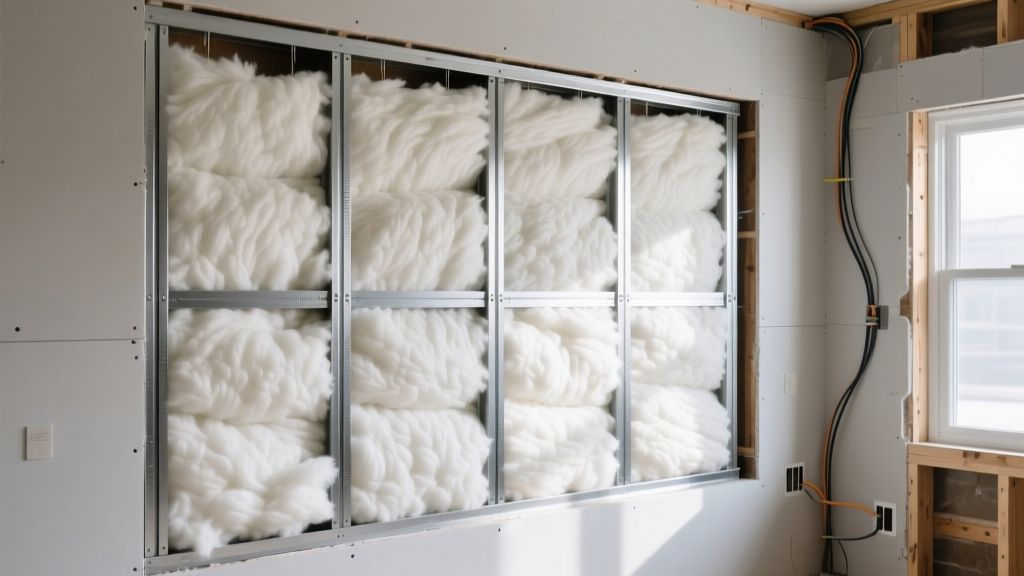
Top Insulation Construction Materials for Acoustic Control
Not all insulation is created equal. Thermal performance (R-value) does not correlate directly with acoustic performance. Below is a comparison matrix of the most effective insulation construction materials for sound control in 2026.
| Material Type | Specific Product Example | Density (lbs/cu ft) | STC Boost in 2x4 Wall | Approx. Cost (per sq ft) | Best Application |
|---|---|---|---|---|---|
| Mineral Wool Batts | Rockwool Safe'n'Sound | 2.5 | +8 to +10 | $1.10 - $1.40 | Interior partition walls, home theaters |
| Acoustic Fiberglass | OC QuietZone | 1.2 | +5 to +7 | $0.75 - $0.95 | Standard bedroom/bathroom separations |
| Open-Cell Spray Foam | Icynene Classic Max | 0.5 | +4 to +6 | $1.50 - $2.00 | Irregular cavities, retrofits |
| Mass Loaded Vinyl (MLV) | Soundproof Cow 1lb MLV | N/A (Surface mass) | +5 to +8 (when layered) | $2.50 - $3.50 | Decoupled assemblies, pipe wrapping |
Mineral Wool: The Gold Standard for Partitions
Stone wool, specifically engineered for acoustics like Rockwool Safe'n'Sound, remains the premier choice for interior soundproofing. Its high density (2.5 lbs per cubic foot) and complex, non-directional fiber matrix create immense friction for airborne sound waves, converting acoustic energy into trace amounts of heat. Unlike standard thermal batts, Safe'n'Sound is not rated for thermal resistance (R-value) because it is manufactured slightly thinner (2.5 inches) to leave a deliberate air gap in a standard 3.5-inch 2x4 cavity, which further enhances low-frequency sound absorption.
Acoustic Fiberglass: The Budget-Conscious Alternative
If mineral wool exceeds the project budget, specialized acoustic fiberglass like Owens Corning QuietZone is a viable alternative. While its density (approx. 1.2 lbs/cu ft) is lower than mineral wool, it is still significantly denser than standard pink thermal batts. It performs exceptionally well at mid-to-high frequencies (human speech, television noise) but struggles slightly more with low-frequency bass transmission compared to stone wool.
The Spray Foam Trap: Open-Cell vs. Closed-Cell
A common mistake in acoustic construction is specifying closed-cell spray foam for soundproofing. Closed-cell foam cures to a rigid, dense plastic (approx. 2.0 lbs/cu ft) that structurally couples the drywall to the wood framing, creating a direct pathway for vibrational transfer. Open-cell spray foam (0.5 lbs/cu ft) is the correct choice for acoustics; its spongy, semi-flexible matrix absorbs sound waves and provides a superior air seal, which is critical since even a 1% gap in a wall assembly can reduce its STC rating by up to 50%.
Assembly Strategies: Decoupling, Mass, and Damping
Insulation construction materials only perform to their maximum potential when integrated into a properly engineered wall assembly. The U.S. Department of Housing and Urban Development (HUD) outlines four primary elements of sound control: mass, decoupling, absorption, and damping.
Sound behaves like water; it will exploit the weakest point in your assembly. You can build an STC 55 wall with Rockwool and resilient channels, but if you install recessed can lights, back-to-back electrical boxes, or unlined HVAC return grilles, the assembly's effective STC will plummet to the 30s. Always use acoustic putty pads over electrical boxes and specify staggered-stud framing to prevent shared penetrations.
Implementing Viscoelastic Damping
To stop low-frequency structural vibration (footsteps, heavy bass), insulation must be paired with a damping compound. Green Glue Noiseproofing Compound is a viscoelastic polymer applied between two rigid layers of 5/8-inch Type X gypsum board. As the drywall flexes from sound pressure, the Green Glue shears, converting mechanical vibration into negligible heat. A standard double-stud wall with mineral wool and Green Glue can achieve an STC of 60+, effectively silencing loud musical instruments.
2026 Cost Breakdown: Soundproofing a 10x12 Media Room
To provide actionable budgeting data, here is a material-only cost breakdown for upgrading the four interior walls (approx. 340 sq ft of wall area) of a 10x12 room from a standard code-minimum assembly to a high-performance STC 50+ acoustic assembly.
| Component | Material Specification | Quantity | Estimated Material Cost |
|---|---|---|---|
| Cavity Insulation | Rockwool Safe'n'Sound (2.5" thick) | 340 sq ft | $425.00 |
| Decoupling | Resilient Sound Isolation Clips (RSIC) & Hat Channel | 85 clips / 140 ft channel | $310.00 |
| Base Layer Mass | 5/8" Type X Gypsum Board | 340 sq ft (11 sheets) | $220.00 |
| Damping Compound | Green Glue (2 tubes per 4x8 sheet) | 22 tubes | $385.00 |
| Face Layer Mass | 5/8" Type X Gypsum Board | 340 sq ft (11 sheets) | $220.00 |
| Sealant | Acoustic Caulk (OS-150 or equivalent) | 6 tubes | $60.00 |
| Total Materials | High-Performance STC 50+ Assembly | $1,620.00 (approx. $4.76/sq ft) | |
Note: Labor costs for acoustic assemblies are typically 20-30% higher than standard framing and drywall due to the meticulous attention required for sealing perimeters and isolating clips.
FAQ: Troubleshooting Acoustic Failures
Does adding more insulation keep improving the STC rating?
No. Acoustic insulation follows the law of diminishing returns. A cavity filled to 70-80% capacity with mineral wool performs virtually identically to a cavity stuffed to 100%. In fact, overstuffing the cavity can compress the batts, increasing their density to the point where they begin to mechanically couple the two sides of the drywall, slightly degrading high-frequency performance. Always cut batts to fit snugly without aggressive compression.
Can I use standard thermal fiberglass batts instead of acoustic batts?
You can, but you will sacrifice performance. Standard R-13 thermal fiberglass is too light and porous to effectively trap mid-to-low frequency sound waves. While it is better than an empty cavity, the STC improvement will be roughly 3 to 4 points, compared to the 8 to 10 points achieved by high-density mineral wool. For critical spaces like bedrooms, bathrooms, and media rooms, the $0.40 per square foot premium for acoustic-specific materials is highly justified.
How do I test my assembly for air leaks before closing the drywall?
Acoustic sealant is mandatory at the top and bottom plates, around all electrical boxes, and at any pipe penetrations. Before hanging the final layer of drywall, turn on a high-lumen work light inside the darkened cavity or adjacent room. Have a helper trace the perimeter and penetrations while you look for light bleed. If light passes through, sound will pass through. Apply a continuous 3/8-inch bead of non-hardening acoustic sealant to any visible gaps.
Written by
David NakamuraDavid Nakamura is a licensed architect (AIA) and construction technology writer focused on sustainable building methods, mass timber engineering, and high-performance building envelopes. He holds a Master of Architecture from the University of Washington and is a certified Passive House Consultant (CPHC). David spent eight years at the Seattle firm Mithun, where he led the design of three LEED Platinum projects, before founding his own practice specializing in net-zero residential design. He serves on the editorial advisory board of GreenBuilder Magazine and has authored peer-reviewed papers on cross-laminated timber (CLT) connections for the Journal of Structural Engineering. In his spare time, David teaches woodworking at Pratt Fine Arts Center and kayaks the Puget Sound.
More from David Nakamura
View all
Construction Cost
Labor Cost to Build a Deck Per Sq Ft: 2026 Installation Guide
Discover the exact labor cost to build a deck per sq ft in 2026. This installation guide breaks down contractor rates, complexity factors, and hidden fees.
Aug 4, 2026

Construction Cost
How Much Does It Cost to Build a 3 Bedroom House? Financing Guide
Learn exactly how much it costs to build a 3 bedroom house and explore 2026 financing options, construction loan types, and budget frameworks for your build.
Aug 4, 2026

Construction Cost
Cost to Build a Tennis Court: 2026 Guide
How much does it cost to build a tennis court in 2026? Breakdowns for asphalt, concrete, and synthetic surfaces plus fencing and lighting.
Jul 30, 2026