High Temp Insulation Material Guide: Ceramic vs Mineral Wool 2026
Compare high temp insulation material options for 2026. We analyze ceramic fiber, mineral wool, calcium silicate, and microporous silica for industrial heat.

The Thermal Threshold: Defining High-Temperature Insulation
In industrial and commercial construction, standard fiberglass and polyiso foams fail catastrophically when exposed to temperatures exceeding 450°F (232°C). Selecting the correct high temp insulation material requires matching the specific thermal profile, mechanical stress, and environmental exposure of the application. According to the North American Insulation Manufacturers Association (NAIMA), industrial insulation systems must account for thermal expansion, vibration, and potential moisture ingress, which dictate material viability far beyond simple maximum temperature ratings.
This guide provides a rigorous, specification-level comparison of the four primary high-temperature insulation categories used in 2026: Ceramic Fiber, High-Density Mineral Wool, Calcium Silicate, and Microporous Silica.
Core Contenders: Material Profiles & Specifications
The table below outlines the baseline engineering specifications for standard grades within each material category. Note that thermal conductivity (k-value) increases non-linearly as temperatures rise, making the 400°F benchmark critical for high-heat system design.
| Material Type | Continuous Max Temp | k-value @ 400°F (BTU·in/hr·ft²·°F) | Compressive Strength (10% deflection) | Avg. Cost per Sq. Ft. (1" Thick) |
|---|---|---|---|---|
| Ceramic Fiber Blanket | 2,300°F (1,260°C) | 0.72 | N/A (Flexible) | $1.80 - $2.50 |
| High-Density Mineral Wool Board | 1,200°F (650°C) | 0.55 | 7.5 psi (52 kPa) | $1.20 - $1.60 |
| Calcium Silicate Block | 1,200°F (650°C) | 0.41 | 100+ psi (690+ kPa) | $3.50 - $5.00 |
| Microporous Silica Panel | 1,832°F (1,000°C) | 0.14 | 15 psi (100 kPa) | $14.00 - $18.00 |
1. Ceramic Fiber Blankets & Boards (Refractory Ceramic Fibers)
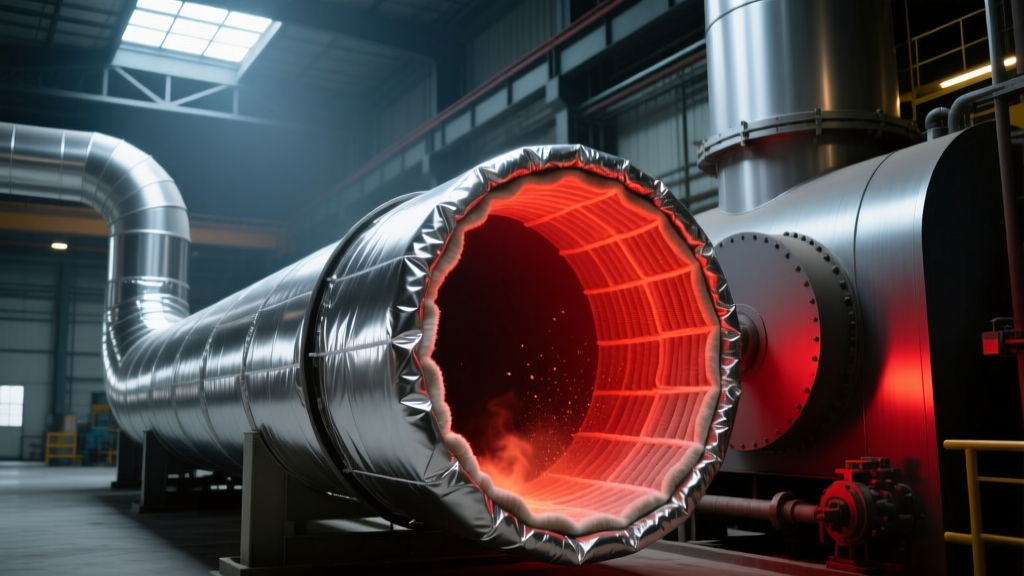
Ceramic fiber, commonly known by legacy brand names like Kaowool, is the undisputed leader for extreme heat applications such as kiln linings, boiler doors, and expansion joints. Manufactured from alumina-silica materials, these fibers maintain structural integrity up to 2,300°F. Products like Morgan Thermal Ceramics' Cerablanket are spun or blown to create a highly flexible, low-thermal-mass blanket.
Edge Case & Failure Mode: Ceramic fibers undergo devitrification when held at temperatures above 1,800°F for extended periods. The amorphous glass structure crystallizes into cristobalite, causing the material to shrink, become highly brittle, and lose its insulating value. Furthermore, the Occupational Safety and Health Administration (OSHA) classifies Refractory Ceramic Fibers (RCF) as a potential occupational carcinogen. Installation mandates strict PPE protocols, and the material must be fully encapsulated or coated with a rigidizing agent to prevent airborne fiber shedding during operation.
2. High-Density Mineral Wool (Stone Wool)
Mineral wool, specifically high-density stone wool boards (e.g., ROCKWOOL ProRox PS960), bridges the gap between commercial HVAC and light industrial applications. Spun from basalt rock and slag, the fibers themselves can withstand 1,200°F. However, the structural integrity of the board at high temperatures relies on a critical nuance: the organic binder.
The thermoset resin binder in mineral wool boards begins to oxidize and burn off at approximately 392°F (200°C). Above this threshold, the board loses its rigid factory form and relies entirely on mechanical friction and external jacketing to stay in place. If used in vertical pipe runs without adequate wire netting or metal jacketing, binder burnout will lead to severe sagging and void formation at the top of the pipe.
3. Calcium Silicate Pipe & Block
Calcium silicate (e.g., Johns Manville Thermo-1200 Gold) is a rigid, pre-formed insulation made from lime, silica, and reinforcing fibers. Governed by ASTM C533 standards, it is the premier choice for high-temperature piping and equipment that requires structural support or is subject to foot traffic during maintenance. Its compressive strength routinely exceeds 100 psi, vastly outperforming mineral wool and ceramic boards.
Corrosion Under Insulation (CUI) Risk: Calcium silicate is highly alkaline (pH > 10) and inherently hydrophilic. If the outer metal jacketing is breached and water infiltrates the system, the wet calcium silicate creates a highly corrosive alkaline poultice against carbon steel pipes. According to the National Insulation Association (NIA), preventing CUI requires meticulous jacketing, the use of hydrophobic weather barriers, and strict adherence to ASTM C1617 for corrosion testing before specifying this material in outdoor, coastal, or washdown environments.
4. Microporous Silica Panels
Microporous insulation represents the cutting edge of thermal resistance. Composed of pyrogenic silica, opacifiers (like titanium dioxide to block infrared radiation), and glass filament reinforcements, the pore structure is smaller than the mean free path of air molecules. This effectively eliminates convective and gaseous thermal transfer. The result is a k-value at 400°F that is roughly 25% of standard mineral wool.
While the upfront material cost is exceptionally high ($14+ per sq. ft.), microporous panels (such as Microtherm) are economically justified in space-constrained environments. In aerospace, marine engine compartments, and tight industrial retrofits where adding 4 inches of mineral wool is physically impossible, 1 inch of microporous silica delivers equivalent thermal performance.
Decision Framework: Selecting the Right Material
Choosing the optimal high temp insulation material requires filtering your project parameters through the following decision matrix:
- Operating Temp > 1,200°F: You must use Ceramic Fiber or Microporous Silica. Mineral wool and calcium silicate will fail structurally.
- High Vibration / Moving Equipment: Use flexible Ceramic Fiber Blankets. Rigid calcium silicate will fracture and powder under continuous mechanical vibration.
- Space Constraints / Weight Limits: Specify Microporous Silica. It provides the highest R-value per inch (R-10 at room temp, maintaining excellent resistance at 800°F) and weighs significantly less than equivalent thicknesses of stone wool.
- High Mechanical Abuse / Foot Traffic: Specify Calcium Silicate. It is the only high-temp material capable of supporting the weight of maintenance personnel without crushing or compromising the thermal envelope.
- Acoustic Attenuation Required: High-Density Mineral Wool is the superior choice. Its dense, interlocking fibrous matrix provides excellent sound absorption coefficients (NRC > 0.90) alongside thermal resistance, making it ideal for high-heat exhaust silencers and generator enclosures.
Installation Tolerances and Joint Staggering
Material selection is only half the battle; installation execution dictates system longevity. For rigid high-temp materials like calcium silicate and mineral wool boards, thermal expansion of the underlying steel pipe can reach 1/8 inch per 10 feet of pipe at 500°F. If insulation joints are tightly butted without accounting for pipe expansion, the insulation will buckle and crack when the system reaches operating temperature.
Always specify double-layer installations for temperatures above 600°F. The inner layer joints must be staggered by at least 6 inches from the outer layer joints to prevent continuous thermal short-circuits (heat leaks). Use high-temperature silicone or sodium silicate cements rated for the specific hot-face temperature to seal all longitudinal and circumferential seams, ensuring no convective air loops can form beneath the metal jacketing.
Written by
Sarah WhitfieldSarah Whitfield is a chartered quantity surveyor (MRICS) and construction cost analyst with 15 years of experience in material pricing, procurement strategy, and project budgeting. She earned her degree in Construction Management from the University of Reading (UK) and has worked on projects ranging from $2M custom homes to $180M mixed-use developments across North America and Europe. Sarah currently leads cost estimating for BuildMat Insight, maintaining a proprietary database of 4,000+ material price points updated quarterly. She is a frequent contributor to RSMeans cost data panels and has presented at the International Cost Engineering Council (ICEC) congress. Based in Denver, CO, Sarah is an avid trail runner and volunteer mentor for Women in Construction.
More from Sarah Whitfield
View all
Wood & Lumber
What Are the Different Types of Wood? A Builder's Guide
Compare structural softwoods, finish hardwoods, and engineered lumber. Analyze Janka ratings, MOE values, and 2026 pricing for construction.
Aug 4, 2026

Walls & Panels
Steel Framing vs Wood Framing: Corrosion and Moisture Defense
Compare steel framing vs wood framing for moisture resistance. Learn about galvanized coatings, condensation risks, and corrosion protection strategies.
Jul 21, 2026

Stone & Masonry
How to Cut Stone Veneer: Wet Saw vs Grinder Comparison
Compare the best tools for cutting stone veneer. We review wet saws, angle grinders, and chop saws to help you achieve clean, chip-free cuts.
Jul 21, 2026