How to Choose the Right Thermal Insulation Materials Manufacturer
Discover how to evaluate a thermal insulation materials manufacturer based on R-value compliance, EPDs, supply chain resilience, and BIM support.
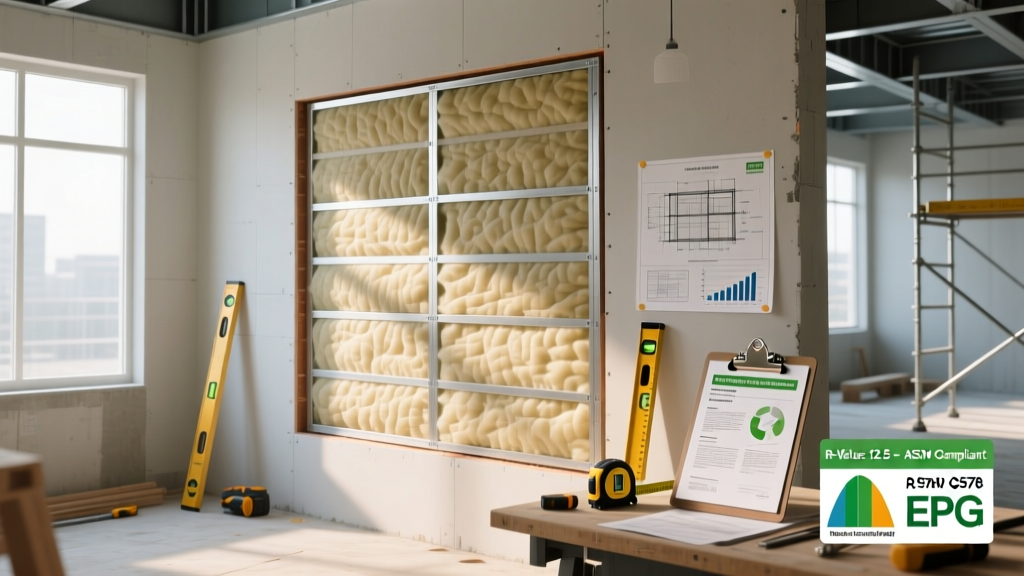
The Hidden Costs of Choosing the Wrong Insulation Partner
Procuring building envelope materials at scale requires looking far beyond the glossy product brochures. Selecting the right thermal insulation materials manufacturer is a critical decision that impacts long-term building energy performance, structural integrity, and project scheduling. A suboptimal manufacturer choice often manifests as delayed submittal approvals, inconsistent R-value performance in extreme temperatures, and catastrophic supply chain bottlenecks during peak construction seasons. For commercial and large-scale residential projects, the focus must shift from simple unit-cost comparisons to a rigorous evaluation of material science, compliance documentation, and logistical reliability.
Decoding Compliance: Beyond the FTC R-Value Rule
Any reputable manufacturer must strictly adhere to the Federal Trade Commission's R-Value Rule (16 CFR Part 460), which mandates uniform testing and labeling to prevent deceptive marketing. However, top-tier manufacturers go significantly further, providing third-party verified data that aligns with the Department of Energy's insulation guidelines and rigorous ASTM standards.
- ASTM C518 / C177: Verify that the manufacturer conducts steady-state thermal transmission testing on aged samples, not just freshly produced foam.
- ASTM E84: Require surface burning characteristics reports (Flame Spread and Smoke Developed indices) specific to the exact thickness and facer configuration you are ordering.
- UL Certification: Ensure the manufacturer's products carry active UL classifications for specific roof or wall assemblies, not just generic material listings.
Manufacturer Specialization and Material Science Matrix
Very few manufacturers excel across all insulation chemistries. The most effective procurement strategy involves matching the manufacturer's core competency to your specific building envelope requirement. Below is a matrix detailing how leading manufacturers specialize and the specific technical nuances of their flagship products.
| Manufacturer | Core Specialty | Flagship Product Line | Technical Edge Case / Consideration |
|---|---|---|---|
| Owens Corning | Fiberglass / Mineral Wool | EcoTouch & Thermafiber | Excellent acoustic NRC ratings; formaldehyde-free binders require strict moisture control during storage. |
| Rockwool | Stone Wool | Comfortboard 80 & 110 | High compressive strength (up to 16 psi) makes it ideal for parapets and heavy roofing traffic, but adds significant dead load. |
| Johns Manville | Polyiso / Fiberglass | AP Foil-Faced Polyiso | Foil facers act as vapor retarders; thermal drift in extreme cold must be accounted for in HVAC load calculations. |
| Hunter Panels | Polyiso / EPS | H-Shield Polyiso | Offers specialized tapered systems for roof drainage; lead times can extend during regional commercial roofing booms. |
The Polyiso Thermal Drift Phenomenon
When evaluating polyisocyanurate manufacturers, you must address thermal drift. Polyiso relies on blowing agents trapped within the closed-cell structure to achieve high R-values (typically R-6.0 to R-6.5 per inch). However, as the material ages and the blowing agents diffuse out, the R-value drops. More critically, polyiso experiences a significant R-value penalty at temperatures below 40°F (4°C). Premier manufacturers now utilize proprietary hydrofluoroolefin (HFO) blowing agent blends that not only stabilize the aged R-value but also drastically reduce the low-temperature performance penalty. Always request the manufacturer's LTTR (Long-Term Thermal Resistance) data sheet, verified under ASTM C1303.
Evaluating Environmental Product Declarations (EPDs)
With the adoption of LEED v4.1 and the impending v5 standards, the environmental impact of building materials is heavily scrutinized. A forward-thinking thermal insulation materials manufacturer will provide transparent, third-party verified EPDs and Health Product Declarations (HPDs). You can verify these claims using databases like UL SPOT, which catalogs sustainable building products and their specific environmental metrics.
For extruded polystyrene (XPS) and spray polyurethane foam (SPF) manufacturers, the Global Warming Potential (GWP) of their blowing agents is the critical metric. Manufacturers still relying on HFC-134a (GWP of 1,430) should be disqualified in favor of those who have fully transitioned to HFO-1234ze or HFO-1336mzz (GWP < 2). This transition is not just an environmental preference; it is increasingly mandated by state-level regulations, such as the AIM Act implementations across various US jurisdictions.

Supply Chain Resilience and Freight Realities
Insulation is inherently a high-volume, low-weight commodity. Consequently, freight costs can easily consume 20% to 35% of the total landed material cost. When selecting a manufacturer, evaluate their regional manufacturing footprint relative to your job site.
Furthermore, assess the manufacturer's raw material sourcing. Manufacturers that produce their own resin or spin their own glass fibers in-house possess greater buffer against upstream supply chain shocks compared to fabricators who merely buy raw foam buns and glue facers onto them.
Technical Support and BIM Integration Capabilities
In complex commercial builds, the manufacturer's technical support team is as valuable as the product itself. Evaluate their digital deliverables. Does the manufacturer provide LOD 300 (Level of Development) Revit families for their specific insulation profiles, including accurate thicknesses for tapered roof systems and integrated vapor retarder layers?
Additionally, top-tier manufacturers employ dedicated building envelope engineers who can review architectural details, identify thermal bridging at structural penetrations, and recommend specific detailing solutions (such as integrating fluid-applied air barriers with their rigid board transitions). This level of support mitigates costly change orders during the submittal phase.
Decision Framework: Scoring Your Shortlisted Manufacturers
To remove subjective bias from the procurement process, utilize a weighted scoring matrix when comparing your final three manufacturer candidates. Adjust the weights based on your specific project priorities (e.g., increase the weight of 'Logistics' for remote sites, or 'EPDs' for strict green building mandates).
| Evaluation Criteria | Weight | Key Metric to Verify |
|---|---|---|
| Material Science & LTTR Data | 25% | ASTM C1303 aged R-value, HFO blowing agent usage |
| Compliance & Fire Ratings | 20% | UL assembly listings, FM Global approvals |
| Supply Chain & Freight | 20% | Proximity of plant/hub, FTL delivery capabilities |
| Sustainability (EPDs/HPDs) | 15% | GWP of blowing agents, recycled content percentages |
| Technical & BIM Support | 20% | Revit family availability, envelope engineering access |
By systematically evaluating a thermal insulation materials manufacturer through this rigorous, data-driven lens, procurement teams and architects can secure building envelope systems that deliver verified thermal performance, seamless installation, and long-term durability. The initial effort invested in vetting the manufacturer's technical depth and logistical footprint invariably pays dividends in reduced field friction and optimized lifecycle energy costs.
Written by
Marcus ChenMarcus Chen is a licensed structural engineer (PE) and building materials analyst with over 12 years of experience across residential, commercial, and industrial construction. He holds a Master of Science in Civil Engineering from UC Berkeley and spent six years at Thornton Tomasetti before transitioning to independent consulting and technical writing. Marcus specializes in material selection for seismic-prone regions, concrete reinforcement strategies, and lifecycle cost analysis. His work has been cited by the American Concrete Institute (ACI) and the Structural Engineers Association of California (SEAOC). When he is not on a job site or at his desk, you will find him hiking the Sierra Nevada or restoring a 1920s craftsman bungalow in Oakland, CA.
More from Marcus Chen
View all
Construction Cost
How Much Did the Eiffel Tower Cost to Build?
How much did the Eiffel Tower cost to build in 1889? We adjust for inflation and compare its budget to modern skyscraper construction.
Aug 4, 2026

Fire Resistance
What Is a Fire Resistant Material? Testing & Certification Guide
Discover what is a fire resistant material through ASTM and UL testing. Learn how fire ratings, certifications, and assemblies work in construction.
Aug 4, 2026

Construction Cost
How Much Did the Burj Khalifa Cost to Build?
How much did the Burj Khalifa cost to build? We break down the $1.5B project and extract 5 money-saving strategies for your next build.
Jul 30, 2026