Cost Analysis: Warm Sound-Insulating Flooring Material & Bulletin Board Cork
Analyze 2026 costs for cork flooring and underlayment. Discover how bulletin board cork performs as a warm sound-insulating flooring material for homes.

The 'Bulletin Board' Connection: Why Cork Dominates Acoustic Flooring
When architects and homeowners search for a highly effective warm sound-insulating flooring material, they frequently overlook the very substance pinned with daily notices in offices and classrooms: cork. While the general public primarily associates cork with bulletin boards, high-density agglomerated cork is engineered from the exact same sustainable bark harvest (Quercus suber) but compressed under high heat and pressure to create premium flooring and acoustic underlayments.
The cellular structure of cork contains millions of microscopic, air-filled polyhedral cells coated in suberin—a naturally fire-resistant, water-repellent waxy substance. This closed-cell matrix is what gives bulletin boards their self-healing pin properties, and it is precisely what makes cork an exceptional thermal break and acoustic decoupler in floor assemblies. In 2026, as building codes mandate stricter Impact Insulation Class (IIC) ratings for multi-family dwellings, cork has transitioned from a niche eco-material to a mainstream acoustic solution.
2026 Cost Breakdown: Cork Flooring vs. Traditional Acoustic Underlayments
Evaluating the true cost of cork requires separating finished flooring from standalone acoustic underlayment. Below is the current market pricing for material and professional installation in North America.
| Product Category | Material Cost (per sq. ft.) | Install Cost (per sq. ft.) | Primary Use Case |
|---|---|---|---|
| 1/4" Cork Underlayment Rolls | $1.15 - $1.60 | $0.80 - $1.20 | Decoupling layer beneath LVP, engineered wood, or tile |
| 1/2" High-Density Cork Panels | $2.20 - $3.10 | $1.50 - $2.00 | Maximum acoustic isolation for multi-story condos |
| Glue-Down Cork Tiles (Finished) | $3.50 - $5.50 | $2.50 - $4.00 | Kitchens, bathrooms, and high-traffic commercial spaces |
| Floating Cork Planks (Finished) | $5.00 - $8.50 | $2.00 - $3.50 | Living areas, bedrooms, and DIY-friendly retrofits |
Compared to synthetic rubber acoustic mats (which average $2.50–$4.00 per square foot for material alone), cork underlayment offers a 20% to 30% cost saving while providing superior thermal resistance. According to the Cork Forest Conservation Alliance, the harvesting process strips only the bark, allowing the tree to regenerate and sequester more carbon, making it a highly sustainable investment.
Acoustic & Thermal Metrics That Justify the Premium
To understand the ROI of cork as a warm sound-insulating flooring material, you must look at the standardized testing metrics. The U.S. Department of Energy highlights the importance of continuous thermal breaks in building envelopes, a role cork fulfills exceptionally well at the floor level.
Thermal Resistance (R-Value)
Cork possesses an inherent R-value of approximately R-2.8 per inch. While this is lower than rigid XPS foam (R-5 per inch), cork's advantage lies in its structural load-bearing capacity. You can install heavy furniture over a 1/2" cork underlayment (R-1.4) without compressing the material and losing its thermal value—a common failure mode with softer foam underlayments. This thermal break prevents cold transfer from concrete slabs, keeping floor surfaces noticeably warmer to the touch.
Acoustic Performance (STC and IIC)
- Sound Transmission Class (STC): Measures airborne noise (voices, TVs). A standard 6-inch concrete slab yields an STC of ~45. Adding a 1/2" cork underlayment and a floating floor pushes the assembly STC to 55-60, exceeding the IBC code requirement of 50 for multi-family units.
- Impact Insulation Class (IIC): Measures structure-borne impact noise (footsteps, dropped objects). This is where cork excels. The compressive resilience of the suberin cells absorbs kinetic energy. A cork-insulated floor assembly routinely achieves an IIC of 55 to 62, drastically reducing the 'click-clack' of hard-soled shoes transmitted to the unit below.
Floating vs. Glue-Down: A Cost-to-Performance Decision Tree
Choosing the right installation method dictates both your upfront budget and the long-term acoustic performance of the floor.
Choose Glue-Down Tiles if: You are installing over a radiant heating system (cork's glue-down profile is thinner, allowing better heat transfer), or in a wet area like a bathroom where water ingress into the seams of a floating floor could cause swelling.
Choose Floating Planks if: You are retrofitting an existing floor (like old vinyl or tile) and cannot use chemical adhesives, or if you require the thickest possible cork layer for maximum acoustic decoupling in a condo.
Glue-Down Specifics
Glue-down cork tiles (typically 3/16" to 1/4" thick) require a perfectly level subfloor (within 1/8" over 10 feet). The cost of self-leveling compound ($1.50 - $2.50 per sq. ft.) must be factored into your budget. Furthermore, you must use a premium contact cement or water-based acrylic adhesive specifically formulated for cork, such as Wakol D-3540, which adds roughly $0.60 per square foot to the material cost.
Floating Floor Specifics
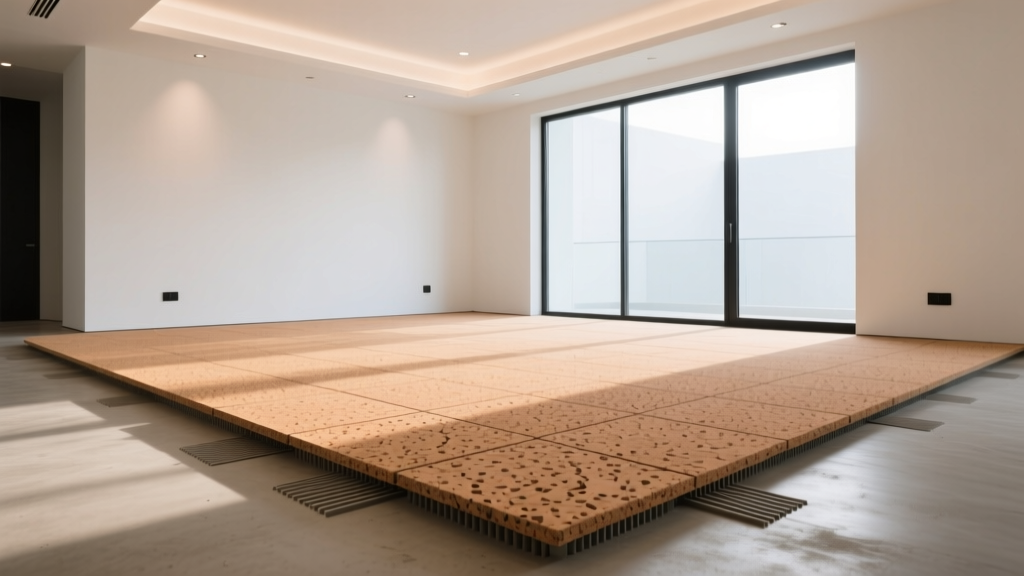
Floating cork planks (like those from Amorim or Wicanders) feature an HDF (High-Density Fiberboard) core sandwiched between a cork top layer and an integrated cork underlayment. While the material cost is higher, the subfloor prep is less rigorous, and the click-lock installation reduces labor time by up to 40% compared to glue-down methods.
Hidden Costs and Edge Cases in Cork Flooring
Budgeting for cork requires anticipating specific edge cases that can derail a project's financial projections.
- Moisture Vapor Emission Rates (MVER): Cork is naturally water-resistant, but the HDF core in floating planks and the adhesives in glue-down tiles are not. If installing over a below-grade concrete slab, you must perform a calcium chloride test. If MVER exceeds 3-5 lbs per 1,000 sq. ft. per 24 hours, you will need to apply an epoxy moisture barrier ($3.00 - $4.50 per sq. ft.) before the cork goes down.
- UV Fading and Finishing: Unfinished cork will oxidize and yellow when exposed to direct sunlight. Factory-finished planks use UV-cured polyurethane or ceramic micro-bead finishes. If you buy raw glue-down tiles, you must budget for site-applied polyurethane sealant ($1.20 per sq. ft.) and the labor to apply two to three coats.
- Acclimation Time: Cork must acclimate to the room's temperature (65°F–75°F) and humidity (35%–55%) for a minimum of 72 hours before installation. Failure to do so can result in edge-curling or gapping, leading to costly board replacements.
Long-Term ROI: Energy and Acoustic Dividends
The initial premium paid for high-density cork over standard foam underlayments is typically recouped within 5 to 7 years through reduced heating costs and extended flooring lifespan. By acting as a permanent thermal break, cork reduces heat loss through ground-floor slabs by up to 12%, according to building envelope thermal studies. Furthermore, because cork compresses and rebounds rather than bottoming out like closed-cell polyethylene foams, it prevents the premature wear and tear of the finished floor above it, delaying costly floor replacements. When evaluating a warm sound-insulating flooring material, cork's dual identity as both a humble bulletin board staple and a high-performance architectural insulator makes it one of the most cost-effective, multi-functional materials available in the 2026 market.
Written by
David NakamuraDavid Nakamura is a licensed architect (AIA) and construction technology writer focused on sustainable building methods, mass timber engineering, and high-performance building envelopes. He holds a Master of Architecture from the University of Washington and is a certified Passive House Consultant (CPHC). David spent eight years at the Seattle firm Mithun, where he led the design of three LEED Platinum projects, before founding his own practice specializing in net-zero residential design. He serves on the editorial advisory board of GreenBuilder Magazine and has authored peer-reviewed papers on cross-laminated timber (CLT) connections for the Journal of Structural Engineering. In his spare time, David teaches woodworking at Pratt Fine Arts Center and kayaks the Puget Sound.
More from David Nakamura
View all
Construction Cost
Labor Cost to Build a Deck Per Sq Ft: 2026 Installation Guide
Discover the exact labor cost to build a deck per sq ft in 2026. This installation guide breaks down contractor rates, complexity factors, and hidden fees.
Aug 4, 2026

Construction Cost
How Much Does It Cost to Build a 3 Bedroom House? Financing Guide
Learn exactly how much it costs to build a 3 bedroom house and explore 2026 financing options, construction loan types, and budget frameworks for your build.
Aug 4, 2026

Construction Cost
Cost to Build a Tennis Court: 2026 Guide
How much does it cost to build a tennis court in 2026? Breakdowns for asphalt, concrete, and synthetic surfaces plus fencing and lighting.
Jul 30, 2026