Choosing the Best Insulator Material: R-Value and Thermal Performance
Compare insulator material options by R-value and real-world thermal performance. Discover how moisture, thermal drift, and installation affect efficiency.

The R-Value Illusion: Nominal vs. Effective Thermal Resistance
When evaluating an insulator material, builders, architects, and homeowners often fixate on a single metric: the center-of-cavity R-value. Printed on the packaging of fiberglass batts, rigid foam boards, and spray foam, this number represents the material's resistance to conductive heat flow under strict, steady-state laboratory conditions (typically tested via ASTM C518 at a mean temperature of 75°F). However, relying solely on nominal R-value leads to severe underperformance in real-world building envelopes.
Nominal R-value measures only the insulation itself. Effective (or whole-wall) R-value accounts for the entire wall assembly, including thermal bridging through studs, air leakage, moisture intrusion, and installation defects. A wall with R-20 cavity insulation might only yield an effective R-value of R-13 once framing and air films are calculated.
According to research published by the Building Science Corporation, the thermal performance of an insulator material is highly dependent on its placement within the assembly and its interaction with structural elements. To make informed procurement decisions, you must compare materials based on their installed, real-world behavior rather than their laboratory ratings.
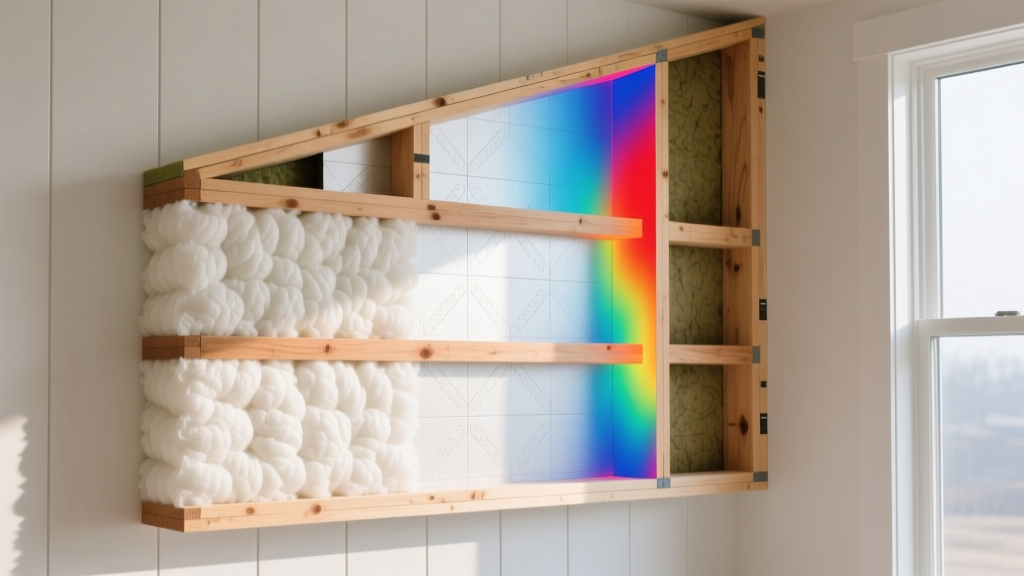
Comparative Matrix: Insulator Material Performance Data
The following table breaks down the most common residential and commercial insulator materials, contrasting their laboratory claims with real-world effective performance in a standard 2x6 wood-framed wall (16 inches on-center) with standard sheathing and drywall.
| Insulator Material | Nominal R-Value (per inch) | Effective Whole-Wall R-Value | Installed Cost (per sq ft) |
|---|---|---|---|
| Closed-Cell Spray Foam (ccSPF) | R-6.5 to R-7.0 | R-19.5 to R-21.0 | $2.50 to $3.20 |
| Polyisocyanurate Rigid Board | R-5.6 to R-6.5 | R-16.0 to R-18.0 (Cold Climate Drop) | $1.10 to $1.60 |
| Mineral Wool Batts (e.g., Rockwool) | R-4.2 to R-4.3 | R-13.5 to R-14.5 | $1.30 to $1.70 |
| High-Density Fiberglass Batts | R-3.7 to R-4.0 | R-11.5 to R-12.5 | $0.60 to $0.90 |
| Open-Cell Spray Foam (ocSPF) | R-3.5 to R-3.8 | R-12.0 to R-13.5 | $1.20 to $1.60 |
Thermal Drift: The Polyisocyanurate Anomaly
One of the most critical, yet frequently misunderstood, performance variables in modern construction is thermal drift. Polyisocyanurate (polyiso) rigid foam is heavily specified for continuous exterior insulation (ci) because it boasts the highest nominal R-value per inch among readily available rigid boards. However, polyiso relies on low-conductivity blowing agents trapped within its closed cells to achieve these numbers.
When exterior temperatures drop below 50°F, these blowing agents begin to condense. As the gas condenses into a liquid, the thermal resistance of the foam plummets. A polyiso board rated at R-6.5 per inch at 75°F can degrade to R-4.5 per inch during freezing winter conditions. This means a 2-inch layer of exterior polyiso, intended to provide R-13 of continuous insulation, may only deliver R-9 when you need it most. To mitigate this, advanced building envelopes often pair polyiso with a layer of expanded polystyrene (EPS) or extruded polystyrene (XPS), which do not suffer from thermal drift, or utilize newer HFO-blown polyiso formulations that exhibit improved cold-weather retention.
The Framing Factor: Wood vs. Steel Thermal Bridging
An insulator material does not exist in a vacuum; it is installed between structural framing. The 'framing factor' dictates the percentage of the wall assembly composed of highly conductive structural materials rather than insulation.
Wood Framing Dynamics
In a standard 2x6 wood-framed wall with studs placed 16 inches on-center, the framing factor is approximately 15% to 18%. This includes studs, top plates, bottom plates, and headers. Because wood has an R-value of roughly R-1.25 per inch, it acts as a thermal bridge, allowing heat to bypass the cavity insulation. Transitioning to 'advanced framing' (24 inches on-center with insulated headers and single top plates) reduces the framing factor to roughly 10%, significantly boosting the whole-wall R-value without changing the insulator material itself.
The Steel Framing Penalty
Light-gauge steel framing presents a severe thermal bridging challenge. Steel is roughly 400 times more conductive than wood. In a steel-framed wall, the studs act as massive heat sinks, short-circuiting the cavity insulation. The U.S. Department of Energy highlights that an R-19 fiberglass batt installed in a steel-framed wall can perform at an effective R-value as low as R-7 to R-9. When using steel studs, continuous exterior rigid insulation is not just a code upgrade; it is an absolute thermal necessity to break the conductive bridge.
Convection, Air Leakage, and the R-Value Illusion
R-value strictly measures resistance to conductive heat transfer. It does not measure resistance to convective heat loss (air movement). If an insulator material is highly air-permeable—such as standard fiberglass batts or open-cell spray foam—wind washing and stack effect can render its R-value largely irrelevant.
'Air leakage can account for 25% to 40% of the heat loss in a typical residential building. Without a continuous air barrier, the theoretical R-value of the cavity insulation is severely compromised by convective looping within the wall.' — EPA ENERGY STAR Guidelines
Closed-cell spray foam (ccSPF) and rigid foam boards sealed with specialized tape or fluid-applied membranes act as both insulators and air barriers. Fiberglass and mineral wool, however, require a separate, meticulously detailed air barrier (such as intelligent vapor retarders or exterior fluid-applied membranes) to perform to their rated R-value. If you specify high-R fiberglass but fail to detail the air barrier at the rim joists, top plates, and window rough openings, your effective thermal performance will drop by 30% or more.
Climate-Specific Insulator Material Selection Framework
Selecting the optimal insulator material requires aligning the assembly's hygrothermal properties with the specific IECC Climate Zone. Use the following decision matrix to guide material procurement:
- Climate Zones 1 to 3 (Hot-Humid / Hot-Dry): Focus on exterior continuous insulation to keep the sheathing above the dew point, preventing interior condensation. Open-cell spray foam or unfaced fiberglass batts combined with exterior EPS or XPS work well. Avoid interior polyethylene vapor retarders, which trap moisture inside the wall cavity.
- Climate Zone 4 (Mixed-Humid): This zone requires balanced drying potential in both directions. Use Class II vapor retarders (like kraft-faced batts or specific smart membranes) and ensure exterior rigid insulation ratios meet the minimum code requirements to prevent winter condensation on the interior face of the sheathing.
- Climate Zones 5 to 8 (Cold / Very Cold): Maximize exterior continuous insulation to warm the structural sheathing. Specify high-density mineral wool or XPS for exterior layers, as they maintain R-value in freezing temperatures and allow outward drying. Use closed-cell spray foam in rim joists and complex geometries to provide both high R-value (R-7 per inch) and an absolute vapor/air seal.
Installation Defects That Void Manufacturer Warranties
Even the highest-performing insulator material will fail if installed improperly. The most common installation defects that destroy R-value include:
- Compression: Stuffing an R-19 (6.25-inch) fiberglass batt into a 5.5-inch 2x6 wall cavity does not yield R-19. The compression increases the material's density but reduces its overall thickness, dropping the effective R-value to roughly R-17 or R-18. Always buy batts specifically sized for the cavity depth.
- Gaps and Voids: A gap of just 1 inch at the top or bottom of a batt allows convective air loops to form inside the wall, drastically reducing thermal resistance. Mineral wool is highly resistant to this defect due to its semi-rigid, friction-fit spring-back properties.
- Improper Spray Foam Curing: If ccSPF is applied in lifts that are too thick, the exothermic chemical reaction can cause the foam to char, shrink, and pull away from the studs, creating massive air channels and destroying the advertised R-value.
Final Verdict: Optimizing Your Insulation Strategy
Choosing the right insulator material is an exercise in systems thinking. Do not purchase insulation based solely on the highest R-value per dollar printed on the bag. Evaluate the material's susceptibility to thermal drift, its interaction with your specific framing type, and its air-permeability. For maximum real-world performance in demanding climates, hybrid assemblies—combining the air-sealing and high R-value of closed-cell foam or mineral wool in the cavity with a thermally stable rigid board on the exterior—consistently outperform single-material, center-of-cavity approaches.
Written by
David NakamuraDavid Nakamura is a licensed architect (AIA) and construction technology writer focused on sustainable building methods, mass timber engineering, and high-performance building envelopes. He holds a Master of Architecture from the University of Washington and is a certified Passive House Consultant (CPHC). David spent eight years at the Seattle firm Mithun, where he led the design of three LEED Platinum projects, before founding his own practice specializing in net-zero residential design. He serves on the editorial advisory board of GreenBuilder Magazine and has authored peer-reviewed papers on cross-laminated timber (CLT) connections for the Journal of Structural Engineering. In his spare time, David teaches woodworking at Pratt Fine Arts Center and kayaks the Puget Sound.
More from David Nakamura
View all
Construction Cost
Labor Cost to Build a Deck Per Sq Ft: 2026 Installation Guide
Discover the exact labor cost to build a deck per sq ft in 2026. This installation guide breaks down contractor rates, complexity factors, and hidden fees.
Aug 4, 2026

Construction Cost
How Much Does It Cost to Build a 3 Bedroom House? Financing Guide
Learn exactly how much it costs to build a 3 bedroom house and explore 2026 financing options, construction loan types, and budget frameworks for your build.
Aug 4, 2026

Construction Cost
Cost to Build a Tennis Court: 2026 Guide
How much does it cost to build a tennis court in 2026? Breakdowns for asphalt, concrete, and synthetic surfaces plus fencing and lighting.
Jul 30, 2026