How Lightweight Insulating Material Improves Sound Control
Discover how to use lightweight insulating material for sound control. Learn acoustic physics, top products, NRC ratings, and decoupled wall assemblies.

In architectural acoustics, the prevailing rule of thumb is the Mass Law: heavier, denser materials block sound more effectively than lighter ones. This leads to a common misconception among builders and DIYers that lightweight insulating material is useless for soundproofing. In reality, while lightweight materials do not act as standalone acoustic barriers, they are absolutely critical for managing cavity resonance, damping structural vibration, and absorbing airborne noise within decoupled assemblies. When engineered correctly, lightweight insulating material is the hidden variable that pushes a wall assembly from an STC (Sound Transmission Class) of 35 to over 55.
The Acoustic Paradox: Mass vs. Absorption
To specify the right materials, you must first separate sound isolation (blocking sound from passing through a partition) from sound absorption (converting acoustic energy into trace heat within a porous matrix). Heavy materials like Mass Loaded Vinyl (MLV), lead sheeting, and 5/8-inch Type X gypsum board provide isolation. Lightweight insulating materials provide absorption.
The Coincidence Dip and Cavity Resonance
When sound enters a hollow wall cavity, it bounces between the drywall layers, creating a resonant chamber that amplifies specific mid-to-high frequencies. Furthermore, every rigid panel has a 'coincidence frequency' where it becomes transparent to sound. By filling the cavity with a lightweight, porous insulating material, you introduce friction. As sound waves navigate the complex microscopic pathways of the insulation, the acoustic energy is dissipated as negligible thermal energy, effectively killing the cavity resonance and smoothing out the coincidence dip.
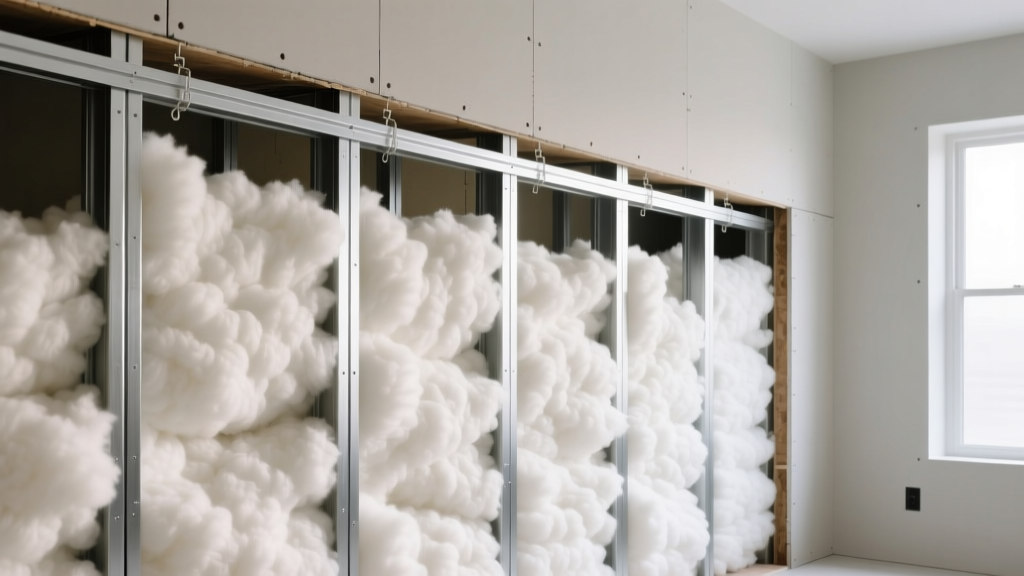
Top Lightweight Insulating Materials for Acoustics
Not all lightweight materials perform equally. Thermal resistance (R-value) does not correlate with acoustic performance. For sound control, we evaluate materials by their NRC (Noise Reduction Coefficient), measured via ASTM C423 standards. Below is a technical comparison of the most effective lightweight options available in 2026.
| Material Type | Brand / Model Example | NRC Rating (2") | Est. Cost / Sq Ft | Best Application |
|---|---|---|---|---|
| Acoustic Melamine Foam | BASF Basotect | 1.05 | $3.50 - $5.00 | High-end studios, anechoic chambers, exposed ceiling clouds. |
| Lightweight Glass Wool | Knauf Earthwool Acoustical | 0.95 | $0.60 - $0.90 | Standard residential/commercial decoupled wall cavities. |
| PET Polyester Fiber | Soundproof Cow Eco-Friendly PET | 0.85 | $1.80 - $2.50 | Moisture-prone areas, home theaters, direct-to-wall mounting. |
| Recycled Denim/Cotton | UltraTouch Denim Insulation | 0.80 | $1.20 - $1.60 | Eco-friendly retrofits, safe handling without PPE. |
Engineering a High-STC Decoupled Wall Assembly
Using lightweight insulating material in a standard single-stud wall yields diminishing returns. To maximize acoustic performance, the insulation must be paired with mechanical decoupling. Here is the exact specification sequence for achieving an STC 55+ partition using lightweight cavity fill.
Step 1: Frame for Decoupling
Avoid standard 2x4 single-stud framing at 16" on-center, as the rigid connection transfers low-frequency vibration. Instead, specify a staggered-stud design on a 2x6 plate, or build two independent 2x4 walls separated by a 1-inch air gap. This physical break prevents structural sound transmission.
Step 2: Fill the Cavity (Without Compression)
Install your chosen lightweight insulating material into the stud bays. Critical rule: Never compress the insulation to fit. If a 3.5-inch batt is forced into a 3-inch space, you destroy the porous matrix required for acoustic friction, effectively turning an absorber into a solid coupler. For 2x4 walls, use 3.5-inch unfaced batts. For 2x6 walls, use 5.5-inch batts or layer a 2-inch PET board behind a 3.5-inch glass wool batt.
Step 3: Apply Resilient Channeling
Attach 25-gauge RC-1 resilient channels horizontally across the studs at 24" on-center. Use acoustic sealant on the flanges where they meet the perimeter framing. This adds a secondary mechanical break.
Step 4: Damping and Mass Layers
Screw the first layer of 5/8-inch Type X gypsum board to the resilient channels. Apply a 3/8-inch bead of viscoelastic damping compound (e.g., Green Glue) to the back of the second layer of 5/8-inch Type X, then screw it to the first layer. The lightweight insulation handles the mid/high frequencies inside the wall, while the mass and damping compound handle the low frequencies and structural shear.
Warning: The Flanking Path Trap
Even with perfect cavity insulation and decoupling, your STC rating will plummet if you ignore flanking paths. Sound will bypass your lightweight insulation by traveling through continuous hardwood floors, shared HVAC ductwork, or unsealed electrical back-boxes. Always use putty pads on electrical boxes and install acoustic baffles in HVAC transfer grilles.
Low-Frequency Bass Trapping and Modal Ringing
While lightweight insulating material excels at mid and high-frequency absorption (500 Hz to 4000 Hz), low-frequency bass (20 Hz to 150 Hz) requires massive thickness to absorb effectively. In home theaters and recording studios, lightweight melamine foam or thick PET arrays are often built into corner bass traps. Because low-frequency waves have massive physical wavelengths, you need at least 4 to 6 inches of lightweight, high-flow-resistivity material, ideally backed by a 2-inch air gap, to begin absorbing modal ringing below 100 Hz. For pure low-frequency isolation, however, you must rely on the mass-spring-mass system of the decoupled drywall, not the insulation itself.
Sourcing and Specification Standards
When writing architectural specifications or sourcing materials for commercial builds, always demand independent laboratory test data. Do not rely on manufacturer-published 'in-house' NRC numbers. Require certification that the lightweight insulating material was tested in accordance with ASTM E90 for transmission loss and ASTM C423 for absorption. Suppliers like Soundproof Cow and major commercial distributors provide verified third-party acoustic lab reports for their PET and melamine products, ensuring your assembly will perform as engineered in the field.
By understanding the distinct role of absorption versus isolation, builders can leverage lightweight insulating material to create exceptionally quiet environments without the structural burden and cost of adding excessive mass to every partition.
Written by
Elena RodriguezElena Rodriguez is a civil engineer and technical writer specializing in concrete technology, masonry systems, and ASTM/ACI compliance. She earned her B.S. in Civil Engineering from Texas A&M University and spent a decade at a materials testing laboratory, performing over 2,000 concrete compressive strength tests and masonry prism evaluations. Elena is an ACI-certified Field Testing Technician (Grade I) and a member of ASTM Committee C12 on Natural Building Stone. She currently consults on forensic engineering cases involving concrete failures and moisture intrusion. Based in San Antonio, TX, Elena is a proud member of the Society of Women Engineers (SWE) and coaches her daughter's FIRST Robotics team.
More from Elena Rodriguez
View all
Walls & Panels
Cost Analysis: Light Gauge Steel Framing Advantages and Disadvantages
Evaluate light gauge steel framing advantages and disadvantages through a strict cost analysis lens, comparing material, labor, and lifecycle expenses.
Aug 4, 2026

Walls & Panels
Gypsum Board Types: Exact Specifications, Thickness & Dimensions
Compare standard, Type X, and moisture-resistant gypsum board types. Get exact specifications, thicknesses, dimensions, and ASTM standards for your project.
Aug 4, 2026

Fire Resistance
Best Fire-Resistant Outdoor Decking Materials: 2026 Buyer Guide
Discover the best fire-resistant outdoor decking materials for 2026. Compare Class A PVC, aluminum, and hardwood options for WUI compliance and safety.
Aug 4, 2026