Sourcing Insulation Materials Near Me: Pro Installation Specs
Learn how to evaluate local suppliers and verify exact framing widths, R-values, and vapor retarders when sourcing insulation materials near me.
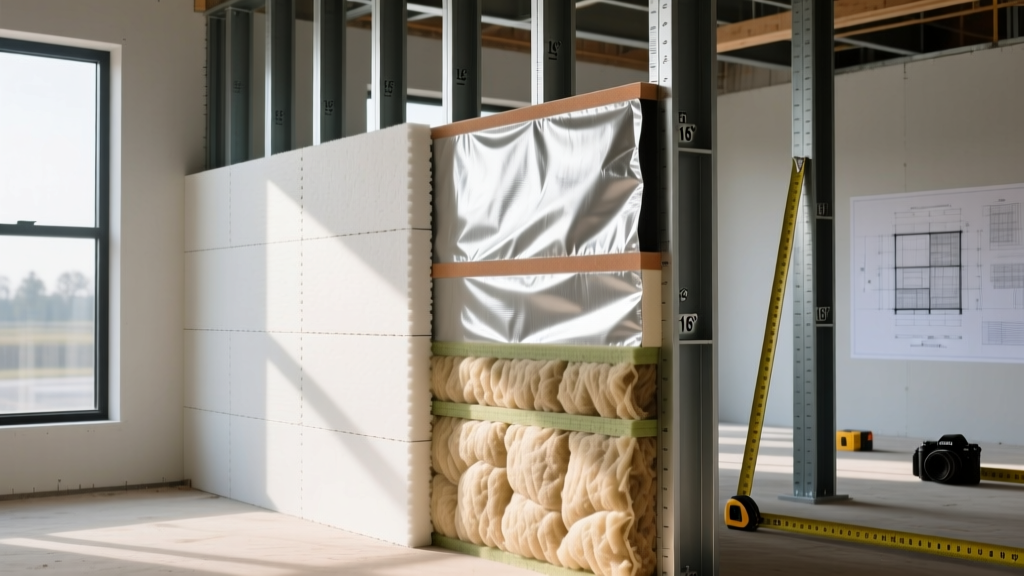
The 'Local Inventory' Trap: Why Proximity Is Not Enough
When contractors and advanced DIYers search for insulation materials near me, the results are typically dominated by big-box home improvement centers. While these stores offer immediate pickup, their inventory is heavily skewed toward standard residential retrofits—specifically 15-inch wide R-13 and R-19 batts designed for 2x4 framing at 16 inches on center (O.C.).
If your project utilizes advanced framing (24 inches O.C.) or 2x6 exterior walls, relying on local big-box stock forces a compromise. You either buy 15-inch batts and spend double the labor cutting and piecing them into 22.5-inch cavities, or you buy R-19 batts and compress them into 3.5-inch 2x4 cavities. Both approaches violate North American Insulation Manufacturers Association (NAIMA) installation standards, resulting in severe thermal bridging and lost R-value.
Material-to-Framing Matrix: What to Verify Before You Buy
Before driving to a local supplier, map your exact framing dimensions to the required insulation specs. Use this matrix to dictate your purchase order, ensuring the yard can actually fulfill the correct widths and facings.
| Framing Type | Stud Spacing | Required Batt Width | Target R-Value | Example Product Match |
|---|---|---|---|---|
| 2x4 Wall | 16' O.C. | 15' | R-13 / R-15 | Owens Corning EcoTouch R-15 |
| 2x6 Wall | 16' O.C. | 15' | R-19 / R-21 | ROCKWOOL Comfortbatt R-23 |
| 2x6 Wall (Advanced) | 24' O.C. | 23' | R-21 | Johns Manville R-21 Kraft |
| Floor Joist (2x10) | 16' O.C. | 15' | R-30 | Owens Corning ProPink R-30 |
Vapor Retarders and Climate Zone Compliance
The most frequent error when sourcing locally is buying the wrong vapor retarder class for the specific climate zone. Local lumberyards often stock only kraft-faced batts (Class II vapor retarder) because it is the highest-volume seller for their region. If you are building in a hot, humid climate (IECC Zones 1-3) and install kraft-faced insulation with the facing pointing inward, you risk trapping moisture inside the wall assembly during the cooling season.
According to the U.S. Department of Energy, vapor retarders should generally face the warm-in-winter side of the insulation. In northern climates, this means facing inward; in southern climates, it often means facing outward, or utilizing unfaced batts paired with a variable-permeance membrane.
Facing Options to Request from Local Suppliers
- Unfaced: Required for Zones 1-3, or for interior partition walls where acoustic dampening is needed without moisture trapping.
- Kraft-Faced (Class II): Standard for Zones 4 and higher. Ensure the staple flange is intact; local yards with high forklift traffic often tear the edges of kraft bundles.
- FSK (Foil-Scrim-Kraft): Class I vapor retarder. Often required for commercial HVAC plenums or specific cathedral ceiling assemblies. Rarely stocked at retail; requires a specialized distributor.

Supplier Comparison: Where to Source Locally
Not all local suppliers are equal. When searching for insulation materials near me, categorize the results into three tiers based on your installation requirements.
| Supplier Type | Inventory Depth | Pricing (Mineral Wool vs. Fiberglass) | Best For |
|---|---|---|---|
| Big Box Retail | Low (15' widths, R-13/R-19 only) | $0.65-$0.85/sq ft (Fiberglass) | Retrofits, basic 2x4 16' O.C. walls |
| Pro Lumberyard | Medium (Can special-order 23' widths) | $1.15-$1.45/sq ft (Mineral Wool) | New construction, advanced framing |
| Specialty Distributor (e.g., FBM, L&L) | High (FSK, acoustic, rigid polyiso) | Volume tiered; 10-15% cheaper on bulk | Commercial, soundproofing, high-R envelopes |
Installation Tolerances and Material Handling
The physical properties of the insulation you source locally dictate your installation technique. Fiberglass and mineral wool behave entirely differently on the job site, and buying the wrong type for your crew's skill level leads to installation defects.
Cutting and Fitting Protocols
If your local supplier only stocks mineral wool (like ROCKWOOL or Thermafiber) and you pivot from fiberglass, you must change your cutting tools. Standard utility blades dull after three or four cuts through dense rock-wool fibers. Equip your crew with serrated insulation knives or heavy-duty bread knives to ensure clean, square cuts. A jagged cut leaves a 1/4-inch gap at the stud, which the Building Science Corporation notes can reduce the thermal performance of the entire cavity by allowing convective air looping.
The Friction-Fit Requirement
Both fiberglass and mineral wool rely on a friction fit to stay in place before drywall is hung. Mineral wool is denser and holds its shape better in overhead applications (like floor joists). If you are insulating a crawlspace ceiling and your local yard only has lightweight unfaced fiberglass, you must also source mechanical fasteners (insulation hangers or wire supports) every 12 inches. Relying on friction-fit fiberglass overhead will result in sagging and detachment within 6 months due to humidity absorption and gravity.
Real-World Sourcing Checklist for the Job Site
Before finalizing a local pickup or delivery, run this exact script with the supplier's pro desk or dispatch manager:
- Width Verification: 'Do you have [15 / 23] inch widths in stock, or are you substituting 16 / 24 inch nominal sizes?' (Nominal sizes often mean the batt is actually 15.5', which causes bowing in tight 14.5' cavities).
- Facing Integrity: 'If I am ordering kraft-faced, can you guarantee the bundles are not torn on the staple flanges from forklift handling?'
- Compression Check: 'Is this R-value achieved at the exact depth of my framing (3.5' vs 5.5'), or does it require compression that drops the rating?'
- Acoustic Add-ons: 'Do you carry acoustic sealant and gasket tape to pair with the batts for the drywall air-sealing phase?'
By treating local sourcing as a technical procurement process rather than a simple retail errand, you ensure that the materials arriving on your job site actively support, rather than hinder, your installation techniques and the building's overall thermal envelope.
Written by
Sarah WhitfieldSarah Whitfield is a chartered quantity surveyor (MRICS) and construction cost analyst with 15 years of experience in material pricing, procurement strategy, and project budgeting. She earned her degree in Construction Management from the University of Reading (UK) and has worked on projects ranging from $2M custom homes to $180M mixed-use developments across North America and Europe. Sarah currently leads cost estimating for BuildMat Insight, maintaining a proprietary database of 4,000+ material price points updated quarterly. She is a frequent contributor to RSMeans cost data panels and has presented at the International Cost Engineering Council (ICEC) congress. Based in Denver, CO, Sarah is an avid trail runner and volunteer mentor for Women in Construction.
More from Sarah Whitfield
View all
Wood & Lumber
What Are the Different Types of Wood? A Builder's Guide
Compare structural softwoods, finish hardwoods, and engineered lumber. Analyze Janka ratings, MOE values, and 2026 pricing for construction.
Aug 4, 2026

Walls & Panels
Steel Framing vs Wood Framing: Corrosion and Moisture Defense
Compare steel framing vs wood framing for moisture resistance. Learn about galvanized coatings, condensation risks, and corrosion protection strategies.
Jul 21, 2026

Stone & Masonry
How to Cut Stone Veneer: Wet Saw vs Grinder Comparison
Compare the best tools for cutting stone veneer. We review wet saws, angle grinders, and chop saws to help you achieve clean, chip-free cuts.
Jul 21, 2026