Dry Stack Veneer Stone Maintenance: Cleaning & Sealing
Master dry stack veneer stone maintenance with expert cleaning techniques, sealer recommendations, and moisture prevention strategies for lasting beauty.

The Unique Maintenance Challenges of Dry Stack Veneer Stone
Dry stack veneer stone delivers a striking, mortarless aesthetic by fitting stones tightly together without visible face joints. While visually appealing, this installation method creates distinct maintenance vulnerabilities. The absence of face mortar means water, dust, and airborne pollutants can infiltrate the micro-crevices between the stones, reaching the weather-resistant barrier (WRB) and metal lath behind the veneer. According to the Natural Stone Institute, improper cleaning or sealing of mortarless stone profiles is a leading cause of premature spalling, efflorescence, and substrate moisture damage. Maintaining dry stack stone requires a precise approach to cleaning, sealing, and moisture management that differs significantly from traditional mortared masonry.
Routine Dusting and Debris Removal
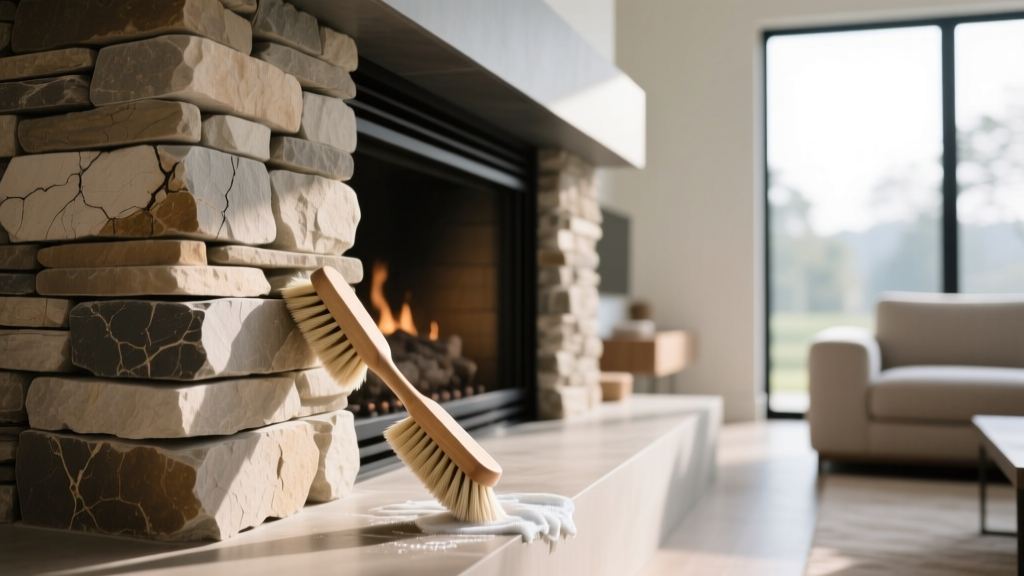
Because dry stack ledgestone and fieldstone feature heavy texturing and horizontal ledges, they act as natural dust catchers. Interior applications, particularly fireplace surrounds and accent walls, require a strict routine maintenance schedule to prevent particulate buildup from becoming embedded in the stone's pores.
Recommended Tools and Techniques
- Soft-Bristle Nylon Brushes: Use a brush with 2-inch to 3-inch flagged nylon bristles. Never use wire brushes, steel wool, or abrasive scouring pads, which will leave metallic particles that rust and permanently stain calcareous stones like limestone or travertine.
- HEPA Vacuum with Brush Attachment: For interior walls, vacuuming the stone face with a soft brush attachment on a low-suction setting removes loose particulates without grinding dust into the stone's surface.
- Microfiber Dusting: For flat-cut dry stack profiles, a dry microfiber mop can quickly capture surface dust on large expanses.
Perform routine dusting every two to four weeks for interior applications, and bi-annually for exterior walls to remove pollen, spider webs, and wind-blown soil.
Deep Cleaning Protocols for Stacked Stone
When routine dusting is insufficient, deep cleaning is required to extract embedded grime, biological growth (mold and mildew on exterior walls), and atmospheric staining. The tight joints of dry stack veneer stone mean that cleaning solutions can easily pool behind the stone face, making thorough rinsing critical.
Step-by-Step Deep Cleaning Process
- Pre-Wet the Surface: Saturate the stone and the surrounding area with clean water. This prevents the stone from absorbing the cleaning solution too rapidly, which can cause localized staining.
- Apply a Neutral-pH Cleaner: Use a dedicated, neutral-pH stone cleaner (such as PROSOCO Sure Klean® Natural Stone Cleaner). Apply using a low-pressure pump sprayer, working from the bottom of the wall upward to prevent streaking.
- Agitate Gently: Work the cleaner into the crevices using a soft nylon brush. Allow a dwell time of 3 to 5 minutes, but do not let the solution dry on the surface.
- Low-Pressure Rinsing: Rinse thoroughly with clean water. If using a pressure washer on exterior veneer, restrict the pressure to a maximum of 1,200 PSI. Use a 40-degree (white) spray tip and maintain a minimum distance of 18 inches from the stone face to avoid dislodging the veneer or forcing water behind the WRB.
Sealing Dry Stack Stone: Penetrating vs. Film-Forming
Sealing is the most critical maintenance step for dry stack veneer stone. Because water can easily bypass the stone face through the tight, unmortared joints, the stone and the substrate behind it are highly susceptible to moisture intrusion. The PROSOCO masonry care guidelines emphasize that selecting the correct sealer chemistry is vital to prevent trapped moisture, which leads to freeze-thaw spalling in colder climates.
Sealer Selection Matrix
| Sealer Type | Chemistry | Breathability | Best Application | Recoat Cycle |
|---|---|---|---|---|
| Penetrating Siloxane | Silane/Siloxane | High (Vapor permeable) | Exterior dry stack, porous stone | 3-5 Years |
| Film-Forming Acrylic | Acrylic Polymer | Low (Traps moisture) | Interior only, non-porous stone | 1-2 Years |
| Impregnating Fluoropolymer | Fluorocarbon | Medium | High-traffic interior, stain resistance | 5-7 Years |
For exterior dry stack veneer stone, a silane/siloxane penetrating sealer (such as PROSOCO Siloxane PD or Tenax Aquatec) is mandatory. These sealers line the microscopic pores of the stone, creating a hydrophobic barrier that repels liquid water while allowing water vapor to escape. Film-forming sealers (acrylics and urethanes) create a plastic-like skin on the surface. When moisture inevitably enters the wall cavity behind the dry stack joints, film-forming sealers trap it, leading to blistering, peeling, and catastrophic stone delamination.
Moisture Management and Efflorescence Treatment
Efflorescence—the white, powdery salt deposit that appears on masonry surfaces—is a common issue with dry stack installations. In mortarless systems, efflorescence typically originates from the mortar scratch coat behind the stone or from mineral-rich groundwater wicking up through the foundation.
Treating Efflorescence Safely
Do not immediately reach for chemical removers. New efflorescence is often water-soluble and can be removed by dry-brushing with a stiff nylon brush. If the deposits have hardened into insoluble calcium carbonate, apply a dedicated, non-acidic efflorescence remover (such as Aqua Mix Eff-Ex). Apply the solution, allow it to dwell for the manufacturer's specified time, and rinse thoroughly. Addressing the source of the moisture is equally important; ensure that weep holes at the base of exterior veneer walls are clear of debris and that roof flashing directs water away from the stone profile.
Structural Inspection and Repairing Loose Stones
Without the structural locking mechanism of face mortar joints, individual stones in a dry stack veneer system can occasionally loosen due to thermal expansion, substrate settling, or impact.
Repair Protocol for Dislodged Veneer
- Clean the Cavity: Remove any loose debris, old adhesive, or dust from the back of the stone and the wall cavity using a vacuum and a wire brush (only on the substrate, not the stone face).
- Apply Polyurethane Adhesive: Use a high-strength, moisture-curing polyurethane construction adhesive, such as Loctite PL Premium 3x. Apply a continuous serpentine bead to the back of the stone, keeping the adhesive at least half an inch from the edges to prevent squeeze-out onto the stone face.
- Brace and Cure: Press the stone firmly into place and brace it using painter's tape or temporary wooden shoring. Polyurethane adhesives typically require 24 to 48 hours to achieve full structural cure, depending on ambient humidity and temperature.
Frequently Asked Questions
Can I use a leaf blower to clean exterior dry stack stone?
Yes, a gas or electric leaf blower is an excellent, non-contact method for removing loose leaves, spider webs, and dry surface dust from exterior dry stack walls without risking the high-pressure water intrusion associated with power washing.
How do I know if my exterior dry stack stone needs to be resealed?
Perform a simple splash test. Flick a few drops of water onto the stone surface in an inconspicuous area. If the water beads up and rolls off, the sealer is still active. If the water immediately darkens the stone and absorbs into the pore structure, it is time to apply a fresh coat of penetrating siloxane sealer.
Is it safe to install dry stack veneer stone in a shower?
While technically possible, dry stack stone is highly discouraged for interior wet areas like showers. The unmortared joints provide thousands of entry points for water, creating an ideal environment for mold growth behind the tile backer board. If used in wet areas, the stone must be heavily sealed with a high-performance impregnating sealer, and the shower must have exceptional mechanical ventilation.
Written by
Marcus ChenMarcus Chen is a licensed structural engineer (PE) and building materials analyst with over 12 years of experience across residential, commercial, and industrial construction. He holds a Master of Science in Civil Engineering from UC Berkeley and spent six years at Thornton Tomasetti before transitioning to independent consulting and technical writing. Marcus specializes in material selection for seismic-prone regions, concrete reinforcement strategies, and lifecycle cost analysis. His work has been cited by the American Concrete Institute (ACI) and the Structural Engineers Association of California (SEAOC). When he is not on a job site or at his desk, you will find him hiking the Sierra Nevada or restoring a 1920s craftsman bungalow in Oakland, CA.
More from Marcus Chen
View all
Construction Cost
How Much Did the Eiffel Tower Cost to Build?
How much did the Eiffel Tower cost to build in 1889? We adjust for inflation and compare its budget to modern skyscraper construction.
Aug 4, 2026

Fire Resistance
What Is a Fire Resistant Material? Testing & Certification Guide
Discover what is a fire resistant material through ASTM and UL testing. Learn how fire ratings, certifications, and assemblies work in construction.
Aug 4, 2026

Construction Cost
How Much Did the Burj Khalifa Cost to Build?
How much did the Burj Khalifa cost to build? We break down the $1.5B project and extract 5 money-saving strategies for your next build.
Jul 30, 2026