Exterior Wall Stone Veneer: Technical Specs and ASTM Standards
Master exterior wall stone veneer technical specifications. Learn ASTM standards, weight limits, moisture management, and mortar requirements for facades.

Core ASTM Standards for Adhered Veneer Systems
Exterior wall stone veneer functions as a non-loadbearing cladding system, meaning it must support its own weight while transferring wind and seismic loads to the structural backing. Engineering a durable facade requires strict adherence to material and installation standards. For manufactured stone, ASTM C1670 dictates the baseline physical properties, mandating a minimum compressive strength of 1,800 psi and a maximum water absorption rate of 22%. Natural stone veneer is governed by ASTM C1879, which categorizes requirements based on lithology (e.g., limestone, sandstone, slate) and enforces rigorous freeze-thaw durability testing.
Adhered masonry veneer (AMV) relies entirely on the bond between the mortar setting bed and the substrate preparation. Unlike anchored veneer, which uses metal ties to a structural wythe, AMV depends on the mechanical interlock of the mortar into the stone's pores and the metal lath's integration with the scratch coat. Failure to meet the specific gravity and absorption thresholds outlined in these ASTM standards inevitably leads to moisture retention, freeze-thaw spalling, and eventual delamination.
Weight Thresholds and IBC Load Limits
The International Building Code (IBC) Section 1404.6 strictly limits adhered veneer to a maximum weight of 15 pounds per square foot (psf), or 73 kg/m². Exceeding this threshold requires transitioning to an anchored masonry veneer system with structural ties and a concrete or steel backing. When specifying exterior wall stone veneer, structural engineers must calculate the dead load of the heaviest stone profile in the batch, not the average.
| Material Type | Average Weight (psf) | Maximum Profile Thickness | IBC 15 psf Compliance |
|---|---|---|---|
| Manufactured Stone Veneer (MSV) | 8.5 - 12.0 | 2.5 inches | Compliant (Standard Adhered) |
| Natural Limestone (Sawn Thin) | 10.0 - 13.5 | 2.0 inches | Compliant (Standard Adhered) |
| Natural Granite (Fieldstone) | 14.0 - 18.0+ | 3.5+ inches | Non-Compliant (Requires Anchored System) |
| Natural Slate (Stacked) | 11.0 - 14.5 | 2.25 inches | Compliant (Verify Batch Density) |
Moisture Management and the Drainage Plane
Stone and mortar are porous materials that act as moisture reservoirs. When exterior wall stone veneer absorbs wind-driven rain, it holds the water against the building envelope. Without a properly engineered capillary break, this moisture migrates inward, causing wood sheathing rot and steel stud corrosion. The TMS 402/602 Building Code Requirements for Masonry Structures mandates a continuous Weather-Resistive Barrier (WRB) behind all adhered veneer.
Never terminate stone veneer directly into the soil or hardscape. Install a corrosion-resistant weep screed (ASTM C1063) at the base of all wall assemblies. The screed must be positioned a minimum of 4 inches above earth grade and 2 inches above paved surfaces. This prevents capillary wicking of ground moisture and blocks soil-borne chlorides from migrating into the mortar joints, which is the primary catalyst for severe efflorescence.
For wood-frame construction, best practice exceeds minimum code by utilizing a three-dimensional drainage mat (e.g., a 1/4-inch dimpled polymer matrix) installed over the primary WRB. This creates an unobstructed air gap that allows hydrostatic pressure to equalize and bulk water to drain freely to the weep screed, completely decoupling the moisture reservoir of the stone from the structural sheathing.
Mortar Chemistry, Lath, and Substrate Preparation
The structural integrity of exterior wall stone veneer relies on the chemical and mechanical properties of the mortar assembly. Specify ASTM C270 Type S mortar for both the scratch coat and the setting bed. Type S mandates a 1:1/2:4.5 ratio of Portland cement to hydrated lime to masonry sand, yielding a minimum compressive strength of 1,800 psi. While Type N mortar (750 psi) is acceptable for interior applications, it lacks the bond strength and freeze-thaw resilience required for exterior cladding.
Substrate Layering Sequence
- Structural Sheathing: OSB or plywood, properly gapped at 1/8-inch per manufacturer specs to allow for thermal expansion.
- Weather-Resistive Barrier (WRB): Two layers of Grade D building paper (ASTM D226) or a code-approved fluid-applied membrane. The first layer acts as the primary drainage plane; the second protects the first during lath fastening.
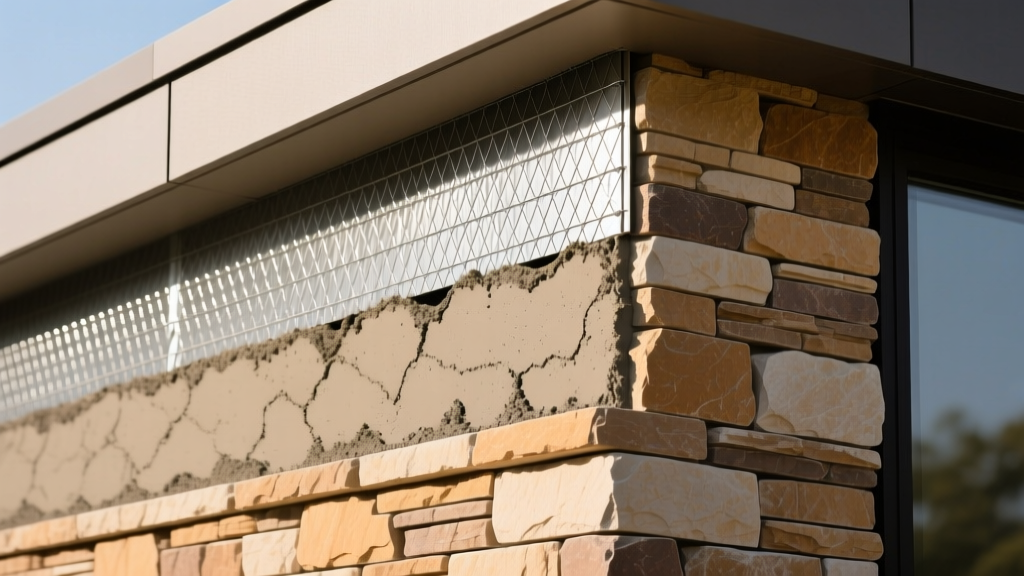
- Metal Lath: Minimum 2.5 lb/sq yd self-furring galvanized wire lath (ASTM C847). The "self-furring" dimples are critical—they hold the lath 1/4 inch away from the WRB, ensuring the scratch coat fully encapsulates the wire from behind, preventing rust and maximizing mechanical lock.
- Scratch Coat: A 1/2-inch thick layer of Type S mortar, applied forcefully to push through the lath. Must be scored horizontally at 1-inch intervals to provide a mechanical key for the setting bed. Cure for 24 to 48 hours under damp conditions before applying stone.
Freeze-Thaw Durability and Absorption Limits
In climates subject to cyclic freezing, the water absorption rate of the stone veneer is the single most critical predictor of lifespan. When trapped moisture freezes, it expands by approximately 9%, generating internal tensile stresses that exceed the stone's natural strength, resulting in micro-cracking and face spalling.
ASTM C1670 requires manufactured stone to undergo a 50-cycle freeze-thaw test (ASTM C666), where the specimen is repeatedly saturated and frozen. To pass, the material must exhibit no more than a 1% loss in mass and show no visible signs of cracking or delamination. Natural stone specified for exterior use in Zone 4 or colder must be tested for its specific saturation coefficient. If a natural stone's 24-hour cold water absorption exceeds 80% of its 5-hour boiling water absorption, it is highly susceptible to freeze-thaw failure and must be rejected for exterior adhered applications.
Troubleshooting Matrix: Failure Modes and Engineering Fixes
Even with premium materials, improper execution of technical specifications leads to predictable system failures. Refer to the Brick Industry Association Technical Notes for comprehensive masonry troubleshooting protocols. Below is a decision matrix for common exterior wall stone veneer failures.
| Failure Mode | Root Cause Analysis | Engineering Fix / Specification Correction |
|---|---|---|
| Severe Efflorescence (White Staining) | Water migrating through the wall assembly dissolves soluble salts in the Portland cement and deposits them on the surface upon evaporation. | Install a 3D drainage mat to create a capillary break. Ensure weep screeds are clear of debris. Use low-alkali Portland cement (ASTM C150 Type II) in the mortar mix. |
| Stone Delamination (Falling off wall) | Poor mechanical bond due to a dusty stone back, insufficient mortar coverage, or failure to score the scratch coat horizontally. | Brush the back of every natural stone with a stiff bristle brush before setting. Apply a 1/2-inch setting bed of Type S mortar to both the wall and the stone back (back-buttering). |
| Lath Rust Staining | Use of non-galvanized or lightly galvanized lath, or scratch coat applied too thin, leaving the wire exposed to the elements behind the stone. | Specify 2.5 lb/sq yd hot-dipped galvanized lath (ASTM A641). Ensure self-furring dimples are used so mortar fully wraps the back of the wire. |
| Mortar Joint Cracking | Mortar mixed too wet (high water-cement ratio), causing excessive shrinkage during the curing process, or joints struck before initial set. | Limit water content to achieve a stiff, workable consistency. Strike joints only when the mortar is "thumbprint hard" (initial set) to compress the surface and close micro-cracks. |
Adhering strictly to these technical specifications ensures that exterior wall stone veneer performs as a durable, weather-resistant cladding system capable of withstanding decades of environmental exposure without compromising the structural integrity of the building envelope.
Written by
David NakamuraDavid Nakamura is a licensed architect (AIA) and construction technology writer focused on sustainable building methods, mass timber engineering, and high-performance building envelopes. He holds a Master of Architecture from the University of Washington and is a certified Passive House Consultant (CPHC). David spent eight years at the Seattle firm Mithun, where he led the design of three LEED Platinum projects, before founding his own practice specializing in net-zero residential design. He serves on the editorial advisory board of GreenBuilder Magazine and has authored peer-reviewed papers on cross-laminated timber (CLT) connections for the Journal of Structural Engineering. In his spare time, David teaches woodworking at Pratt Fine Arts Center and kayaks the Puget Sound.
More from David Nakamura
View all
Construction Cost
Labor Cost to Build a Deck Per Sq Ft: 2026 Installation Guide
Discover the exact labor cost to build a deck per sq ft in 2026. This installation guide breaks down contractor rates, complexity factors, and hidden fees.
Aug 4, 2026

Construction Cost
How Much Does It Cost to Build a 3 Bedroom House? Financing Guide
Learn exactly how much it costs to build a 3 bedroom house and explore 2026 financing options, construction loan types, and budget frameworks for your build.
Aug 4, 2026

Construction Cost
Cost to Build a Tennis Court: 2026 Guide
How much does it cost to build a tennis court in 2026? Breakdowns for asphalt, concrete, and synthetic surfaces plus fencing and lighting.
Jul 30, 2026