Maintaining Wall Stone Veneer Panels: Expert Care Guide
Learn expert techniques for cleaning, sealing, and maintaining wall stone veneer panels to prevent efflorescence, staining, and mortar degradation.

The Chemistry of Stone Veneer Degradation
Wall stone veneer panels—whether manufactured from architectural concrete or quarried from natural stone—are frequently marketed as zero-maintenance cladding. This is a structural misnomer. While the stone itself may endure for decades, the mortar matrix, scratch coats, and capillary networks within the veneer system are highly susceptible to moisture intrusion. When water infiltrates the wall assembly, it dissolves water-soluble salts (primarily calcium hydroxide from Portland cement) and migrates them to the surface. Upon evaporation, these salts react with atmospheric carbon dioxide to form calcium carbonate, manifesting as efflorescence. Over time, trapped moisture subjected to freeze-thaw cycles generates hydrostatic pressure that exceeds the tensile strength of the veneer, leading to catastrophic spalling and delamination.
Proper maintenance of wall stone veneer panels requires an understanding of masonry chemistry, precise cleaning parameters, and the strategic application of breathable water repellents. The protocols below outline the exact methodologies required to preserve both manufactured and natural stone veneer systems.
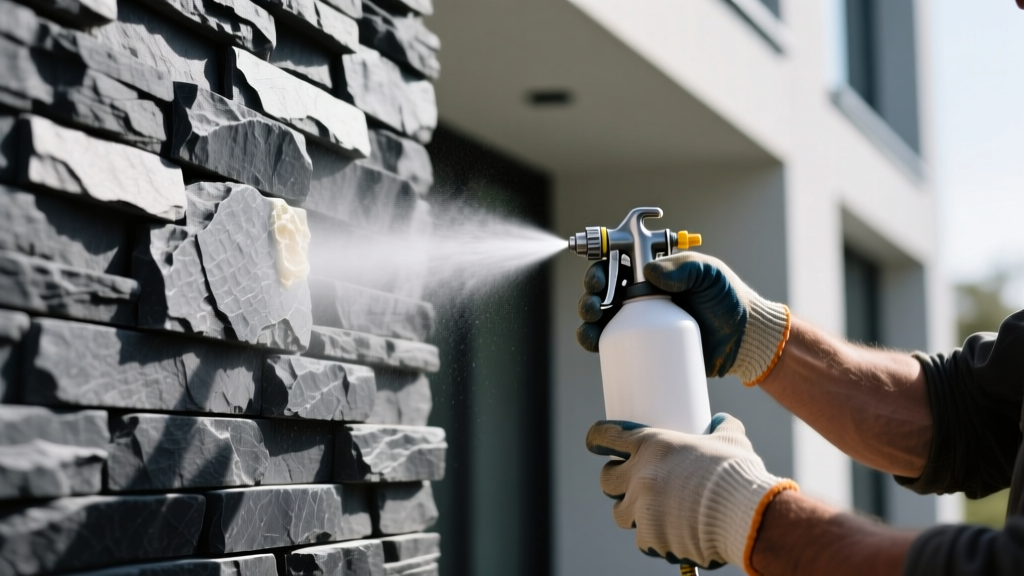
Safe Cleaning Protocols for Wall Stone Veneer Panels
Routine cleaning removes biological growth, atmospheric pollutants, and early-stage efflorescence before they compromise the mortar joints. However, aggressive cleaning methods can permanently etch manufactured stone or erode the natural patina of sandstone and limestone.
Pressure Washing Parameters
High-pressure water can fracture the cured surface of manufactured veneer panels and drive water deep into the wall cavity, bypassing the weather-resistant barrier (WRB). Adhere strictly to these limits:
| Veneer Type | Maximum PSI | Nozzle Requirement | Minimum Distance |
|---|---|---|---|
| Manufactured Concrete Veneer | 1,500 PSI | 40-degree (White Tip) | 18 inches |
| Natural Sandstone / Limestone | 800 PSI | 40-degree (White Tip) | 24 inches |
| Natural Granite / Slate | 2,000 PSI | 25-degree (Green Tip) | 12 inches |
Never use muriatic (hydrochloric) acid or unbuffered acidic cleaners on manufactured wall stone veneer panels. The acid reacts with the Portland cement matrix, dissolving the binder and causing the aggregate to loosen and shed. For heavy mineral deposits, use a specialized, buffered masonry cleaner like Prosoco DailyKlean or a pH-neutral detergent applied with a soft nylon bristle brush.
Water Repellents and Sealers: Penetrating vs. Film-Forming
Applying the wrong sealer to exterior wall stone veneer panels is the leading cause of premature system failure. Sealers dictate how the wall assembly manages vapor drive and bulk water.
Sealer Comparison Matrix
| Sealer Chemistry | Mechanism | Vapor Permeability | Best Application | Failure Risk |
|---|---|---|---|---|
| Silane / Siloxane | Penetrating (lines pores) | High (Breathable) | Exterior Veneer | Low (requires reapplication every 5-7 years) |
| Acrylic / Urethane | Film-forming (surface coat) | None (Traps vapor) | Interior Veneer Only | High (causes freeze-thaw spalling on exteriors) |
| Silicate / Lithium | Densifier (reacts chemically) | High (Breathable) | Interior Concrete Veneer | Low (permanent, but does not repel liquid water) |
For exterior applications, a penetrating silane-siloxane blend is mandatory. Products like Prosoco Siloxane PD penetrate up to 1/4 inch into the masonry, bonding chemically with the silica in the stone and mortar to create a hydrophobic barrier. This prevents liquid water ingress while allowing interior water vapor to escape. Film-forming acrylics create a plastic skin on the surface; when interior humidity attempts to exit the wall cavity, it condenses behind the acrylic film, saturating the stone and leading to severe winter spalling.
Troubleshooting Decision Matrix: Symptoms and Fixes
When wall stone veneer panels exhibit signs of distress, accurate diagnosis is required to prevent cascading structural damage. Use this framework to identify and remediate common failures.
- Symptom: White, powdery crystalline residue on the stone surface.
Cause: Efflorescence (salt migration).
Fix: Do not wash with water, which drives salts back into the pores. Use a stiff, dry nylon brush to remove the bulk of the crystals. Follow up with a specialized efflorescence remover (e.g., Prosoco Efflorescence Cleaner) applied via low-pressure pump sprayer. Identify and repair the moisture source (failed flashing, clogged weep holes, or roof runoff). - Symptom: Hairline cracking or crumbling in mortar joints.
Cause: Thermal expansion, structural settling, or freeze-thaw degradation of the mortar.
Fix: Rake out the compromised mortar to a depth of twice the joint width. Repoint using a Type N mortar mix (1 part Portland cement, 1 part hydrated lime, 6 parts masonry sand), which offers the ideal balance of compressive strength and flexibility for veneer systems. Consult the National Park Service Preservation Brief 2 for detailed repointing methodologies. - Symptom: Green, black, or red biological staining, typically on north-facing elevations.
Cause: Algae, cyanobacteria, or moss growth thriving in shaded, damp microclimates.
Fix: Apply a solution of sodium hypochlorite (standard household bleach) diluted at a 1:10 ratio with water. Allow a 15-minute dwell time without letting the solution dry on the surface, then rinse thoroughly with low-pressure water. Trim back vegetation to maintain a minimum 12-inch clearance from the veneer to improve airflow and UV exposure.
Interior vs. Exterior Maintenance Divergence
The maintenance requirements for interior wall stone veneer panels differ fundamentally from exterior installations due to the absence of weather loading and UV exposure.
Interior Veneer Care
Interior panels, such as those used on fireplace surrounds or accent walls, primarily accumulate household dust, pet dander, and airborne grease (in kitchen applications). Avoid using wax-based polishes or oil-soaps. These products leave a sticky residue that traps dust and alters the natural sheen of the stone. Instead, use a microfiber duster for routine maintenance and a pH-neutral stone cleaner diluted in warm water for periodic deep cleaning. For interior manufactured stone, a matte-finish acrylic sealer can be applied to prevent dusting and make the surface wipeable, as vapor trapping is not a concern in climate-controlled interiors.
Exterior Veneer Care
Exterior maintenance focuses heavily on water management. The Brick Industry Association Technical Notes emphasize that masonry veneers are designed to manage water, not act as absolute barriers. Therefore, ensuring that weep holes at the base of the veneer are completely clear of soil, mulch, and debris is the single most critical exterior maintenance task. Grade the surrounding soil so it slopes away from the foundation at a minimum 5% grade (6 inches of drop over 10 feet) to prevent capillary wicking into the bottom course of the stone panels.
Annual Inspection and Maintenance Checklist
Execute this checklist bi-annually (spring and late autumn) to maximize the lifespan of your wall stone veneer panels.
- Clear Weep Holes: Use a shop vacuum or compressed air to clear debris from weep holes located just above the foundation flashing.
- Inspect Mortar Joints: Run a flathead screwdriver lightly along the mortar joints. If the mortar crumbles or powders easily, schedule repointing before the winter freeze.
- Check Flashing Intersections: Examine the flashing where the veneer meets the roofline, windows, and doors. Reapply exterior-grade polyurethane sealant (e.g., Sikaflex) to any gaps where the flashing meets the stone.
- Manage Vegetation: Prune ivy, shrubs, and tree branches to maintain a strict 12-inch clearance from the stone surface. Ivy rootlets can penetrate micro-fissures in manufactured stone and pry panels loose.
- Evaluate Sealer Beading: Splash a cup of water onto the exterior veneer. If the water absorbs into the stone within 30 seconds rather than beading on the surface, the silane-siloxane sealer has degraded and requires reapplication.
By adhering to these precise chemical, mechanical, and structural maintenance protocols, property owners can ensure that wall stone veneer panels retain their structural integrity and aesthetic profile for decades, avoiding the costly remediation associated with moisture-induced masonry failures.
Written by
Sarah WhitfieldSarah Whitfield is a chartered quantity surveyor (MRICS) and construction cost analyst with 15 years of experience in material pricing, procurement strategy, and project budgeting. She earned her degree in Construction Management from the University of Reading (UK) and has worked on projects ranging from $2M custom homes to $180M mixed-use developments across North America and Europe. Sarah currently leads cost estimating for BuildMat Insight, maintaining a proprietary database of 4,000+ material price points updated quarterly. She is a frequent contributor to RSMeans cost data panels and has presented at the International Cost Engineering Council (ICEC) congress. Based in Denver, CO, Sarah is an avid trail runner and volunteer mentor for Women in Construction.
More from Sarah Whitfield
View all
Wood & Lumber
What Are the Different Types of Wood? A Builder's Guide
Compare structural softwoods, finish hardwoods, and engineered lumber. Analyze Janka ratings, MOE values, and 2026 pricing for construction.
Aug 4, 2026

Walls & Panels
Steel Framing vs Wood Framing: Corrosion and Moisture Defense
Compare steel framing vs wood framing for moisture resistance. Learn about galvanized coatings, condensation risks, and corrosion protection strategies.
Jul 21, 2026

Stone & Masonry
How to Cut Stone Veneer: Wet Saw vs Grinder Comparison
Compare the best tools for cutting stone veneer. We review wet saws, angle grinders, and chop saws to help you achieve clean, chip-free cuts.
Jul 21, 2026