Carbon Fiber Foundation Repair Cost: 2026 Case Studies
Analyze real-world carbon fiber foundation repair cost through 2026 case studies, comparing ROI, embodied carbon savings, and structural limits.

The Carbon Footprint of Foundation Triage
When a foundation wall begins to bow or shear, the traditional reflex is demolition and replacement. However, pouring new concrete is highly carbon-intensive. The global concrete industry is responsible for roughly 8% of all CO2 emissions. In 2026, sustainable structural engineering prioritizes retaining and reinforcing existing embodied carbon over replacement. Carbon Fiber Reinforced Polymer (CFRP) systems have emerged as the premier low-carbon alternative to steel I-beams and wall rebuilds.
When evaluating carbon fiber foundation repair cost, contractors and homeowners must look beyond the initial invoice. The true financial and environmental ROI includes avoided excavation costs, zero heavy machinery emissions, and eligibility for LEED v4.1 Material and Resources (MR) credits for building life-cycle impact reduction. Below, we break down two distinct 2026 case studies to illustrate the real-world economics and structural limits of CFRP foundation repairs.
• Average CO2 Avoided: 3.2 metric tons per 40-linear-foot wall rebuild prevented.
• Site Disruption: Zero exterior excavation required.
• Typical Tensile Strength: 10,000 to 14,000 PSI (unidirectional CFRP straps).
• LEED Alignment: Qualifies under USGBC MR Credit: Building Life-Cycle Impact Reduction.
Case Study A: StablWall Straps on CMU Block Bowing
Project Parameters & Execution
A 1970s residential build in Ohio exhibited 1.5 inches of inward bowing along a 40-foot Concrete Masonry Unit (CMU) basement wall due to expansive clay soil and hydrostatic pressure. The structural engineer specified unidirectional carbon fiber straps to halt lateral movement without exterior excavation.
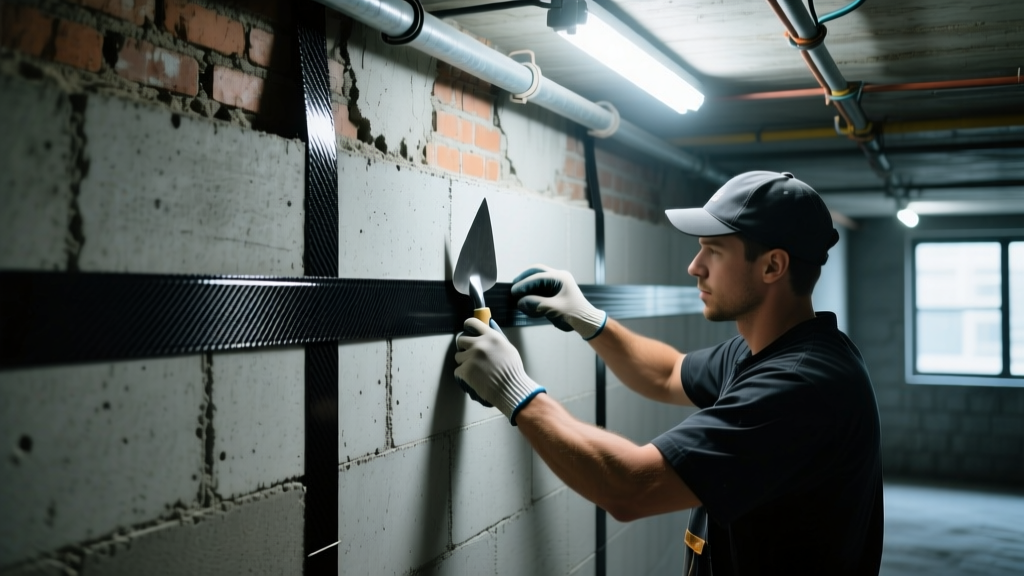
The installation team utilized the StablWall Carbon Fiber Strap System. Surface preparation is the most critical variable in CFRP adhesion. The crew ground the block face to a Concrete Surface Profile (CSP) 3, removing all paint, efflorescence, and mortar droppings. They then applied a 100% solids structural epoxy paste, embedding the carbon fiber straps vertically every 48 inches, wrapping the top strap into the rim joist and the bottom strap into the foundation floor slab to create a continuous load path.
Cost Breakdown & Carbon Savings
- Materials (10 StablWall Kits): $2,800
- Labor & Surface Prep (14 hours): $2,100
- Engineering & Permits: $650
- Total Carbon Fiber Foundation Repair Cost: $5,550 ($138 per linear foot)
Comparative Avoidance: Excavating, demolishing, and repouring this 40-foot wall would have cost between $18,000 and $24,000 in 2026. Furthermore, replacing the wall would have required approximately 14 cubic yards of concrete, generating an estimated 4,900 lbs of embodied CO2. The CFRP repair utilized less than 60 lbs of composite material, representing a 98% reduction in material-based emissions.
Case Study B: Fortress Grid System on Poured Concrete Shear
Project Parameters & Execution
A commercial retaining wall in a LEED-certified municipal facility showed severe diagonal shear cracking and localized spalling. Unidirectional straps were insufficient here because the wall required multi-directional tensile reinforcement to handle complex lateral earth loads and shear forces.
The engineering firm specified the Fortress Stabilization Carbon Fiber Grid System, a biaxial woven grid that provides strength in both vertical and horizontal axes. The crew routed the existing cracks and injected them with a low-viscosity structural epoxy to rebond the concrete matrix. Following the ACI Committee 440 guidelines for externally bonded FRP systems, they applied a saturating epoxy and embedded the biaxial carbon fiber grid across the 800-square-foot affected area, finishing with a UV-resistant polyurethane topcoat.
Cost Breakdown & Carbon Savings
- Materials (Fortress Grid & Epoxies): $14,400
- Labor (Crack Injection & Grid Application): $11,200
- Non-Destructive Testing (Pull-off adhesion tests): $1,200
- Total Carbon Fiber Foundation Repair Cost: $26,800 ($33.50 per square foot)
While the upfront cost is higher than strap systems, this biaxial grid approach allowed the municipality to retain the existing retaining wall. According to USGBC LEED v4.1 guidelines, maintaining the existing structure and avoiding the demolition of 800 square feet of reinforced concrete secured vital MR credits for the facility's ongoing green certification.
2026 Cost vs. Embodied Carbon Matrix
The following matrix compares standard foundation repair methodologies based on current 2026 pricing and environmental impact metrics. Data assumes a standard 40-linear-foot, 8-foot-high basement wall with moderate inward bowing.
| Repair Methodology | Avg. Cost (40ft Wall) | Embodied Carbon Impact | Installation Time | Exterior Excavation Required? |
|---|---|---|---|---|
| CFRP Straps (Unidirectional) | $4,500 - $6,500 | Extremely Low (<100 kg CO2e) | 1 - 2 Days | No |
| CFRP Grid (Biaxial) | $12,000 - $18,000 | Low (~150 kg CO2e) | 3 - 4 Days | No |
| Steel I-Beam Bracing | $14,000 - $20,000 | Moderate (Steel smelting emissions) | 3 - 5 Days | Sometimes (for exterior drainage) |
| Excavate & Rebuild (Concrete) | $18,000 - $28,000+ | Extremely High (~5,000 kg CO2e) | 2 - 3 Weeks | Yes (Massive site disruption) |
Failure Modes: When Carbon Fiber is the Wrong Choice
Carbon fiber possesses immense tensile strength, but it is not a panacea for all foundation ailments. Misapplication leads to catastrophic failure and wasted capital. Based on EPA sustainable materials management principles, specifying the wrong material negates any environmental benefit due to the need for secondary repairs. Avoid CFRP in the following edge cases:
- Active Footing Settlement: CFRP straps only stabilize the wall face. If the underlying concrete footing is sinking due to poor soil bearing capacity, the wall will continue to drop. The carbon fiber will either delaminate from the concrete or snap under the unexpected compressive and shear loads. Underpinning (helical piers) is required first.
- Unmitigated Hydrostatic Pressure: Carbon fiber can hold back soil, but it cannot hold back water. If exterior drainage (French drains, proper grading) is not installed, hydrostatic pressure can exceed 60 lbs per square foot. This force can push the concrete block out from behind the carbon fiber strap, causing the block to spall and the strap to remain intact while the wall fails.
- Walls with >2 Inches of Bowing: Most CFRP systems are engineered to arrest movement in walls that have bowed up to 2 inches. Beyond this threshold, the wall must be hydraulically pushed back toward plumb before strap application, or traditional excavation and rebuilding becomes structurally mandatory.
- Severe Mortar Deterioration: On CMU walls, if the mortar joints are crumbling or missing, the carbon fiber will bond only to the face of individual blocks. When lateral pressure is applied, the blocks will simply separate at the joints, rendering the strap useless. Tuckpointing and structural grouting must precede CFRP installation.
Sourcing and Contractor Vetting for LEED Compliance
To ensure your carbon fiber foundation repair cost translates into genuine structural and environmental value, contractor vetting is paramount. In 2026, require your contractor to provide an ICC-ES (International Code Council Evaluation Service) report specific to the CFRP brand they are installing. This ensures the epoxy and carbon fiber composite have been independently tested for long-term creep and alkaline resistance within concrete environments.
Furthermore, demand post-installation pull-off adhesion testing (ASTM D7234). This destructive test verifies that the epoxy achieved a minimum bond strength of 200 PSI to the concrete substrate, ensuring the system will perform as engineered over its 50-year lifecycle. By prioritizing precise surface prep, verified materials, and correct structural application, CFRP remains the most cost-effective and ecologically responsible foundation repair method available today.
Written by
Marcus ChenMarcus Chen is a licensed structural engineer (PE) and building materials analyst with over 12 years of experience across residential, commercial, and industrial construction. He holds a Master of Science in Civil Engineering from UC Berkeley and spent six years at Thornton Tomasetti before transitioning to independent consulting and technical writing. Marcus specializes in material selection for seismic-prone regions, concrete reinforcement strategies, and lifecycle cost analysis. His work has been cited by the American Concrete Institute (ACI) and the Structural Engineers Association of California (SEAOC). When he is not on a job site or at his desk, you will find him hiking the Sierra Nevada or restoring a 1920s craftsman bungalow in Oakland, CA.
More from Marcus Chen
View all
Construction Cost
How Much Did the Eiffel Tower Cost to Build?
How much did the Eiffel Tower cost to build in 1889? We adjust for inflation and compare its budget to modern skyscraper construction.
Aug 4, 2026

Fire Resistance
What Is a Fire Resistant Material? Testing & Certification Guide
Discover what is a fire resistant material through ASTM and UL testing. Learn how fire ratings, certifications, and assemblies work in construction.
Aug 4, 2026

Construction Cost
How Much Did the Burj Khalifa Cost to Build?
How much did the Burj Khalifa cost to build? We break down the $1.5B project and extract 5 money-saving strategies for your next build.
Jul 30, 2026