7 Innovative Sustainable Building Materials Transforming 2026
Discover the top innovative sustainable building materials for 2026. Compare costs, R-values, and carbon footprints for your next green construction project.

The Shift from Operational to Embodied Carbon
For decades, green building focused primarily on operational carbon—reducing the energy required to heat, cool, and light a structure. In 2026, the industry mandate has decisively shifted toward embodied carbon: the greenhouse gas emissions generated during the extraction, manufacturing, and transportation of building materials. According to the Whole Building Design Guide (WBDG), selecting low-embodied-carbon materials is now the most critical lever for achieving net-zero construction. This complete guide details the most viable innovative sustainable building materials currently available for commercial and high-end residential projects, complete with structural specifications, thermal performance data, and real-world pricing.
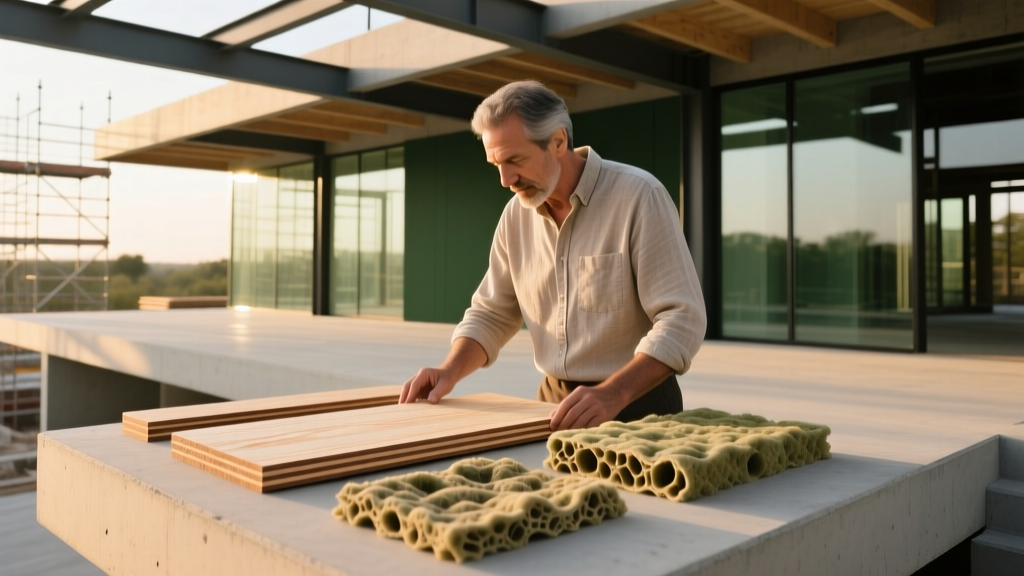
1. Mycelium-Based Insulation and Acoustic Panels
Mycelium, the vegetative root structure of fungi, is grown in molds filled with agricultural waste (like corn stalks or hemp hurds). The resulting composite is baked to halt growth, yielding a rigid, lightweight panel. Brands like Ecovative MycoBoard have scaled this technology for commercial interiors.
Technical Specifications & Performance
- Thermal Resistance: R-3.8 to R-4.2 per inch, comparable to expanded polystyrene (EPS).
- Acoustic Absorption: NRC (Noise Reduction Coefficient) of 0.75 to 0.85 at 500 Hz, making it superior to standard fiberglass for open-plan offices.
- Fire Rating: Naturally chars without melting; achieves ASTM E84 Class A when treated with non-toxic borate solutions.
- Cost: $4.50 to $6.50 per square foot (installed as interior acoustic baffles or cavity insulation).
Application constraint: Mycelium is strictly for non-structural, interior, or protected cavity applications. It degrades if exposed to continuous liquid water, requiring a vapor barrier in exterior wall assemblies.
2. Hempcrete Blocks (Hemp-Lime Composites)
Hempcrete is a bio-composite made from the inner woody core of the hemp plant (hurds) mixed with a lime-based binder and water. Unlike traditional concrete, it is carbon-negative; the hemp sequesters CO2 during growth, and the lime binder continues to absorb CO2 as it cures and carbonates over decades.
Technical Specifications & Performance
- Thermal Resistance: R-2.4 to R-3.5 per inch. While lower than petrochemical foams, its high thermal mass provides excellent phase-shift properties, stabilizing indoor temperatures.
- Compressive Strength: 0.5 to 1.5 MPa (72 to 217 psi). Do not use for load-bearing foundations or columns. It requires a structural timber or steel frame.
- Moisture Regulation: Highly vapor-permeable (mu-value of 5-10), allowing walls to 'breathe' and drastically reducing mold risk.
- Cost: $8.00 to $12.00 per square foot of wall area (materials and specialized labor).
3. Cross-Laminated Timber (CLT) & Mass Timber
CLT consists of multiple layers of kiln-dried lumber boards stacked in alternating directions and bonded with structural adhesives. This cross-lamination provides dimensional stability and strength comparable to precast concrete, allowing for multi-story timber construction.
Technical Specifications & Performance
- Carbon Sequestration: Stores approximately 1.1 tons of CO2 per cubic meter of wood.
- Fire Resistance: Achieves 1-hour and 2-hour fire ratings (per ASTM E119) through predictable charring rates (typically 1.5 inches per hour for the outer lamella), which insulates the structural core.
- Span Capabilities: 5-ply CLT panels (approx. 6.8 inches thick) can span up to 20 feet for floor systems.
- Cost: $45.00 to $75.00 per square foot of floor area (fabricated and craned into place), offset by a 20-30% reduction in overall construction time.
Material Comparison Matrix
| Material | Embodied Carbon (kgCO2e/kg) | R-Value per Inch | Approx. Cost (USD) | Primary Application |
|---|---|---|---|---|
| Mycelium Panels | -0.5 (Negative) | R-3.8 to R-4.2 | $4.50 - $6.50 / sq ft | Interior acoustic/insulation |
| Hempcrete | -1.2 (Negative) | R-2.4 to R-3.5 | $8.00 - $12.00 / sq ft | Non-load bearing exterior walls |
| CLT (Mass Timber) | -0.9 (Negative) | R-1.25 (per inch) | $45.00 - $75.00 / sq ft | Structural floors, walls, roofs |
| Ferrock | 0.05 (Near Zero) | N/A (Structural) | $120 - $150 / cu yd | Slabs, foundations, flatwork |
| Aerogel Blankets | 4.5 to 6.0 | R-10.0 | $3.00 - $5.00 / board ft | Space-constrained retrofits |
4. Ferrock and AshCrete (Low-Carbon Concrete Alternatives)
Traditional Portland cement accounts for roughly 8% of global CO2 emissions. Ferrock replaces cement with iron-rich dust recycled from steel mills and silica from ground glass. When cured, it actually absorbs CO2 to harden. AshCrete utilizes fly ash (a coal combustion byproduct) activated with alkali solutions, bypassing the need for clinker entirely.
Technical Specifications & Performance
- Compressive Strength: Ferrock achieves 7,000 to 9,000 psi, significantly outperforming standard 3,000 psi Portland mixes.
- Permeability: Highly resistant to chloride ion penetration, making it ideal for marine environments or de-icing salt exposure.
- Cost: $120 to $150 per cubic yard. While the material cost is 15-20% higher than standard concrete, the reduced curing time and superior durability lower lifecycle maintenance costs.
5. Recycled Silica Aerogel Insulation
Aerogel is a synthetic porous ultralight material derived from a gel, in which the liquid component is replaced with a gas. The result is a solid with extremely low density and low thermal conductivity. Modern 2026 formulations utilize up to 50% recycled silica glass.
Technical Specifications & Performance
- Thermal Resistance: R-10.0 per inch, the highest commercially available insulation.
- Thickness: Achieves R-20 in a mere 2-inch profile, critical for historic masonry retrofits where preserving interior square footage is paramount.
- Cost: $3.00 to $5.00 per board foot. Due to high costs, it is strictly specified for thermal bridging mitigation (e.g., balcony connections, window reveals) rather than whole-wall cavity fill.
6. Bio-Based Polyurethane (PU) Foams
Standard spray foam relies on petrochemical polyols. Bio-based PU foams replace 20% to 40% of the petrochemical polyols with soy, castor oil, or cashew nut shell liquids. While not entirely bio-based, this reduction significantly lowers the embodied carbon of the building envelope.
Technical Specifications & Performance
- Thermal Resistance: R-6.5 to R-7.0 per inch for closed-cell formulations.
- Blowing Agents: Modern 2026 bio-foams utilize hydrofluoroolefin (HFO) blowing agents with a Global Warming Potential (GWP) of less than 1, down from the HFC agents that had GWPs over 1,000.
- Cost: $1.80 to $2.50 per board foot (installed), virtually identical to traditional closed-cell foam.
7. Transparent Wood (Lignin-Modified Timber)
Still transitioning from university labs to commercial pilot projects, transparent wood is created by chemically removing lignin (the component that gives wood its color and rigidity) and infusing the remaining cellulose scaffold with a bio-based epoxy. The result is a material that transmits up to 90% of visible light while maintaining the structural tensile strength of natural wood.
Technical Specifications & Performance
- Thermal Insulation: 5 times better than standard architectural glass due to the insulating properties of the cellulose matrix.
- Load Bearing: Can be used in structural glazing applications where standard glass would require heavy steel mullions.
- Cost & Availability: Currently limited to custom architectural facades and skylights, costing upwards of $150 per square foot. Expect broader commercial availability in curtain wall systems by 2028.
Procurement Strategy: Securing LEED v4.1 Credits
To maximize points under the U.S. Green Building Council's LEED v4.1 Building Product Disclosure and Optimization (BPDO) credits, do not simply ask suppliers if a product is 'green.' Require third-party verified Environmental Product Declarations (EPDs) compliant with ISO 14025. Specifically, target Option 1: EPDs for materials that demonstrate a 10% reduction in Global Warming Potential (GWP) compared to the industry baseline. Furthermore, source materials from manufacturers who publish Chemical Abstract Service Registration Numbers (CASRN) for all ingredients to satisfy the Material Ingredients credit.
End-of-Life and Circularity Considerations
The Environmental Protection Agency (EPA) emphasizes that sustainable materials must be evaluated through a circular lifecycle. When specifying the materials above, mandate mechanical fastening over chemical adhesives wherever possible. For example, use screw-down CLT panels rather than glued laminates, and specify hempcrete with lime-only binders (no Portland cement additions) to ensure the material can be crushed and reused as agricultural soil amendment at the end of the building's 60-year lifespan.
Frequently Asked Questions
Can hempcrete be used for below-grade foundations?
No. Hempcrete is highly capillary-active and will wick ground moisture, leading to structural degradation and rot in the structural timber frame. Use Ferrock, traditional low-carbon concrete mixes, or helical steel piers for below-grade foundations, and transition to hempcrete at least 8 inches above the finished grade line.
Does mass timber (CLT) require additional fireproofing?
For most commercial applications up to 18 stories under the 2021 and 2024 IBC (International Building Code) Type IV-A, IV-B, and IV-C classifications, exposed CLT does not require additional gypsum fireproofing. The code relies on the predictable char layer (typically requiring 1.5 to 2.7 inches of sacrificial wood thickness) to protect the structural core during a 1-to-2-hour fire event.
Are bio-based spray foams safe for indoor air quality?
Yes, provided they are fully cured. Look for bio-based closed-cell foams certified by UL GREENGUARD Gold. This certification ensures that VOC emissions (including uncured isocyanates and amine catalysts) remain below strict limits (e.g., total VOCs < 0.22 mg/m³) after 168 hours of curing, making them safe for sensitive environments like schools and hospitals.
Written by
David NakamuraDavid Nakamura is a licensed architect (AIA) and construction technology writer focused on sustainable building methods, mass timber engineering, and high-performance building envelopes. He holds a Master of Architecture from the University of Washington and is a certified Passive House Consultant (CPHC). David spent eight years at the Seattle firm Mithun, where he led the design of three LEED Platinum projects, before founding his own practice specializing in net-zero residential design. He serves on the editorial advisory board of GreenBuilder Magazine and has authored peer-reviewed papers on cross-laminated timber (CLT) connections for the Journal of Structural Engineering. In his spare time, David teaches woodworking at Pratt Fine Arts Center and kayaks the Puget Sound.
More from David Nakamura
View all
Construction Cost
Labor Cost to Build a Deck Per Sq Ft: 2026 Installation Guide
Discover the exact labor cost to build a deck per sq ft in 2026. This installation guide breaks down contractor rates, complexity factors, and hidden fees.
Aug 4, 2026

Construction Cost
How Much Does It Cost to Build a 3 Bedroom House? Financing Guide
Learn exactly how much it costs to build a 3 bedroom house and explore 2026 financing options, construction loan types, and budget frameworks for your build.
Aug 4, 2026

Construction Cost
Cost to Build a Tennis Court: 2026 Guide
How much does it cost to build a tennis court in 2026? Breakdowns for asphalt, concrete, and synthetic surfaces plus fencing and lighting.
Jul 30, 2026