Acoustical Gypsum Board: Code Compliance and STC Rating Guide
Master acoustical gypsum board code compliance. Learn IBC requirements, STC ratings, ASTM standards, and assembly details for soundproofing.

Navigating IBC Section 1206: The Baseline for Sound Transmission
When designing multi-family residential, hospitality, or commercial office spaces, acoustic privacy is not merely a luxury; it is a strict code requirement. The International Building Code (IBC) addresses this primarily in Section 1206, which mandates minimum sound transmission thresholds for interior walls and floor-ceiling assemblies separating dwelling units. To pass municipal inspections and avoid costly post-construction remediation, specifiers must understand how acoustical gypsum board systems interact with these legal thresholds.
Under IBC Section 1206.2, walls separating dwelling units must achieve a minimum Sound Transmission Class (STC) of 50 when tested in accordance with ASTM E90. For field testing, the Apparent Sound Transmission Class (ASTC) must not fall below 45. Standard 1/2-inch or 5/8-inch gypsum boards alone cannot reliably achieve these metrics without specialized framing, insulation, or the use of advanced acoustical gypsum panels featuring constrained-layer damping technology.
Material Science: What Defines Acoustical Gypsum Board?
Unlike standard gypsum panels, which rely primarily on mass to block airborne noise, true acoustical gypsum board utilizes a combination of high-density cores and viscoelastic damping compounds. Products like CertainTeed SilentFX QuickCut and USG Sheetrock Soundcode feature a proprietary polymer layer sandwiched between two high-density gypsum cores.
Core Density and Damping Mechanics
Standard 5/8-inch gypsum board weighs approximately 1.9 pounds per square foot. In contrast, specialized acoustical boards often exceed 2.2 to 2.6 pounds per square foot. However, mass alone only improves STC by roughly 3 to 5 decibels per doubling of weight (the Mass Law). The real compliance advantage comes from the viscoelastic polymer layer, which converts sound wave vibrations into microscopic amounts of heat through shear friction. This dramatically reduces resonance at low-to-mid frequencies (125 Hz to 500 Hz), which is where standard drywall assemblies typically fail to block voices and bass-heavy noise.
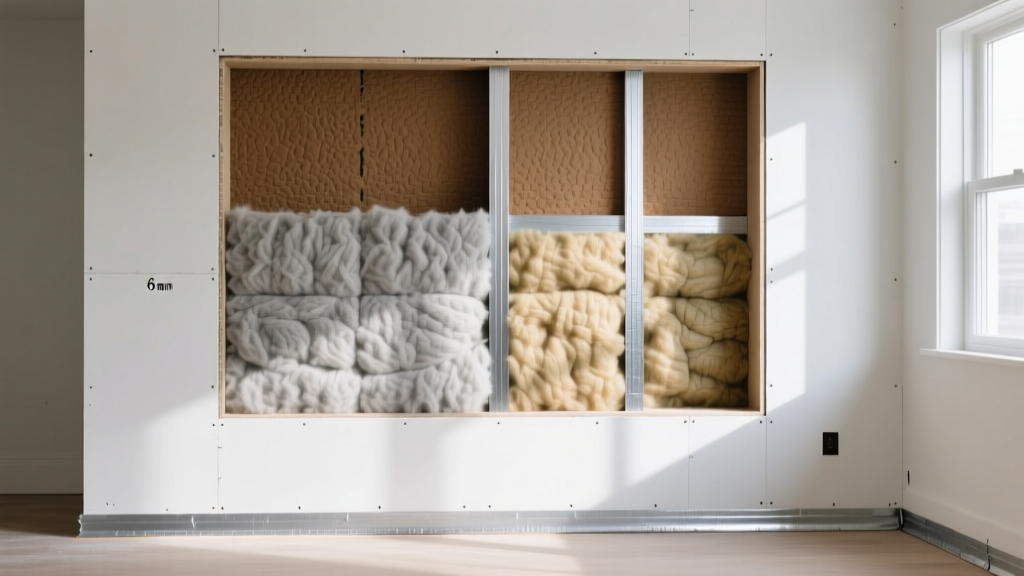
STC Compliance Matrix: Assembly Configurations
Achieving code compliance requires looking at the entire assembly, not just the panel. Below is a compliance matrix comparing common wall configurations utilizing acoustical gypsum board versus standard panels. All assemblies assume 3-5/8-inch steel studs spaced 24 inches on center, with 3-inch mineral wool insulation in the cavity.
| Assembly Configuration | Lab STC Rating | Field ASTC Est. | IBC 1206 Compliant? |
|---|---|---|---|
| Standard 5/8" Type X (1 layer each side) | 45 | 40 | NO |
| Acoustical Damped Board (1 layer each side) | 52 | 47 | YES |
| Standard 5/8" Type X (2 layers each side) | 54 | 48 | YES |
| Acoustical Board + Resilient Channel (1 layer) | 58 | 52 | YES (Exceeds) |
As demonstrated, a single layer of advanced acoustical board can achieve compliance where double layers of standard board might struggle in field conditions, primarily due to the damping layer's ability to mitigate installation imperfections and minor flanking.
Critical Installation Details for Code Approval
The Gypsum Association explicitly warns that the weakest link in any sound-rated assembly dictates the performance of the entire wall. To ensure your acoustical gypsum board installation passes municipal acoustic testing, the following site protocols must be enforced:
- Perimeter Isolation: A continuous 1/4-inch to 3/8-inch bead of non-hardening acoustical sealant (such as OSI SC-175 or Tremco Acoustical Sealant) must be applied between the bottom track and the concrete slab, as well as at all vertical corner joints and ceiling tracks.
- Electrical Box Decoupling: Back-to-back electrical outlets on a party wall destroy STC ratings. Code requires boxes to be staggered by at least 24 inches horizontally. Furthermore, every recessed box must be wrapped in an intumescent acoustic putty pad (e.g., STI SPEAK-OUT) to restore the mass and damping lost by cutting the drywall.
- Flanking Path Mitigation: Sound travels through rigid connections. HVAC ductwork penetrating the party wall must utilize flexible canvas connectors. Plumbing lines must be isolated from the framing using rubber hangers.
Procurement Tip: Budget approximately $1.15 to $1.45 per square foot for high-performance damped acoustical gypsum board, compared to $0.45 to $0.55 for standard 5/8-inch Type X. While the material premium is roughly 150%, it eliminates the labor cost of hanging, taping, and finishing a second layer of drywall, often resulting in a net-zero or net-positive project cost.
Troubleshooting Failed Acoustic Inspections
When an assembly fails to meet the ASTC 45 field requirement despite using rated acoustical gypsum board, the failure is almost never the panel itself. Inspectors and acoustical consultants typically identify one of three edge-case culprits:
1. The 'Short Circuit' Effect
If resilient channels or sound isolation clips are used to decouple the drywall from the studs, a single rogue screw driven too deeply—penetrating the channel and biting into the wood or steel stud—creates a rigid mechanical bridge. This 'short circuit' can drop the assembly's STC by up to 10 points. Installers must use screws specifically sized to engage the channel flange without touching the underlying framing.
2. Unsealed Penetrations
Even a 1/16-inch gap around a plumbing pipe or HVAC register allows high-frequency airborne noise to bypass the acoustical board entirely. All penetrations must be sealed with a UL-listed acoustic firestop compound that remains flexible after curing.
3. Rigid Floor Ties
In multi-story wood-frame construction, continuous rigid flooring (like hardwood or tile) spanning across the top of a party wall acts as a flanking membrane. A flexible acoustic break (such as a cork or rubber underlayment strip) must be installed at the base of the wall to sever this structural connection.
Frequently Asked Questions
Can I paint directly over acoustical gypsum board?
Yes. Damped acoustical boards feature standard paper or glass-mat faces that accept Level 4 or Level 5 finishes, primers, and standard latex or epoxy paints. The viscoelastic layer is fully encapsulated within the core and is not affected by surface coatings.
Does acoustical gypsum board also provide fire resistance?
Many premium acoustical boards incorporate fire-resistant cores that meet ASTM E119 for 1-hour and 2-hour fire-rated assemblies. However, you must verify the specific product's UL Design Number to ensure it satisfies both the acoustic (IBC 1206) and fire (IBC 715) code requirements for your specific jurisdiction.
Is acoustic sealant required by code?
While the IBC dictates the performance metric (STC 50 / ASTC 45), the specific UL or ULC design directory you submit to the building department for approval will explicitly mandate the use of acoustic sealant at the perimeters. Omitting it violates the approved design assembly.
Written by
Elena RodriguezElena Rodriguez is a civil engineer and technical writer specializing in concrete technology, masonry systems, and ASTM/ACI compliance. She earned her B.S. in Civil Engineering from Texas A&M University and spent a decade at a materials testing laboratory, performing over 2,000 concrete compressive strength tests and masonry prism evaluations. Elena is an ACI-certified Field Testing Technician (Grade I) and a member of ASTM Committee C12 on Natural Building Stone. She currently consults on forensic engineering cases involving concrete failures and moisture intrusion. Based in San Antonio, TX, Elena is a proud member of the Society of Women Engineers (SWE) and coaches her daughter's FIRST Robotics team.
More from Elena Rodriguez
View all
Walls & Panels
Cost Analysis: Light Gauge Steel Framing Advantages and Disadvantages
Evaluate light gauge steel framing advantages and disadvantages through a strict cost analysis lens, comparing material, labor, and lifecycle expenses.
Aug 4, 2026

Walls & Panels
Gypsum Board Types: Exact Specifications, Thickness & Dimensions
Compare standard, Type X, and moisture-resistant gypsum board types. Get exact specifications, thicknesses, dimensions, and ASTM standards for your project.
Aug 4, 2026

Fire Resistance
Best Fire-Resistant Outdoor Decking Materials: 2026 Buyer Guide
Discover the best fire-resistant outdoor decking materials for 2026. Compare Class A PVC, aluminum, and hardwood options for WUI compliance and safety.
Aug 4, 2026