Gypsum Board Distributor Pricing: 2026 Wholesale Cost Analysis
Analyze 2026 gypsum board distributor costs. Compare wholesale vs retail pricing, freight surcharges, and volume rebates for commercial drywall projects.

The Unit Economics of Wholesale Sourcing
Sourcing drywall directly from a specialized gypsum board distributor fundamentally alters the unit economics of commercial and multi-family construction projects. While big-box retail pro desks offer convenience for small residential remodels, they lack the pricing tiers, logistical capabilities, and backend rebate structures required for projects exceeding 10,000 square feet. As of early 2026, regional supply chain stabilization has normalized base sheet rock pricing, but localized logistics surcharges and fuel indices remain volatile. Understanding the true landed cost requires looking beyond the sticker price per 4x8 sheet and analyzing freight, staging, waste mitigation, and annual volume incentives.
National and regional distributors—such as Foundation Building Materials (FBM), GMS, and L&W Supply—operate on a high-volume, low-margin model. Their baseline pricing is intrinsically tied to the Bureau of Labor Statistics Producer Price Index (PPI) for gypsum products. By bypassing retail markups, contractors can typically secure base material costs 18% to 24% below retail, provided they meet minimum drop thresholds and navigate the complex web of freight surcharges.
2026 Wholesale vs. Retail Pricing Matrix
The following matrix breaks down current 2026 market rates for standard commercial drywall products. Retail prices reflect average national big-box pro desk pricing, while distributor pricing reflects negotiated baseline rates for accounts spending over $250,000 annually.
| Product Specification | Brand / Model Reference | Retail (per 4x8) | Distributor Base (per 4x8) | Distributor Bulk (per 4x8) |
|---|---|---|---|---|
| 1/2" Regular UltraLight | USG Sheetrock UltraLight | $14.50 - $16.00 | $11.20 - $12.50 | $9.85 - $10.50 |
| 5/8" Type X Fire-Rated | USG Firecode X / GP ToughRock | $21.00 - $23.50 | $16.50 - $18.00 | $14.75 - $15.50 |
| 1/2" Moisture/Mold Resistant | GP DensArmor Plus | $24.00 - $27.00 | $19.50 - $21.00 | $17.25 - $18.50 |
| 1/4" Flexible Board | National Gypsum Gold Bond | $18.00 - $20.00 | $14.00 - $15.50 | $12.50 - $13.25 |
| 5/8" Shaftliner (1" Core) | USG Firecode Shaftliner | $45.00 - $52.00 | $36.00 - $39.50 | $32.00 - $34.50 |
Note: Bulk pricing applies to full semi-truck loads (approx. 38,000 to 42,000 sq. ft.) or guaranteed monthly volume commitments. Data aligns with market trends tracked by the Gypsum Association and major manufacturer bulletins from USG Corporation.
Deconstructing the Landed Cost: Freight and Surcharges
The most common error contractors make when analyzing distributor quotes is ignoring the logistics tail. Distributors rarely include delivery in the base sheet price. Freight is calculated based on mileage, truck type, and site accessibility.
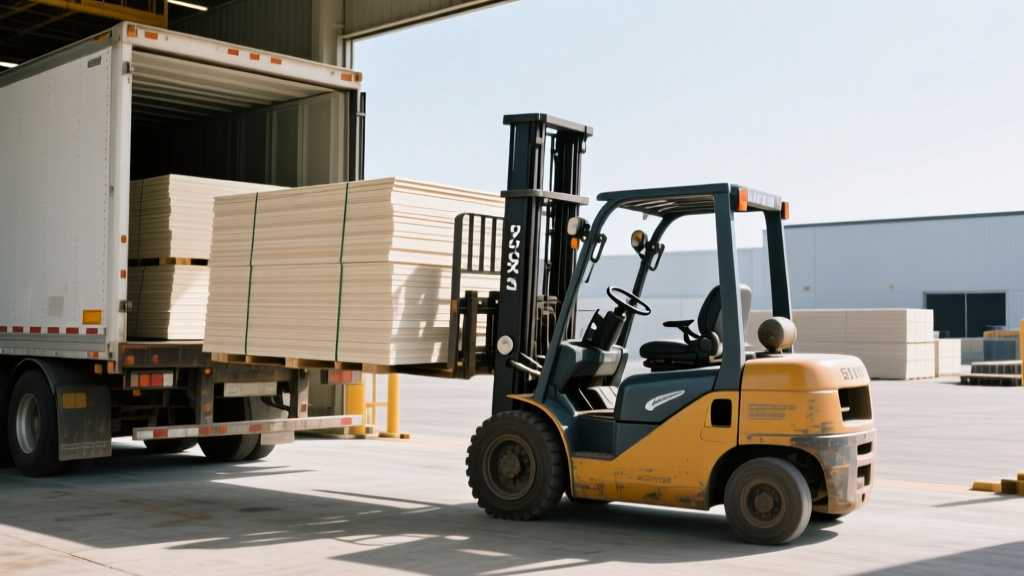
Standard flatbed semi-trucks require a telehandler or forklift on-site for unloading. If your site lacks heavy equipment, you must request a boom truck (a flatbed with an articulating crane). Boom trucks carry a premium delivery fee—typically $175 to $250 per drop within a 20-mile radius of the branch, plus $3.50 to $5.00 per mile thereafter. Furthermore, boom trucks can only carry about 60% of the payload of a standard semi, effectively increasing your per-sheet freight cost.
Beyond the base delivery fee, contractors must account for the Fuel Surcharge (FSC). In 2026, FSCs generally range from 6% to 11% of the total freight invoice, fluctuating monthly based on regional diesel indices. Additionally, if your site requires "inside delivery" or "floor staging"—where the boom truck operator places bundles in specific rooms or on elevated decks—distributors charge a staging fee of $0.12 to $0.22 per square foot. While this adds to the invoice, it typically offsets 4 to 6 hours of general laborer time, yielding a net positive ROI on commercial sites.
Volume Tiers and Backend Rebate Structures
True cost savings with a gypsum board distributor are realized through backend rebates and overage return policies. Unlike retail environments, commercial distributors offer structured incentive programs for high-volume accounts.
- Tier 1 (Under $100k Annual Spend): Standard baseline pricing. No backend rebates. Overage returns subject to a 15% restocking fee.
- Tier 2 ($100k - $500k Annual Spend): 2% to 4% backend rebate paid quarterly. Free return pickups for full, undamaged skids of standard products.
- Tier 3 ($500k+ Annual Spend): 5% to 8% backend rebate. Dedicated account manager, priority boom truck scheduling, and waived restocking fees on overage returns.
The ability to return unused, undamaged skids at the end of a project is a massive hidden cost-saver. On a 50,000 sq. ft. project, a standard 7% waste factor results in 3,500 sq. ft. of excess material. Returning 10 full skids to a distributor can recoup $1,200 to $1,500, a policy big-box retailers rarely honor on commercial-scale quantities.
Real-World Scenario: 25,000 Sq. Ft. Commercial Build-Out
To illustrate the landed cost difference, consider a 25,000 sq. ft. office tenant improvement requiring 5/8" Type X board. The total material requirement, including a 7% waste factor, is 26,750 sq. ft. (approx. 210 sheets of 4x8).
- Big Box Retail Route: 210 sheets at $22.00 = $4,620. Delivery via third-party flatbed ($250). Forklift rental for unloading ($350). Total Landed Cost: $5,220 ($0.208 per sq. ft.). Zero return options for unused material.
- Distributor Route (Tier 2 Account): 210 sheets at $16.50 = $3,465. Boom truck delivery with floor staging ($225 drop fee + $0.15/sq. ft. staging = $4,012.50). Fuel Surcharge (8% on freight = $18). Total Landed Cost: $7,495.50 ($0.299 per sq. ft.).
Strategic Sourcing Decision Framework
Use the following matrix to determine whether to source your gypsum board from a specialized distributor or a local retail pro desk for your next project.
| Project Parameter | Choose Retail Pro Desk | Choose Gypsum Board Distributor |
|---|---|---|
| Total Square Footage | Under 5,000 sq. ft. | Over 5,000 sq. ft. |
| Site Equipment | No forklift/telehandler available | Forklift on site, or budget allows boom truck |
| Board Type Required | Standard 1/2" regular only | Type X, Shaftliner, Glass-Mat, or Acoustic |
| Staging Needs | Ground floor, single open space | Multi-floor, specific room-by-room drops |
| Return Policy Need | Low waste factor, exact cuts | High waste factor, complex framing layouts |
Ultimately, the decision hinges on logistics and volume. A gypsum board distributor provides unparalleled value for complex, multi-story, or high-fire-rating projects where specialized products and precise staging are required. By accurately modeling the landed cost—including freight, FSC, staging, and rebate structures—contractors can protect their margins and ensure material flows seamlessly from the branch to the framing crew.
Written by
Elena RodriguezElena Rodriguez is a civil engineer and technical writer specializing in concrete technology, masonry systems, and ASTM/ACI compliance. She earned her B.S. in Civil Engineering from Texas A&M University and spent a decade at a materials testing laboratory, performing over 2,000 concrete compressive strength tests and masonry prism evaluations. Elena is an ACI-certified Field Testing Technician (Grade I) and a member of ASTM Committee C12 on Natural Building Stone. She currently consults on forensic engineering cases involving concrete failures and moisture intrusion. Based in San Antonio, TX, Elena is a proud member of the Society of Women Engineers (SWE) and coaches her daughter's FIRST Robotics team.
More from Elena Rodriguez
View all
Walls & Panels
Cost Analysis: Light Gauge Steel Framing Advantages and Disadvantages
Evaluate light gauge steel framing advantages and disadvantages through a strict cost analysis lens, comparing material, labor, and lifecycle expenses.
Aug 4, 2026

Walls & Panels
Gypsum Board Types: Exact Specifications, Thickness & Dimensions
Compare standard, Type X, and moisture-resistant gypsum board types. Get exact specifications, thicknesses, dimensions, and ASTM standards for your project.
Aug 4, 2026

Fire Resistance
Best Fire-Resistant Outdoor Decking Materials: 2026 Buyer Guide
Discover the best fire-resistant outdoor decking materials for 2026. Compare Class A PVC, aluminum, and hardwood options for WUI compliance and safety.
Aug 4, 2026