Price of Gypsum Board False Ceiling vs. POP, PVC & Wood: 2026 Guide
Compare the price of gypsum board false ceiling with POP, PVC, and wood. Get 2026 cost breakdowns, material specs, and installation insights.

The True Price of Gypsum Board False Ceiling: 2026 Cost Anatomy
When evaluating the price of gypsum board false ceiling installations, contractors and homeowners often make the mistake of looking solely at the per-sheet cost of the drywall. In reality, the final installed price is a composite of four distinct cost centers: the board itself, the galvanized iron (GI) framing infrastructure, the labor for installation, and the finishing level. As of 2026, the national average for a fully installed, Level 4 finished standard gypsum ceiling ranges from $6.50 to $9.50 per square foot.
Material and Framing Breakdown
Standard 1/2-inch gypsum panels (such as USG Sheetrock UltraLight) cost between $1.50 and $2.20 per square foot for the material alone. However, the board is only as stable as its skeleton. A robust ceiling requires a GI framing system consisting of perimeter channels, primary furring channels, and secondary channels. Upgrading from standard 0.5mm thick GI channels to heavy-duty 0.8mm channels adds roughly $0.40 per square foot but prevents the sagging and joint-cracking that plagues budget installations.
Specifying ultra-lightweight gypsum boards reduces the dead load on the ceiling grid by up to 25%. This structural savings allows framers to space secondary channels at 24 inches on-center (O.C.) rather than the standard 16 inches O.C., effectively cutting your metal framing material costs by 15% to 20% without sacrificing rigidity.
The Finishing Multiplier: Level 4 vs. Level 5
The Gypsum Association defines strict finishing levels. A Level 4 finish (three coats of joint compound over tape) is standard for flat paints and costs roughly $2.00 to $2.50 per square foot in labor. If your design incorporates gloss paints, dark colors, or critical glancing light from large windows, you must upgrade to a Level 5 finish, which includes a full skim coat over the entire surface. This adds $1.25 to $1.75 per square foot to the total price but eliminates the 'photographing' effect where joints become visible under harsh lighting.
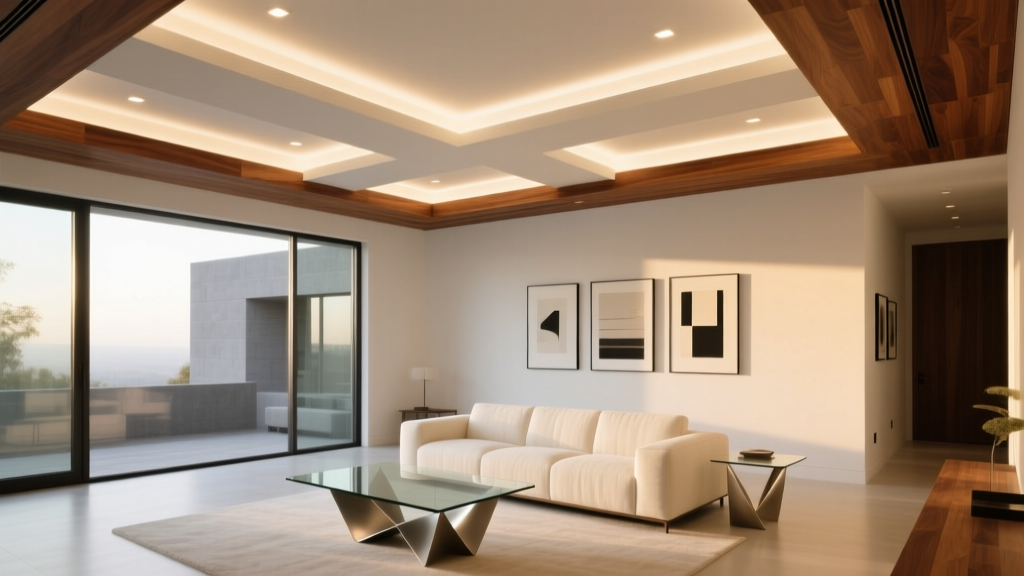
Gypsum vs. POP (Plaster of Paris): The Traditional Rival
Plaster of Paris (POP) was the default ceiling material for decades, but it has largely been superseded by factory-manufactured gypsum in modern commercial and high-end residential builds. The price of gypsum board false ceiling systems is highly competitive with POP, but the value proposition shifts dramatically when you factor in time and structural integrity.
| Feature | Gypsum Board | POP (Plaster of Paris) |
|---|---|---|
| Installed Cost (per sq. ft.) | $6.50 - $9.50 | $7.00 - $11.00 |
| Installation Time (1,000 sq ft) | 4 - 7 Days | 18 - 25 Days |
| Moisture Sensitivity During Install | High (must stay dry) | Extreme (requires water curing) |
| Shrinkage Cracking Risk | Low (confined to joints) | High (random surface cracking) |
| Design Flexibility | Moderate (curves require kerfing) | Excellent (sculpted on-site) |
The primary failure mode of POP is shrinkage. Because POP is mixed with water on-site and applied to a chicken-wire or fiberglass mesh, the evaporation process over 15 to 20 days inevitably leads to micro-cracking. Gypsum boards are kiln-dried in a factory, meaning their moisture content is stabilized before they ever reach your job site. While POP is slightly cheaper in raw material form, the extended labor hours and scaffolding rental time required for the curing process push its final installed price higher than gypsum.
Gypsum vs. PVC Panels: Moisture and Budget Battles
Polyvinyl Chloride (PVC) ceiling panels are hollow-core, interlocking plastic extrusions. They are heavily marketed as the ultimate budget and waterproof alternative. The material cost for PVC panels ranges from $2.00 to $4.50 per square foot, and because they require no taping, mudding, or painting, the total installed price can drop as low as $4.50 to $6.50 per square foot.
When to Choose PVC Over Gypsum
PVC is strictly a utilitarian choice. It is the undisputed winner for unconditioned spaces, high-humidity bathrooms without adequate exhaust ventilation, and basement renovations where minor water leaks from upper-floor plumbing are a persistent threat. However, PVC suffers from severe aesthetic and structural limitations:
- Thermal Expansion: PVC expands and contracts significantly with temperature fluctuations. In spaces with direct sunlight or poor HVAC circulation, the interlocking joints can buckle or separate.
- Span Limitations: PVC panels become visibly wavy and sag if supported on framing spaced wider than 24 inches O.C., requiring a denser (and more expensive) wooden or metal grid than gypsum.
- Aesthetic Ceiling: The visible seam lines and high-gloss plastic finish make PVC unsuitable for living rooms, master bedrooms, or commercial lobbies where a monolithic, premium look is required.
Gypsum vs. Wooden Ceilings: Aesthetics vs. Economics
Wooden false ceilings—ranging from MDF veneers to solid hardwood slats—represent the premium tier of ceiling design. The price gap here is massive. While a standard gypsum ceiling tops out around $9.50 per square foot, a high-quality wooden slat or acoustic timber ceiling typically ranges from $18.00 to $35.00+ per square foot installed.
From a technical standpoint, wood introduces complex fire-rating and acoustic challenges. Standard wood paneling lacks the inherent fire resistance of Type X gypsum board, which contains glass fibers and chemically bound water that actively retard flame spread per Association of the Wall and Ceiling Industry standards. To achieve a 1-hour fire rating with a wood ceiling, contractors must first install a base layer of 5/8-inch Type X gypsum board, essentially forcing you to pay for a gypsum ceiling and a wood ceiling. Furthermore, solid wood is highly susceptible to humidity-induced warping, requiring strict climate control (maintaining 30-50% relative humidity) year-round.
Rather than choosing between materials, modern architectural trends favor hybridization. Use standard gypsum board for 80% of the ceiling plane to maintain a low baseline cost and excellent fire rating, and integrate localized wooden slat baffles or perimeter wood coves as high-impact accent features. This approach typically increases the overall ceiling budget by only 15% to 25% compared to an all-gypsum design, while delivering the visual warmth of an all-wood ceiling.
Hidden Costs That Inflate Your Ceiling Budget
When soliciting bids for the price of gypsum board false ceiling installations, contractors often provide a base 'per-square-foot' rate for a flat, unbroken plane. Real-world designs are rarely flat. Be prepared for the following line-item additions that can inflate your final invoice by 20% to 40%:
- Tray and Cove Details: Creating a dropped tray ceiling or an LED cove requires additional framing, corner beads, and complex taping. Expect a 30% to 50% labor premium on the linear footage of these details.
- Electrical Cutouts and Fixture Support: Cutting holes for recessed can lights is usually billed at $15 to $25 per cutout. More importantly, heavy fixtures like ceiling fans or chandeliers cannot be mounted directly to gypsum. The contractor must install structural plywood backing or unistrut bracing tied to the primary joists during the framing phase, adding $50 to $100 per fixture location.
- Scaffolding and Height Premiums: Standard pricing assumes an 8-to-10-foot ceiling height. For vaulted ceilings, stairwells, or commercial spaces exceeding 12 feet, contractors will add a height premium (often 15% to 25%) to cover scaffolding erection, teardown, and the decreased labor efficiency of working overhead at height.
- HVAC Integration: Dropping a ceiling to hide ductwork requires the HVAC contractor to reroute vents and install plenum boxes flush with the new gypsum plane. This coordination cost is frequently omitted from the drywall contractor's bid but will appear on the mechanical invoice.
Decision Framework: Which Ceiling Material Wins?
Selecting the right material requires matching the physical environment and budget to the material's inherent properties. Use this framework to finalize your specification:
- Choose Gypsum Board If: You require a seamless, paintable surface for living spaces, need a verified 1-hour fire rating for multi-family or commercial code compliance, and want the optimal balance of cost, speed, and acoustic dampening.
- Choose POP If: You are restoring a historical property requiring intricate, hand-carved cornices and rosettes that cannot be achieved with standard gypsum routing tools, and timeline is not a constraint.
- Choose PVC If: The space is an unconditioned garage, a damp basement, or an agricultural facility where moisture, mold, and occasional wash-downs are guaranteed, and aesthetics are secondary to utility.
- Choose Wood If: You are designing a high-end executive boardroom, an acoustic-critical home theater, or a luxury hospitality space where budget is secondary to biophilic design and natural material warmth.
Ultimately, the price of gypsum board false ceiling systems remains the most rational baseline for modern construction. By understanding the hidden costs of framing upgrades, finishing levels, and complex geometries, you can accurately forecast your budget and avoid the costly change orders that derail ceiling projects.
Written by
Marcus ChenMarcus Chen is a licensed structural engineer (PE) and building materials analyst with over 12 years of experience across residential, commercial, and industrial construction. He holds a Master of Science in Civil Engineering from UC Berkeley and spent six years at Thornton Tomasetti before transitioning to independent consulting and technical writing. Marcus specializes in material selection for seismic-prone regions, concrete reinforcement strategies, and lifecycle cost analysis. His work has been cited by the American Concrete Institute (ACI) and the Structural Engineers Association of California (SEAOC). When he is not on a job site or at his desk, you will find him hiking the Sierra Nevada or restoring a 1920s craftsman bungalow in Oakland, CA.
More from Marcus Chen
View all
Construction Cost
How Much Did the Eiffel Tower Cost to Build?
How much did the Eiffel Tower cost to build in 1889? We adjust for inflation and compare its budget to modern skyscraper construction.
Aug 4, 2026

Fire Resistance
What Is a Fire Resistant Material? Testing & Certification Guide
Discover what is a fire resistant material through ASTM and UL testing. Learn how fire ratings, certifications, and assemblies work in construction.
Aug 4, 2026

Construction Cost
How Much Did the Burj Khalifa Cost to Build?
How much did the Burj Khalifa cost to build? We break down the $1.5B project and extract 5 money-saving strategies for your next build.
Jul 30, 2026