Gypsum Board Grid Ceiling Cost Breakdown & Pricing Guide 2026
Analyze 2026 gypsum board grid ceiling costs. Compare suspended drywall furring systems vs. exposed T-bar gypsum tiles with real pricing data.

The Terminology Trap: Suspended Drywall vs. Gypsum Grid Tiles
When estimators and architects specify a "gypsum board grid ceiling," they are usually referring to one of two fundamentally different structural systems. Confusing the two during the bidding phase is a primary driver of budget overruns in commercial construction. Before analyzing 2026 pricing, we must define the scope:
- System A (Suspended Gypsum Board): Traditional drywall panels (e.g., USG Sheetrock UltraLight) attached to a concealed metal furring grid (hat channels and main runners) suspended by hanger wires. This yields a seamless, monolithic ceiling plane requiring Level 4 or 5 finishing.
- System B (Gypsum Tiles in Exposed T-Bar): Pre-cast, factory-finished gypsum acoustic tiles dropped into an exposed suspended T-bar grid system (e.g., Armstrong DONN). This yields a modular ceiling with visible grid lines and drop-in accessibility.
Below is a comprehensive cost matrix and structural breakdown for both systems, reflecting current 2026 material indexes and prevailing union and open-shop labor rates.
2026 Cost Matrix: System A vs. System B
The following table outlines the installed cost per square foot for a standard 10,000 sq. ft. commercial office space with a 12-foot ceiling height. Costs include materials, labor, equipment (scissor lifts), and a standard 10% contractor markup.
| Cost Component | System A: Suspended Drywall (Concealed) | System B: Gypsum Tiles (Exposed T-Bar) |
|---|---|---|
| Metal Grid / Furring Materials | $1.15 - $1.65 / sq. ft. | $1.80 - $2.40 / sq. ft. |
| Gypsum Board / Tile Materials | $0.65 - $1.10 / sq. ft. | $3.50 - $5.50 / sq. ft. |
| Framing & Hanging Labor | $2.20 - $3.10 / sq. ft. | $1.50 - $2.20 / sq. ft. |
| Taping, Finishing & Painting | $2.10 - $3.20 / sq. ft. | $0.00 (Factory finished) |
| Total Installed Cost | $6.10 - $9.05 / sq. ft. | $6.80 - $10.10 / sq. ft. |
Deep Dive: Suspended Gypsum Board (Concealed Grid)
System A is the standard for high-end commercial corridors, lobbies, and open-plan offices where a seamless aesthetic is required. The cost variance here is heavily dictated by the gauge of the metal framing and the fire-rating requirements.
Metal Furring Grid Components
A properly engineered suspended drywall ceiling relies on a robust metal skeleton. For standard 1/2" USG Sheetrock UltraLight panels, estimators should budget for 25-gauge 7/8" hat channels (furring channels) tied to 1-1/2" 20-gauge cold-rolled main channels. Hanger wires (12-gauge) are spaced at 4-foot intervals along the main channels, which are spaced 4 feet on center.
Expert Insight: If the architectural spec requires 5/8" Type X fire-rated board to meet a 1-hour or 2-hour assembly per the Gypsum Association's fire-rated guidelines, the dead load increases significantly (approx. 2.2 lbs/sq. ft. vs 1.6 lbs/sq. ft.). You must upgrade to 20-gauge hat channels and reduce hanger wire spacing to 3 feet on center, increasing framing material costs by roughly 18%.
Drywall Panels, Fasteners, and Finishing
Material costs for the gypsum board itself are surprisingly low relative to the labor required to finish it. A 4x12 sheet of 1/2" UltraLight costs approximately $22 to $28 in 2026. However, the taping and finishing labor is where budgets bleed. Achieving a Level 4 finish requires three coats of joint compound, sanding, and priming. For ceilings with critical lighting angles (e.g., wall-washing LED coves), a Level 5 finish (skim coat) is mandatory, adding $0.80 to $1.20 per square foot in labor and material.
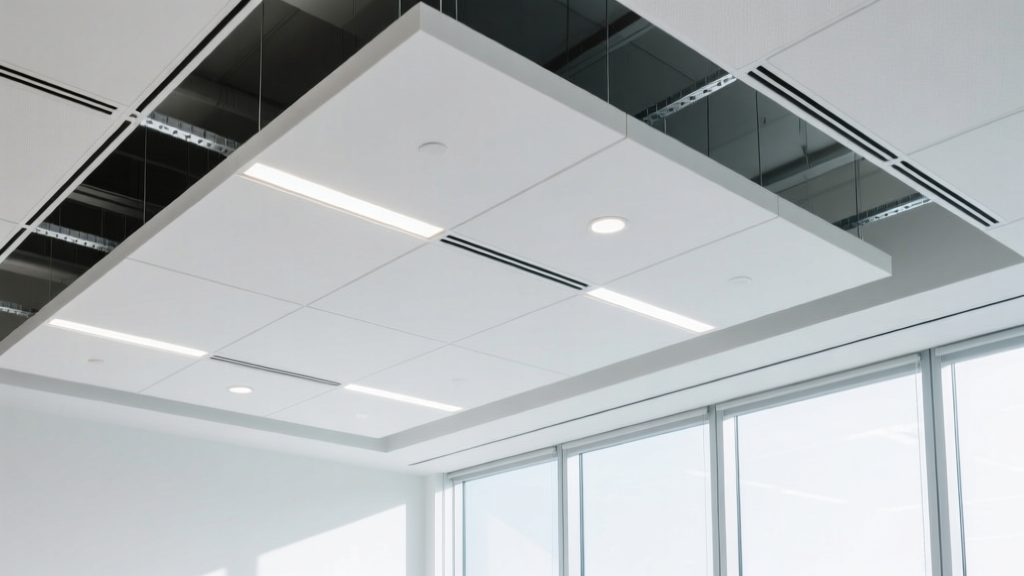
Deep Dive: Gypsum Tiles in Exposed T-Bar Grids
System B utilizes specialized cast gypsum tiles (such as USG Dune or specialized acoustic gypsum panels) that drop into a standard 15/16" exposed T-bar grid. This system is favored in healthcare, laboratories, and tech offices where frequent access to the MEP plenum is required.
Grid and Tile Economics
While the labor to install an exposed T-bar grid and drop in tiles is roughly 30% faster than hanging and finishing drywall, the material costs are substantially higher. Premium cast gypsum tiles with factory-applied acoustic fleece backings and smooth finishes range from $3.50 to $5.50 per square foot. The grid system itself (main tees, cross tees, and wall angles) costs between $1.80 and $2.40 per square foot. According to USG's suspended ceiling product literature, these tiles offer the monolithic look of drywall but with the NRC (Noise Reduction Coefficient) and CAC (Ceiling Attenuation Class) ratings required for acoustic privacy.
Warning: Weight Limits on Standard T-Bar Grids
Standard 15/16" exposed grid systems are engineered for lightweight mineral fiber or fiberglass tiles (approx. 0.5 to 1.0 lbs/sq. ft.). Cast gypsum tiles can weigh up to 2.5 lbs/sq. ft. You must specify heavy-duty (HD) or extra-heavy-duty (XHD) grid systems (e.g., Armstrong HDX) to prevent grid deflection and clip failure over time. Upgrading to an XHD grid adds $0.45 per square foot to the material budget.
5 Hidden Cost Drivers That Blow Up Ceiling Budgets
When reviewing contractor bids for a gypsum board grid ceiling, ensure the following line items are explicitly accounted for. Omissions here typically result in change orders that add 12% to 18% to the final ceiling invoice.
- Seismic Bracing and Expansion Joints: In IBC Seismic Design Categories D, E, and F, suspended ceilings require diagonal wire bracing, compression posts, and splay wires. Budget an additional $0.75 to $1.25 per square foot for seismic detailing.
- MEP Penetrations and Cutouts: Drywall ceilings require precise cutting for HVAC diffusers, recessed can lights, and sprinkler heads. Contractors typically charge $35 to $65 per penetration for cutting, reinforcing the backside with wood blocking, and finishing the edges.
- Access Panels: Concealed drywall ceilings require plastic or metal access doors for VAV box and plumbing valve maintenance. A standard 24x24 flush-mount access panel costs $120 to $180 installed.
- Scissor Lift Rentals and Floor Protection: Working at 12+ feet requires boom or scissor lifts. In occupied or finished spaces, renting lift-compatible floor protection mats adds $0.15 per square foot to the logistical budget.
- Dust Control and Negative Air: Sanding Level 4/5 drywall finishes generates massive particulate matter. If the HVAC system is operational or adjacent spaces are occupied, setting up HEPA negative air machines and poly-barriers is a mandatory AWCI safety and quality standard, adding $800 to $1,500 per week in equipment rentals.
Decision Framework: Which System Yields the Best ROI?
Choosing between suspended drywall and gypsum grid tiles should not be based solely on initial installation cost. Evaluate the lifecycle requirements of the space:
- Choose System A (Suspended Drywall) if: The space is a high-visibility lobby, executive suite, or open-plan office where lighting design relies on seamless coves and shadow-lines. The ROI is realized in architectural prestige and higher tenant lease rates, provided the MEP layout above the ceiling is finalized and will not require frequent alterations.
- Choose System B (Gypsum Tiles) if: The tenant is a high-churn environment (e.g., tech startups, hospitals, or labs) where partition walls and HVAC zones change every 3 to 5 years. The ROI is realized in facility management; relocating a ceiling tile and swapping a T-bar grid component costs pennies compared to cutting, patching, and repainting a monolithic drywall ceiling.
By aligning the ceiling assembly with both the 2026 construction budget and the 10-year facility maintenance plan, project managers can eliminate the friction between architectural intent and operational reality.
Written by
Marcus ChenMarcus Chen is a licensed structural engineer (PE) and building materials analyst with over 12 years of experience across residential, commercial, and industrial construction. He holds a Master of Science in Civil Engineering from UC Berkeley and spent six years at Thornton Tomasetti before transitioning to independent consulting and technical writing. Marcus specializes in material selection for seismic-prone regions, concrete reinforcement strategies, and lifecycle cost analysis. His work has been cited by the American Concrete Institute (ACI) and the Structural Engineers Association of California (SEAOC). When he is not on a job site or at his desk, you will find him hiking the Sierra Nevada or restoring a 1920s craftsman bungalow in Oakland, CA.
More from Marcus Chen
View all
Construction Cost
How Much Did the Eiffel Tower Cost to Build?
How much did the Eiffel Tower cost to build in 1889? We adjust for inflation and compare its budget to modern skyscraper construction.
Aug 4, 2026

Fire Resistance
What Is a Fire Resistant Material? Testing & Certification Guide
Discover what is a fire resistant material through ASTM and UL testing. Learn how fire ratings, certifications, and assemblies work in construction.
Aug 4, 2026

Construction Cost
How Much Did the Burj Khalifa Cost to Build?
How much did the Burj Khalifa cost to build? We break down the $1.5B project and extract 5 money-saving strategies for your next build.
Jul 30, 2026