Troubleshooting Fiberglass Mat Faced Gypsum Board Failures
Expert guide to diagnosing and repairing fiberglass mat faced gypsum board. Fix fastener tears, joint failures, and moisture damage on exterior sheathing.

Diagnostic Matrix: Identifying Fiberglass Mat Faced Gypsum Board Defects
Fiberglass mat faced gypsum board—commonly known by brand names like GP DensGlass, USG Securock, and CertainTeed FiberRock—is the industry standard for exterior sheathing, high-moisture tile backers, and commercial shaft walls. Unlike paper-faced drywall, the inorganic fiberglass mat resists mold and moisture. However, improper installation and site handling lead to distinct failure modes. Use the diagnostic matrix below to identify the root cause of your sheathing or backer board defects before attempting repairs.
| Symptom | Root Cause | Immediate Action |
|---|---|---|
| Frayed halo or torn mat around screw heads | Overdriven bugle screws; incorrect clutch torque on collated gun | Install secondary fastener 2 inches away; patch with exterior setting compound |
| Blistering, peeling, or rotting joint tape | Standard cellulose paper tape used instead of alkali-resistant (AR) mesh | Strip damaged tape, clean residue, re-tape with AR fiberglass mesh |
| Chalky white efflorescence on mat surface | Prolonged UV exposure degrading the acrylic binder; trapped moisture | Wire brush surface; apply fluid-applied weather-resistive barrier (WRB) |
| Soft, spongy core yielding to thumb pressure | Hydrostatic water intrusion behind cladding; core delamination | Cut out damaged section stud-to-stud; replace with new 4x8 panel |
Fastener Pull-Through and Mat Tearing
The most frequent field failure in fiberglass mat faced gypsum board is fastener pull-through. The fiberglass mat relies on an acrylic or polymer binder to hold the glass strands together. When a drywall screw is overdriven, the bugle head acts like a punch, shearing the mat and crushing the gypsum core. According to testing by the Gypsum Association, an overdriven screw can reduce the fastener's withdrawal resistance by up to 40%, compromising the sheer strength of the exterior wall assembly.
Step-by-Step Repair for Torn Fastener Mats
Do not attempt to simply spackle over a torn mat. The structural integrity of that specific fastening point is compromised. Follow this repair protocol:
- Drive a Secondary Fastener: Install a new corrosion-resistant screw (minimum #8 gauge, coarse thread for wood, fine for 20-ga steel) exactly 2 inches away from the failed fastener along the same stud line. Ensure the new screw sits perfectly flush—dimpling the mat without breaking the surface fibers.
- Prep the Failed Hole: Use a utility knife to trim away any frayed fiberglass strands protruding from the original overdriven hole. Do not dig into the gypsum core.
- Fill and Feather: Apply a setting-type joint compound (such as USG Durabond 90 or ProSet 45). Standard air-drying all-purpose compounds shrink and crack in exterior temperature fluctuations. Press the compound firmly into the void and feather it 4 inches outward.
- Sand and Seal: Once cured, lightly sand with 120-grit paper. If this is an exterior application, the patched area must be immediately covered by your fluid-applied WRB or self-adhered membrane to prevent moisture wicking into the exposed gypsum core.
Joint Treatment Degradation and Alkali Reactions
Fiberglass mat boards require specialized joint treatment. The core of moisture-resistant gypsum board and the setting-type compounds used for exterior joints are highly alkaline, often registering a pH between 10 and 12 during the curing process. Standard paper drywall tape will rapidly degrade, rot, and lose adhesion in this high-pH environment.
Selecting the Correct Tape and Compound
When repairing failed joints on fiberglass mat faced gypsum board, you must remove the degraded material and upgrade to chemically compatible components. Always use an alkali-resistant (AR) fiberglass mesh tape, such as Saint-Gobain FibaTape 3275 or equivalent. AR tape is coated with a specialized sizing that prevents the alkaline compounds from dissolving the glass fibers.
- Tape: 2-inch or 2-3/8-inch alkali-resistant self-adhesive fiberglass mesh.
- Compound: Setting-type (calcium sulfate hemihydrate) exterior joint treatment. Never use vinyl-based air-drying compounds on exterior sheathing joints.
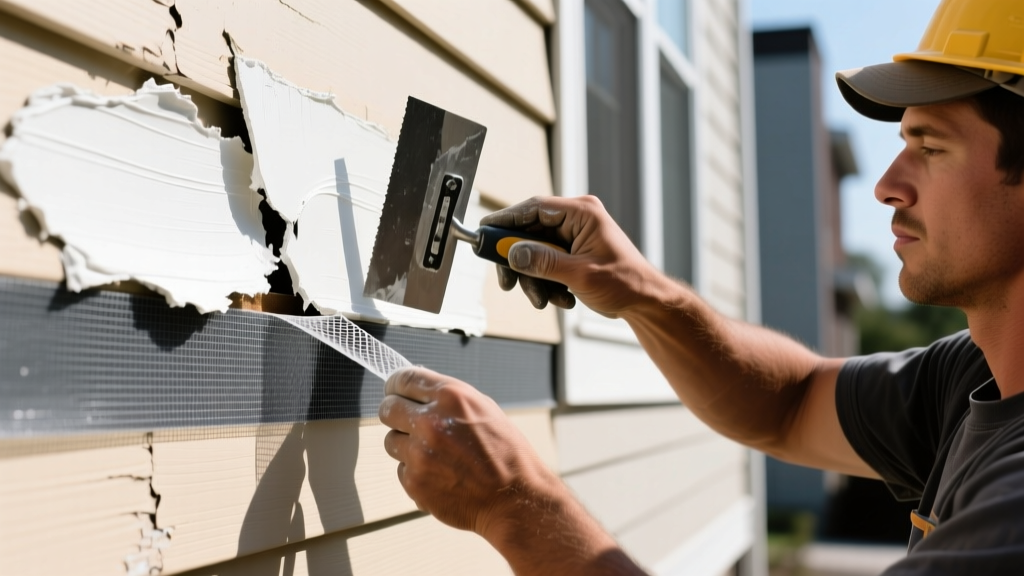
- Application: Embed the AR mesh into a tight first coat of setting compound. Apply a second coat immediately while the first is still workable (wet-on-wet), feathering the edges to 8 inches to ensure a seamless transition for the WRB membrane.
Managing Moisture Intrusion and Core Delamination
It is a common misconception that fiberglass mat faced gypsum board is waterproof. Products manufactured to ASTM C1177 are strictly water-resistant. The standard mandates that the board must not absorb more than 10% of its weight in water after a 2-hour surface soak. However, continuous hydrostatic pressure, such as a slow roof leak or missing flashing behind a window, will eventually saturate the gypsum core, leading to delamination between the core and the fiberglass mat.
The Thumb-Test Decision Tree
When troubleshooting suspected water damage behind removed cladding or tile, use the following decision framework to determine if a patch is viable or if full panel replacement is required:
- Surface Wetness Only: If the mat is damp but the core is rock-hard when pressed firmly with a thumb, allow the board to dry completely (use commercial dehumidifiers for 48 hours). Treat with a borate-based fungicide if any surface debris is present, then proceed with WRB application.
- Mat Separation (Delamination): If the fiberglass mat pulls away from the core like a sticker, the bond is destroyed. Cut out the delaminated section. You must cut back to the center of the nearest framing members (studs or joists) to provide a nailing edge for the replacement patch.
- Core Softening: If your thumb leaves an indentation deeper than 1/8 inch, the crystalline structure of the gypsum has dissolved. The entire affected panel must be removed and replaced. Do not attempt to encapsulate soft core with epoxy or waterproofing paints; trapped moisture will cause the wood or steel framing behind it to rot or corrode.
UV Degradation and Site Storage Protocols
Fiberglass mat sheathing is frequently installed early in the construction sequence and left exposed to the elements before the exterior cladding or WRB is applied. The acrylic binders holding the fiberglass mat together are susceptible to ultraviolet (UV) degradation. Most standard fiberglass mat boards have a maximum UV exposure limit of 3 to 6 months. Beyond this window, the surface becomes chalky, brittle, and loses its water-shedding capabilities.
If you are repairing an older installation or a project that suffered weather delays, inspect the mat for a chalky white residue. Lightly scrub the degraded surface with a stiff-bristle brush (not wire, which can rust and stain) to remove loose fibers. Once cleaned, the surface must be immediately sealed with a high-quality, fluid-applied weather-resistive barrier. For projects requiring extended exposure times, specify integrated WRB sheathing products like USG Securock EXOAir 430, which feature factory-applied membranes designed to withstand up to 12 months of UV and weather exposure, drastically reducing field-applied repair and sealing requirements.
Proper troubleshooting of fiberglass mat faced gypsum board relies on understanding the chemical and physical limits of the materials. By matching the repair protocol to the specific failure mode—whether mechanical tearing, alkaline degradation, or hydrostatic saturation—you ensure the longevity and structural integrity of the building envelope.
Written by
Elena RodriguezElena Rodriguez is a civil engineer and technical writer specializing in concrete technology, masonry systems, and ASTM/ACI compliance. She earned her B.S. in Civil Engineering from Texas A&M University and spent a decade at a materials testing laboratory, performing over 2,000 concrete compressive strength tests and masonry prism evaluations. Elena is an ACI-certified Field Testing Technician (Grade I) and a member of ASTM Committee C12 on Natural Building Stone. She currently consults on forensic engineering cases involving concrete failures and moisture intrusion. Based in San Antonio, TX, Elena is a proud member of the Society of Women Engineers (SWE) and coaches her daughter's FIRST Robotics team.
More from Elena Rodriguez
View all
Walls & Panels
Cost Analysis: Light Gauge Steel Framing Advantages and Disadvantages
Evaluate light gauge steel framing advantages and disadvantages through a strict cost analysis lens, comparing material, labor, and lifecycle expenses.
Aug 4, 2026

Walls & Panels
Gypsum Board Types: Exact Specifications, Thickness & Dimensions
Compare standard, Type X, and moisture-resistant gypsum board types. Get exact specifications, thicknesses, dimensions, and ASTM standards for your project.
Aug 4, 2026

Fire Resistance
Best Fire-Resistant Outdoor Decking Materials: 2026 Buyer Guide
Discover the best fire-resistant outdoor decking materials for 2026. Compare Class A PVC, aluminum, and hardwood options for WUI compliance and safety.
Aug 4, 2026