Gypsum Board Moisture Content: Cost Analysis of Damage and Prevention
Analyze the financial impact of high gypsum board moisture content. Compare material costs, remediation expenses, and prevention strategies for 2026 projects.

The Financial Impact of Moisture in Drywall Systems
Gypsum board is fundamentally a calcium sulfate dihydrate core encased in paper or glass mat facers. When the moisture content within this core exceeds engineered thresholds, the material undergoes rapid physical and chemical degradation. For commercial and residential contractors, ignoring gypsum board moisture content limits does not merely result in cosmetic defects; it triggers a cascade of structural failures, mold abatement liabilities, and catastrophic project delays. In 2026, with material costs remaining elevated and labor shortages persisting, the financial penalty for moisture-related drywall failures averages 300% to 500% higher than the cost of proactive moisture management and material upgrading.
The Gypsum Association GA-216 guidelines mandate that gypsum panels must not be exposed to liquid water and should only be installed in environments where the ambient relative humidity (RH) is controlled. The core moisture content by weight should not exceed 1% at the time of finishing. Exceeding this threshold compromises the board's flexural strength, leading to sagging, fastener pop, and paper delamination.
Critical Moisture Thresholds
- Core Moisture Content: Must be < 1% by weight before applying joint compound or paint.
- Ambient Relative Humidity: Must be maintained below 80% during installation and finishing.
- Surface Temperature: Must be at least 40°F (4°C) for standard adhesive and joint compound curing.
- Equilibrium Moisture Content (EMC):strong> Wood framing behind the gypsum must read below 16% on a wood scale to prevent moisture migration into the gypsum core.
Cost Breakdown: Standard vs. Moisture-Resistant Gypsum Board
Selecting the correct panel type based on the anticipated moisture environment is the first line of defense in cost management. Upgrading to moisture-resistant (MR) or glass mat panels adds upfront material costs but eliminates the risk of premature failure in high-humidity zones. The table below outlines the 2026 installed cost matrix for 5/8-inch Type X panels across different moisture profiles.
| Panel Type | Material Cost / Sq Ft | Labor Cost / Sq Ft | Total Installed | Best Application |
|---|---|---|---|---|
| Standard Type X (Paper-faced) | $0.55 - $0.70 | $1.80 - $2.20 | $2.35 - $2.90 | Climate-controlled interiors (< 70% RH) |
| Moisture-Resistant (MR / Green Board) | $0.80 - $1.05 | $1.90 - $2.30 | $2.70 - $3.35 | Bathrooms, laundry rooms, intermittent humidity |
| Glass Mat Gypsum (e.g., DensGlass, Securock) | $1.30 - $1.90 | $2.20 - $2.80 | $3.50 - $4.70 | Tile backing, exterior soffits, high-moasture commercial |
The Hidden Costs of Exceeding Moisture Content Limits
When contractors install standard gypsum board in environments where the core moisture content climbs above 1%, or where ambient RH exceeds 80%, the resulting physical failures require expensive teardowns. The costs are rarely limited to just replacing the drywall.
1. Core Softening and Structural Sagging
Gypsum relies on its crystalline structure for rigidity. When excess moisture infiltrates the core, the crystalline bonds weaken. On ceiling applications, this manifests as visible sagging between joists. Correcting a sagging ceiling requires shoring the existing structure, tearing out the compromised panels, ensuring the framing is dry, and reinstalling new panels. The labor cost for overhead demolition and reinstallation typically runs $4.50 to $6.50 per square foot, not including the cost of repainting or replacing damaged ceiling fixtures.
2. Paper Delamination and Seam Failure
The bond between the gypsum core and the paper facing is water-soluble. High moisture content causes the paper to bubble and delaminate, particularly at the tapered edges. When joint compound is applied over delaminated paper, the seams crack and blister as the moisture attempts to escape. Fixing this requires stripping all joint compound, cutting out the delaminated paper, applying deep-penetration primers, and re-taping. This adds $2.00 to $3.50 per linear foot of seam in rework labor.
3. Mold Remediation and Abatement
The paper facing on standard gypsum board is a cellulose-based food source for mold spores. If the board remains damp for more than 48 hours, mold colonization begins. According to the EPA Mold Remediation Guidelines, porous materials like gypsum board that exhibit mold growth cannot be cleaned; they must be removed and discarded. Professional mold abatement involves containment barriers, negative air pressure machines, HEPA vacuuming, and hazardous material disposal.
Mold Remediation Cost Multipliers
- Containment Setup: $800 - $1,500 per isolated zone.
- Drywall Tear-out & Disposal: $3.00 - $5.00 per sq ft (includes hazmat bagging and tipping fees).
- Framing Treatment: $1.50 - $2.50 per sq ft for antimicrobial encapsulation on exposed wood studs.
- Post-Remediation Verification: $400 - $800 for independent third-party air quality testing.
Prevention vs. Remediation: A Cost-Benefit Framework
To determine whether the upfront premium for moisture-resistant materials is justified, project managers should utilize a risk-based decision matrix. The cost of glass mat gypsum is approximately $1.50 more per square foot than standard board. However, the remediation cost for a single mold event in a 1,000 sq ft commercial restroom can easily exceed $25,000.
Low Risk (Standard Board)
Criteria: HVAC fully operational, ambient RH consistently below 60%, no plumbing penetrations in the wall cavity.
Action: Use standard paper-faced Type X. Rely on temporary dehumidifiers during the taping phase.
Moderate Risk (MR Board)
Criteria: Bathrooms, kitchens, or spaces where HVAC is not yet commissioned but the building is dried in.
Action: Upgrade to MR (green/purple) board. Ensure framing moisture is below 16% before hanging.
High Risk (Glass Mat)
Criteria: Tile backing in wet areas, exterior soffits, or spaces subject to construction delays before climate control.
Action: Mandate glass mat gypsum. The inorganic facing eliminates the mold food source entirely.
Essential Testing Tools and Their ROI
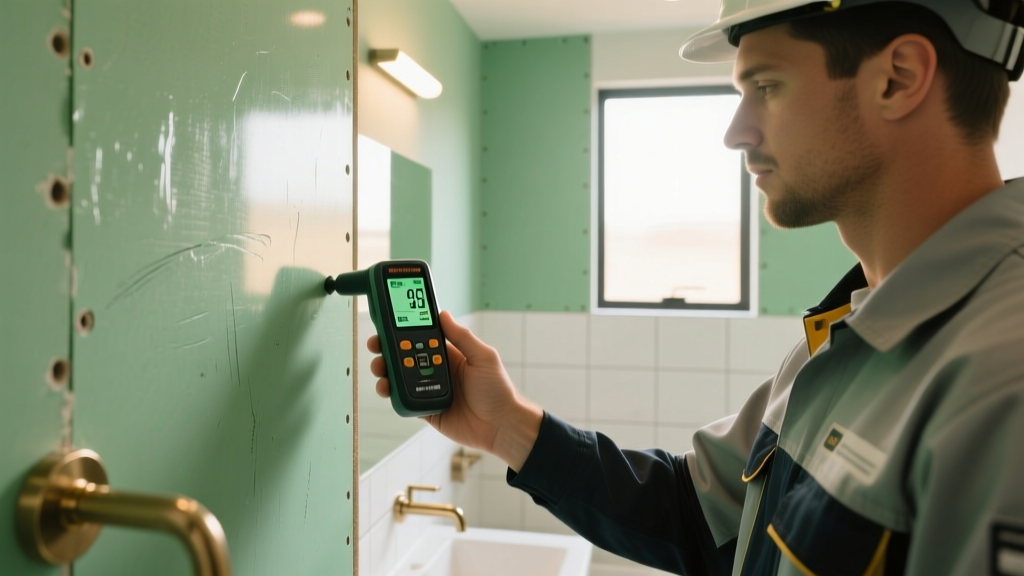
Accurate measurement of gypsum board moisture content requires specialized tools. Standard pin-type wood moisture meters are inaccurate for gypsum because they measure electrical resistance, which is heavily skewed by the mineral salts present in the gypsum core. Instead, contractors must use pinless (electromagnetic) meters calibrated specifically for gypsum, or dual-mode meters with a dedicated gypsum scale.
- Wagner Meters Orion 910/920: (~$450) Features a specific setting for gypsum board, providing accurate readings of equilibrium moisture content without damaging the paper facing.
- Protimeter BLD5800 Aquant: (~$350) Excellent for rapid, non-destructive scanning of large wall areas to identify hidden moisture pockets behind the surface.
- Tramex MEP: (~$400) Specifically designed for moisture encounter in floors and walls, offering deep penetration readings to detect moisture migrating from concrete slabs or masonry.
The return on investment (ROI) for a $450 moisture meter is realized the moment it prevents the installation of joint compound over a damp wall. A single blistered seam repair costs roughly $150 in labor and materials; the meter pays for itself after preventing just three seam failures.
Best Practices for Moisture Management on Site
Achieving the < 1% core moisture requirement requires strict adherence to construction sequencing. Testing protocols mandated by ASTM C473 focus on water absorption limits for manufactured panels, but on-site management dictates the actual performance.
Climate Control and Sequencing
Never hang gypsum board before the building envelope is completely sealed. Roofing, windows, and exterior cladding must be weather-tight. Once enclosed, temporary heating and dehumidification must be deployed to maintain an ambient temperature of at least 55°F and an RH below 70%. This environment must be sustained for a minimum of 48 hours before hanging begins, and continuously throughout the taping and sanding phases to ensure the joint compound cures via evaporation rather than trapping moisture against the paper facing.
Material Storage and Handling
Gypsum board stored on unconditioned concrete slabs will wick moisture directly into the core through capillary action. Panels must be stacked flat on elevated dunnage (minimum 4 inches off the floor) and covered with breathable tarps if stored in unconditioned spaces. Any panel that has been exposed to liquid water, exhibits edge swelling, or shows visible water stains must be rejected and removed from the site immediately. Attempting to dry out a saturated panel is a false economy; the crystalline structure is permanently compromised, and the risk of subsequent mold growth remains unacceptably high.
Written by
Elena RodriguezElena Rodriguez is a civil engineer and technical writer specializing in concrete technology, masonry systems, and ASTM/ACI compliance. She earned her B.S. in Civil Engineering from Texas A&M University and spent a decade at a materials testing laboratory, performing over 2,000 concrete compressive strength tests and masonry prism evaluations. Elena is an ACI-certified Field Testing Technician (Grade I) and a member of ASTM Committee C12 on Natural Building Stone. She currently consults on forensic engineering cases involving concrete failures and moisture intrusion. Based in San Antonio, TX, Elena is a proud member of the Society of Women Engineers (SWE) and coaches her daughter's FIRST Robotics team.
More from Elena Rodriguez
View all
Walls & Panels
Cost Analysis: Light Gauge Steel Framing Advantages and Disadvantages
Evaluate light gauge steel framing advantages and disadvantages through a strict cost analysis lens, comparing material, labor, and lifecycle expenses.
Aug 4, 2026

Walls & Panels
Gypsum Board Types: Exact Specifications, Thickness & Dimensions
Compare standard, Type X, and moisture-resistant gypsum board types. Get exact specifications, thicknesses, dimensions, and ASTM standards for your project.
Aug 4, 2026

Fire Resistance
Best Fire-Resistant Outdoor Decking Materials: 2026 Buyer Guide
Discover the best fire-resistant outdoor decking materials for 2026. Compare Class A PVC, aluminum, and hardwood options for WUI compliance and safety.
Aug 4, 2026