Sag Resistant Gypsum Board Cost Analysis vs 5/8-Inch Drywall
Compare the material and labor costs of sag resistant gypsum board versus standard 5/8-inch drywall for 24-inch ceiling joist spacing in 2026.

The Framing Dilemma: 16-Inch vs. 24-Inch Joist Spacing
When framing residential or light-commercial ceilings, engineers and architects frequently specify 24-inch on-center (o.c.) joist spacing to reduce lumber costs and accommodate deeper insulation batts. However, this wider spacing creates a critical vulnerability: standard 1/2-inch gypsum board lacks the structural rigidity to span 24 inches without deflecting under its own weight, leading to visible, wavy ceilings known as "sag."
Historically, the construction industry solved this by upgrading to 5/8-inch standard drywall. Today, manufacturers offer a specialized alternative: sag resistant gypsum board. Engineered with high-stiffness fiberglass mesh and specialized core formulations, these 1/2-inch lightweight panels meet ASTM C1396 requirements for 24-inch o.c. framing. For general contractors and estimators in 2026, choosing between 1/2-inch sag-resistant panels and 5/8-inch standard boards requires a granular analysis of material premiums, labor multipliers, and assembly ratings.
Material Cost Breakdown: 2026 Market Pricing
The baseline assumption is that specialized lightweight technology carries a steep premium. While 1/2-inch sag resistant gypsum board is more expensive per panel than standard 1/2-inch board, its cost relative to the traditional 5/8-inch alternative is surprisingly competitive. Below is a comparative pricing matrix based on Q1 2026 national averages for 4-foot by 12-foot panels.
| Panel Specification | Weight (4x12) | Avg. Cost per Panel | Cost per Sq. Ft. |
|---|---|---|---|
| Standard 1/2" (16" o.c. max) | 57 lbs | $18.50 - $21.00 | $0.38 - $0.44 |
| 5/8" Standard Firecode | 72 lbs | $23.00 - $26.50 | $0.48 - $0.55 |
| 1/2" Sag Resistant Lightweight | 41 lbs | $24.50 - $28.00 | $0.51 - $0.58 |
As the data indicates, the material premium for sag resistant gypsum board over 5/8-inch standard drywall is typically only $1.50 to $3.00 per 48-square-foot panel (roughly $0.03 to $0.06 per square foot). On a 2,500-square-foot ceiling, the raw material upcharge is between $75 and $150. However, material cost is only a fraction of the total installed price.
The Labor Multiplier: Weight, Fatigue, and Crew Sizing
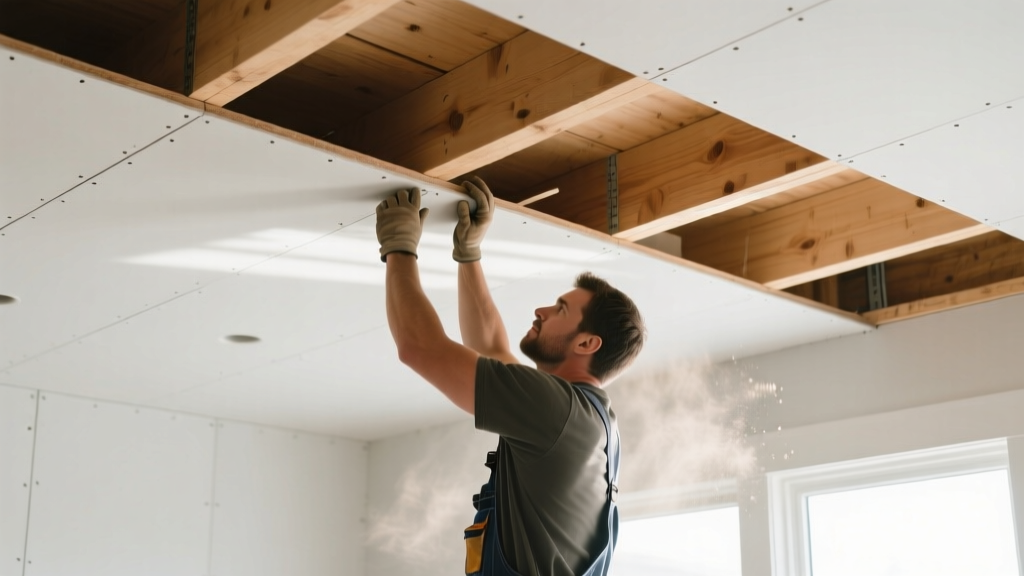
The true financial divergence between these two products occurs during installation. Ceiling drywall installation is notoriously labor-intensive, and the 31-pound weight difference between a 72-lb 5/8-inch panel and a 41-lb 1/2-inch sag-resistant panel drastically alters job site economics.
Data Highlight: The Tonnage Differential
Consider a 2,500 sq. ft. ceiling requiring 53 panels (4x12).
- Total weight lifted (5/8-inch): 3,816 lbs
- Total weight lifted (1/2-inch sag resistant): 2,173 lbs
- Net reduction in overhead lifting: 1,643 lbs (an 821.5-ton reduction per 1,000 homes built).
With union and prevailing commercial drywall labor rates averaging $65 to $95 per hour in 2026, the physical fatigue associated with 5/8-inch boards slows production rates by 15% to 25% on large, open ceilings. Furthermore, the lighter weight of sag resistant gypsum board frequently allows a two-person crew to safely lift and secure 12-foot panels using standard panel lifters, whereas 5/8-inch boards often mandate a three-person crew to prevent edge blowouts and worker injury. Reducing crew size by one hanger on a multi-week commercial ceiling project yields thousands of dollars in labor savings, entirely eclipsing the minor material premium.
Fastener and Consumable Variations
Installation hardware also shifts depending on the board thickness. According to the Gypsum Association's GA-216 application guidelines, fastener penetration into wood framing must be a minimum of 5/8-inch.
- 1/2-Inch Sag Resistant: Requires 1-1/4-inch coarse-thread (Type W) drywall screws.
- 5/8-Inch Standard: Requires 1-3/8-inch coarse-thread drywall screws.
While the per-box cost difference between 1-1/4-inch and 1-3/8-inch screws is negligible (typically under $2.00 per 5lb box), the 1/2-inch board requires slightly fewer screws per panel. Standard 5/8-inch ceiling applications on 24-inch o.c. framing often require supplementary adhesive or tighter screw spacing (7 inches o.c. on edges) to prevent fastener pop as the heavier board settles. The 1/2-inch sag-resistant boards, featuring superior core adhesion and reduced dead load, generally adhere strictly to the standard 12-inch o.c. field spacing, saving 10-15 minutes per board in fastener driving time.
Edge Cases: Fire Ratings and Acoustic Trade-Offs
Contractors must exercise extreme caution regarding fire-rated assemblies. This is the most common point of failure when substituting materials. Standard 5/8-inch gypsum board is inherently classified as Type X, providing a 1-hour fire-resistance rating in standard wood floor-ceiling assemblies (e.g., UL Design L585).
Standard 1/2-inch sag resistant gypsum board does not possess a 1-hour fire rating. If the architectural plans specify a 1-hour rated ceiling membrane (common in multi-family residential, townhomes, and commercial corridors), you must either stick with 5/8-inch Type X or upgrade to a specialized 1/2-inch lightweight fire-rated board, such as USG Sheetrock UltraLight Firecode X. The specialized 1/2-inch fire-rated sag-resistant panels carry a 15% to 20% price premium over standard sag-resistant boards, which shifts the cost-benefit analysis back in favor of 5/8-inch standard Type X for rated assemblies.
Acoustically, 5/8-inch standard drywall offers a marginal advantage in Sound Transmission Class (STC) ratings due to its higher mass. In high-end custom homes where impact noise from upper-level foot traffic is a concern, the added mass of 5/8-inch board, combined with resilient channels and acoustic sealant, remains the superior choice. For standard tract housing or single-story commercial spaces, the acoustic difference is imperceptible, and the 1/2-inch sag-resistant board is structurally adequate.
Finishing Nuances: The Taper Depth Variable
Drywall finishers must adjust their technique when transitioning from 5/8-inch to 1/2-inch lightweight sag-resistant boards. To maintain the structural integrity of the lightweight core, manufacturers often engineer a slightly shallower tapered edge on 1/2-inch panels. If a finisher applies joint compound using the heavy-handed technique developed for deep-tapered 5/8-inch boards, they risk overfilling the joint. This creates a "crowned" seam that requires aggressive sanding, which can scuff the paper face and delay painting. Specifying a lightweight, low-shrinkage setting-type compound (like a 45-minute hot mud) for the tape coat, followed by a thin finishing coat, mitigates this risk and maintains production speed.
Procurement Decision Framework
To streamline material procurement, estimators should apply the following decision matrix when reviewing ceiling plans:
- Verify Joist Spacing: If framing is 16-inch o.c., standard 1/2-inch board is the most cost-effective. If 24-inch o.c., proceed to step 2.
- Check Fire Rating Requirements: If a 1-hour or 2-hour fire rating is required by the building code, specify 5/8-inch Type X (or 1/2-inch lightweight Type X if available and budget permits). If non-rated, proceed to step 3.
- Evaluate Ceiling Height and Layout: For ceilings over 10 feet high, or complex layouts with numerous soffits and recessed can lights, the 41-lb weight of sag resistant gypsum board drastically reduces scaffolding fatigue and panel breakage. Specify 1/2-inch sag-resistant.
- Assess Labor Market: In regions with high prevailing wages and tight labor pools, the ergonomic benefits of lightweight boards will yield a positive ROI through faster completion times and reduced worker compensation risks.
By moving beyond simple per-sheet pricing and evaluating the total installed cost—including lifting labor, fastener consumption, and assembly code requirements—contractors can accurately determine when sag resistant gypsum board provides a definitive financial advantage over traditional heavy panels.
Written by
Sarah WhitfieldSarah Whitfield is a chartered quantity surveyor (MRICS) and construction cost analyst with 15 years of experience in material pricing, procurement strategy, and project budgeting. She earned her degree in Construction Management from the University of Reading (UK) and has worked on projects ranging from $2M custom homes to $180M mixed-use developments across North America and Europe. Sarah currently leads cost estimating for BuildMat Insight, maintaining a proprietary database of 4,000+ material price points updated quarterly. She is a frequent contributor to RSMeans cost data panels and has presented at the International Cost Engineering Council (ICEC) congress. Based in Denver, CO, Sarah is an avid trail runner and volunteer mentor for Women in Construction.
More from Sarah Whitfield
View all
Wood & Lumber
What Are the Different Types of Wood? A Builder's Guide
Compare structural softwoods, finish hardwoods, and engineered lumber. Analyze Janka ratings, MOE values, and 2026 pricing for construction.
Aug 4, 2026

Walls & Panels
Steel Framing vs Wood Framing: Corrosion and Moisture Defense
Compare steel framing vs wood framing for moisture resistance. Learn about galvanized coatings, condensation risks, and corrosion protection strategies.
Jul 21, 2026

Stone & Masonry
How to Cut Stone Veneer: Wet Saw vs Grinder Comparison
Compare the best tools for cutting stone veneer. We review wet saws, angle grinders, and chop saws to help you achieve clean, chip-free cuts.
Jul 21, 2026