SecoRock Gypsum Fiber Roof Board vs. Alternatives: Cover Board Guide
Compare SecoRock gypsum fiber roof board against HD polyiso, perlite, and glass-mat alternatives. Find the best commercial cover board for your roof.
The Critical Role of Cover Boards in Low-Slope Roofing
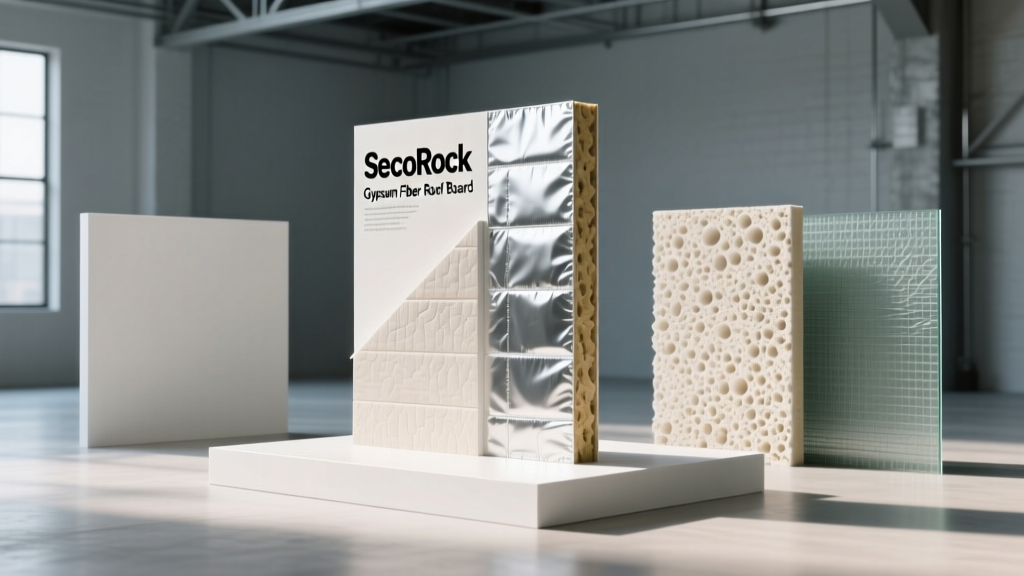
In commercial low-slope roofing assemblies, the cover board acts as the primary defensive layer between the insulation and the roof membrane. It dictates the system's puncture resistance, fire rating, and overall longevity. Among the premium options available to roofing contractors and architects, the SecoRock gypsum fiber roof board (manufactured by USG) represents a distinct material category. Unlike traditional faced gypsum boards, gypsum fiber boards feature a homogeneous, high-density core without paper or fiberglass facers.
Specifying the correct cover board requires navigating a complex matrix of compressive strength, moisture tolerance, and membrane compatibility. This guide provides a technical comparison of SecoRock gypsum fiber against the most common commercial alternatives: high-density polyisocyanurate (HD ISO), perlite, and fiberglass-mat faced gypsum boards.
Head-to-Head: Cover Board Comparison Matrix
The following matrix evaluates the physical properties and 2026 market pricing for the four primary cover board categories used in commercial TPO, EPDM, and modified bitumen assemblies.
| Material Type | Compressive Strength | Moisture Tolerance | Delamination Risk | Approx. Material Cost (per sq. ft.) |
|---|---|---|---|---|
| SecoRock Gypsum Fiber | ~1,200 psi | High (Homogeneous core) | None (No facers) | $1.85 - $2.40 |
| Fiberglass-Mat Gypsum | ~900 - 1,100 psi | Moderate (Core is vulnerable if faced) | Moderate (Under prolonged leak) | $1.60 - $2.10 |
| HD Polyiso (HD ISO) | 110 - 250 psi | Low (Closed-cell, but traps vapor) | N/A (Foam core) | $1.10 - $1.60 |
| Perlite Board | 400 - 600 psi | Very Low (Highly absorptive) | N/A | $1.20 - $1.50 |
Deep Dive: Performance Metrics and Failure Modes
1. Compressive Strength and Puncture Resistance
Commercial roofs endure significant point loads from HVAC equipment, solar panel racking, and routine maintenance foot traffic. The National Roofing Contractors Association (NRCA) consistently recommends cover boards with high compressive strength to prevent membrane splitting and insulation crushing.
- SecoRock Gypsum Fiber: With a compressive strength exceeding 1,100 psi, gypsum fiber provides a rigid substrate. When solar racking legs are bolted through the membrane, the fiber board distributes the load, preventing the localized crushing seen in foam boards.
- HD Polyiso: Even high-density polyiso maxes out around 250 psi. Under heavy static loads (like commercial AC condensers), HD ISO will compress over time, creating depressions that pond water and eventually fatigue the membrane.
- Perlite: Offers decent compressive strength but is brittle. Impact from dropped tools or hail can fracture perlite boards, creating voids beneath the membrane.
2. Moisture Dynamics and the 'Sponge Effect'
When a roof membrane is compromised, the cover board's reaction to water ingress dictates the scope of the required repairs.
Perlite is an expanded volcanic glass. While it performs well in hot asphalt applications due to its thermal stability, it is highly hygroscopic. If a membrane leak occurs, perlite acts as a sponge, wicking water laterally across the roof deck and turning a localized 10-square-foot leak into a 1,000-square-foot tear-off requirement.
Conversely, SecoRock gypsum fiber and fiberglass-mat gypsum boards are engineered for moisture resistance. According to testing standards referenced by the Gypsum Association, gypsum-based roof boards exhibit minimal water absorption. However, the distinct advantage of the fiber variant over the glass-mat variant emerges during prolonged exposure. Fiberglass-mat boards rely on the integrity of the mat-to-core bond. If water pools on the board for weeks before a leak is detected, the facer can delaminate. Because gypsum fiber is homogeneous throughout, it cannot delaminate, maintaining its structural integrity even when wet.
3. Fire Resistance and FM Global Approvals
Gypsum inherently contains chemically combined water (calcium sulfate dihydrate). When exposed to fire, this water is released as steam, actively retarding heat transfer. SecoRock gypsum fiber boards are a critical component in achieving UL Class A fire ratings and FM Global 1-90 wind uplift approvals. While HD ISO is a plastic foam that requires fire retardants (which can degrade over time), gypsum fiber provides a permanent, non-combustible fire stop that protects the underlying combustible insulation and roof deck.
Installation Nuances: Membrane Compatibility
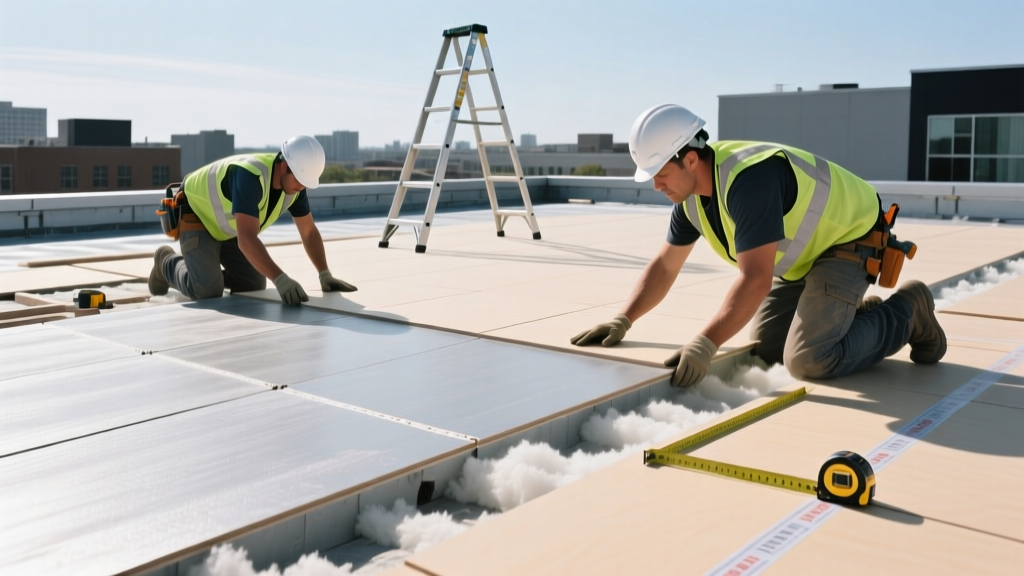
When installing SecoRock gypsum fiber in a modified bitumen system using hot asphalt, the porous surface of the fiber board can absorb moisture from the asphalt or allow the asphalt to bleed through unevenly. Manufacturers typically require a primer or a base sheet to be mechanically fastened or mopped down first to ensure a uniform bond and prevent blistering.
For single-ply systems (TPO, PVC, EPDM), gypsum fiber provides an exceptionally smooth, flat surface that enhances the aesthetic finish of fully adhered membranes. The lack of a fiberglass mat texture means the membrane lays perfectly flat, avoiding the 'picture-framing' effect sometimes seen when facers shrink or expand at different rates than the core.
Cost Analysis: Material vs. Lifecycle Value
While the upfront material cost of SecoRock gypsum fiber ($1.85 to $2.40 per square foot in 2026) is approximately 40% to 60% higher than HD ISO, evaluating the cost strictly on day-one material pricing is a critical error in commercial roofing.
The True Cost of Roof Traffic
Consider a 50,000-square-foot retail facility requiring bi-annual HVAC maintenance. If the roof utilizes HD ISO cover boards, the repeated foot traffic and equipment staging will inevitably crush the foam, leading to membrane ridging and eventual splitting. Repairing these localized failures costs between $15 and $25 per square foot. By investing an additional $0.75 per square foot upfront for gypsum fiber, the facility manager effectively eliminates cover-board-related membrane fatigue, yielding a positive ROI within the first five years of the roof's lifecycle.
Decision Framework: When to Specify SecoRock Gypsum Fiber
Use the following parameters to determine if SecoRock gypsum fiber is the optimal specification for your project:
- Specify Gypsum Fiber When: The roof will host heavy static loads (solar arrays, large HVAC units), experience frequent maintenance traffic, or require maximum hail and puncture resistance (e.g., FM 1-150 hail ratings). It is also the premier choice for high-humidity environments where facer delamination is a known risk.
- Specify HD Polyiso When: The project requires a marginal boost in R-value (HD ISO adds roughly R-5 per inch) and the roof will experience minimal foot traffic or point loads. It is best suited for lightweight metal deck assemblies where minimizing dead load is critical.
- Specify Fiberglass-Mat Gypsum When: You need the fire and puncture benefits of gypsum but are working with a tighter budget, and the roof assembly utilizes a fully adhered single-ply membrane in a dry climate where prolonged water exposure is unlikely.
Frequently Asked Questions
Can SecoRock gypsum fiber be used as a substrate for mechanically fastened TPO?
Yes, but it is not its primary function. While you can drive fasteners through it, gypsum fiber is most effectively utilized as a cover board placed over the primary insulation. Fasteners should penetrate through the cover board, the insulation, and into the structural deck. The cover board then serves to protect the insulation from the mechanical stress of the fastener plates.
How does the weight of gypsum fiber compare to polyiso?
Gypsum fiber is significantly heavier. A 1/2-inch thick 4x8 foot sheet of gypsum fiber weighs approximately 70 to 80 pounds, whereas a similar sheet of HD ISO weighs roughly 15 pounds. Structural engineers must verify that the roof deck can support the additional dead load of roughly 2.2 to 2.5 pounds per square foot when transitioning from foam to gypsum cover boards.
Is gypsum fiber board vapor permeable?
Yes, homogeneous gypsum fiber is vapor permeable. This is a distinct advantage in roof assemblies designed to dry outward. If moisture becomes trapped within the roof assembly (e.g., from construction moisture or a minor interior vapor drive), a vapor-permeable cover board allows the moisture to escape through the membrane's seams or specific vapor vents, preventing blistering and internal condensation.
Written by
Sarah WhitfieldSarah Whitfield is a chartered quantity surveyor (MRICS) and construction cost analyst with 15 years of experience in material pricing, procurement strategy, and project budgeting. She earned her degree in Construction Management from the University of Reading (UK) and has worked on projects ranging from $2M custom homes to $180M mixed-use developments across North America and Europe. Sarah currently leads cost estimating for BuildMat Insight, maintaining a proprietary database of 4,000+ material price points updated quarterly. She is a frequent contributor to RSMeans cost data panels and has presented at the International Cost Engineering Council (ICEC) congress. Based in Denver, CO, Sarah is an avid trail runner and volunteer mentor for Women in Construction.
More from Sarah Whitfield
View all
Wood & Lumber
What Are the Different Types of Wood? A Builder's Guide
Compare structural softwoods, finish hardwoods, and engineered lumber. Analyze Janka ratings, MOE values, and 2026 pricing for construction.
Aug 4, 2026

Walls & Panels
Steel Framing vs Wood Framing: Corrosion and Moisture Defense
Compare steel framing vs wood framing for moisture resistance. Learn about galvanized coatings, condensation risks, and corrosion protection strategies.
Jul 21, 2026

Stone & Masonry
How to Cut Stone Veneer: Wet Saw vs Grinder Comparison
Compare the best tools for cutting stone veneer. We review wet saws, angle grinders, and chop saws to help you achieve clean, chip-free cuts.
Jul 21, 2026