Sound Deadening Gypsum Board: A Code Compliance Guide for STC Ratings
Navigate IBC Section 1206 and ASTM standards. Learn how to specify sound deadening gypsum board to meet STC 50 code requirements efficiently.

Decoding IBC Section 1206: The Baseline for Acoustic Privacy
When designing multifamily residential buildings, hotels, or mixed-use commercial spaces, acoustic separation is not merely a luxury—it is a strict legal requirement. The International Building Code (IBC) Section 1206.2 mandates that walls and floor/ceiling assemblies separating adjacent dwelling units must achieve a minimum Sound Transmission Class (STC) rating of 50 when tested in accordance with ASTM E90. For field testing under ASTM E336, the minimum acceptable Apparent Sound Transmission Class (ASTC) drops to 45 to account for real-world installation variables and flanking paths.
Historically, achieving an STC of 50 required complex, multi-layered assemblies utilizing resilient channels, staggered studs, or double-stud walls. Today, sound deadening gypsum board offers a code-compliant, space-saving alternative that simplifies framing while delivering superior acoustic dampening. Understanding how to specify and install these specialized panels is critical for passing municipal inspections and avoiding costly post-construction remediation.
Building officials evaluate dwelling unit separations primarily on STC, which measures airborne noise (speech, television). However, if your project is near rail lines, airports, or heavy traffic, you must also evaluate the Outdoor-Indoor Transmission Class (OITC). Standard sound deadening gypsum board improves STC significantly but may require supplemental mass or decoupling to achieve high OITC ratings for low-frequency exterior noise.
The Material Science: How Constrained-Layer Damping Works
Standard 1/2-inch gypsum board relies purely on mass to block sound. Because it is rigid, it is susceptible to the coincidence effect—a phenomenon where specific sound frequencies cause the panel to resonate, drastically dropping its STC performance at those frequencies.
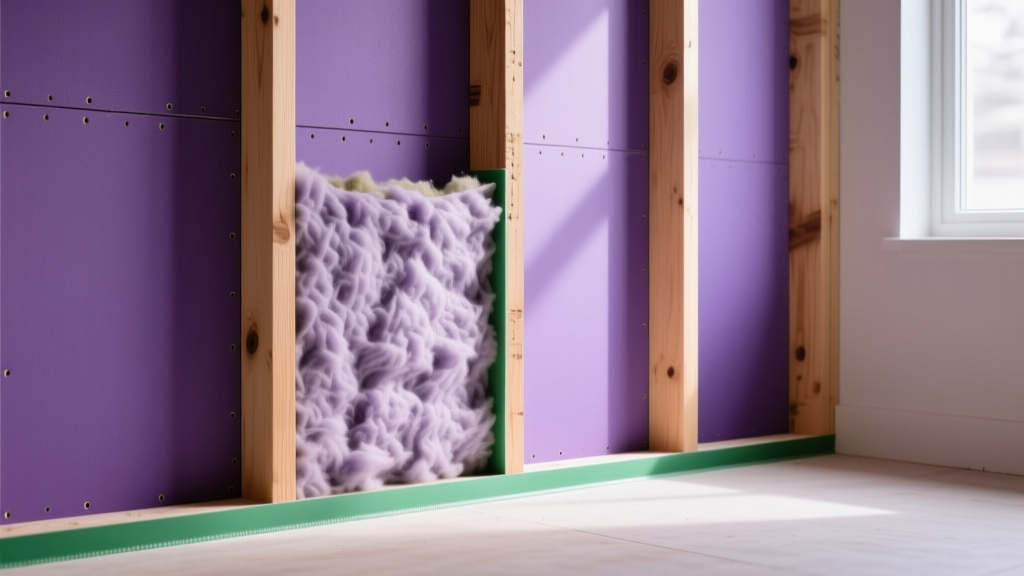
Sound deadening gypsum board solves this through constrained-layer damping (CLD). Manufacturers sandwich a viscoelastic polymer core between two thin layers of gypsum. When sound waves strike the panel, the shear forces generated within the polymer layer convert acoustic energy into negligible amounts of heat. This effectively eliminates the coincidence dip and broadens the frequency range of sound attenuation. According to the Gypsum Association, this technology allows a single layer of acoustic drywall to perform equivalently to two or even three layers of standard drywall.
Comparative Assembly Performance
| Assembly Type | Stud Type | Insulation | Lab STC Rating |
|---|---|---|---|
| 1-Layer Standard 5/8" Type X (Each Side) | 2x4 Wood @ 16" OC | None | 36 |
| 2-Layers Standard 1/2" (Each Side) | 2x4 Wood @ 16" OC | R-13 Fiberglass | 45 |
| 1-Layer Standard 5/8" + Resilient Channel | 2x4 Wood @ 16" OC | R-13 Fiberglass | 52 |
| 1-Layer Sound Deadening Board (Each Side) | 2x4 Wood @ 16" OC | R-13 Mineral Wool | 54 - 56 |
Navigating ASTM E90 Lab Tests vs. ASTM E336 Field Tests
A common failure point in multifamily construction is assuming that a lab-tested STC 55 assembly will automatically pass a field test with an ASTC of 50. The ASTM E90 laboratory standard measures the partition in an idealized, perfectly sealed environment. ASTM E336 measures the apparent STC in the field, capturing all flanking noise and installation defects.
Building officials typically apply a 5-point penalty when translating lab data to field expectations. Therefore, if your local jurisdiction requires a field-tested ASTC of 50, you must specify an assembly with a laboratory STC of 55 or higher. Sound deadening gypsum board provides a critical buffer here; because a single-layer CLD assembly achieves STC 54+ on wood studs (and up to STC 60+ on steel studs with mineral wool), it provides a built-in safety margin against field-test failures that multi-layer standard drywall assemblies often lack.
Specifying the Right Product for Code Minimums
Not all acoustic drywall is manufactured equally. When writing specifications for code compliance, you must select the correct thickness and core type for the specific environmental conditions of the project.
- USG QuietRock 510: The industry benchmark for standard interior partitions. At 1/2-inch thick and weighing roughly 2.2 lbs per square foot, it installs identically to standard drywall and achieves STC 50+ on standard wood framing without resilient channels.
- CertainTeed SilentFX QuickCut: Features a specialized gypsum core that allows installers to score and snap the board with a standard utility knife, eliminating the need for specialized cutting tools and reducing silica dust on the job site.
- National Gypsum SoundBreak XP: Combines the viscoelastic polymer damping layer with a moisture-resistant core and facer. This is the mandatory specification for sound-rated demising walls in high-humidity areas like back-to-back bathrooms, kitchens, or indoor pool enclosures where standard acoustic board would degrade.
The #1 Cause of Code Failure: Flanking Noise
You can specify the most expensive sound deadening gypsum board on the market, but if you ignore flanking paths, the assembly will fail the ASTM E336 field test. Sound behaves like water; it will exploit the smallest structural weakness. To maintain code compliance, the installation crew must execute the following protocols:
- Acoustic Sealant Application: A continuous 3/8-inch bead of non-hardening, flexible acoustic sealant must be applied between the bottom track of the wall and the subfloor, as well as at all vertical corners and ceiling perimeters. Standard latex caulk is unacceptable as it hardens and cracks, transmitting vibration.
- Electrical Box Decoupling: Back-to-back electrical outlets on a demising wall destroy STC ratings. Code requires that boxes be staggered by at least 24 inches horizontally. Furthermore, every electrical box must be wrapped in an intumescent acoustic putty pad to seal the drywall cutout.
- Penetration Sealing: Any HVAC ducting, plumbing stacks, or fire sprinkler pipes penetrating the sound-rated assembly must be sealed with an acoustic firestop compound that matches the STC rating of the wall itself.
- Fastener Isolation: When attaching sound deadening board, screws must be driven flush but not over-driven. Breaking the paper face of the gypsum board compromises the constrained-layer damping effect and reduces the localized STC performance.
Value-engineering teams often suggest using two layers of standard 1/2-inch drywall with Green Glue instead of pre-manufactured sound deadening board. While this can achieve similar STC ratings, it doubles the finishing labor, increases the dead load on the framing by 40%, and introduces a high risk of installer error if the damping compound is applied unevenly. Pre-manufactured CLD board guarantees consistent polymer thickness and factory-controlled quality.
Cost Implications and Value Engineering in 2026
While the upfront material cost of sound deadening gypsum board is significantly higher than standard panels, the total installed cost often favors the acoustic product in commercial and multifamily applications. In 2026, standard 1/2-inch drywall costs approximately $0.50 to $0.65 per square foot (material only). High-performance sound deadening board ranges from $1.60 to $2.80 per square foot.
However, achieving STC 50 with standard board requires either resilient channels (adding $0.90/sq ft in materials and 30% more labor time for installation and taping) or a double-layer application (doubling the material, taping, mudding, and sanding labor). When factoring in the reduced framing time, fewer drywall finishing passes, and the elimination of resilient channel procurement, sound deadening gypsum board frequently yields a net labor savings of 15% to 20% on demising walls, making it the superior choice for schedule-driven projects.
Frequently Asked Code Questions
Can sound deadening gypsum board be used as a fire barrier?
Not inherently. While some acoustic boards incorporate fire-retardant cores, you must verify the specific product's UL Design classification. If the demising wall also serves as a 1-hour or 2-hour fire partition per IBC Section 708, you must specify a fire-rated acoustic board (such as QuietRock 530 or SoundBreak XP Fire-Shield) that has been tested to ASTM E119.
Does the direction of the framing affect the STC rating?
Yes. Steel studs inherently provide better acoustic decoupling than wood studs due to their thinner web profile and flexibility. An assembly using sound deadening board on 25-gauge steel studs will typically test 3 to 5 STC points higher than the identical board installed on 2x4 wood studs.
Is special taping compound required for acoustic drywall?
Standard joint compound is acceptable for the seams. However, the acoustic integrity of the wall relies on the seams being completely sealed. Installers should use fiberglass mesh tape and apply a minimum of three coats of setting-type joint compound to ensure no air gaps remain at the panel junctions.
Written by
Marcus ChenMarcus Chen is a licensed structural engineer (PE) and building materials analyst with over 12 years of experience across residential, commercial, and industrial construction. He holds a Master of Science in Civil Engineering from UC Berkeley and spent six years at Thornton Tomasetti before transitioning to independent consulting and technical writing. Marcus specializes in material selection for seismic-prone regions, concrete reinforcement strategies, and lifecycle cost analysis. His work has been cited by the American Concrete Institute (ACI) and the Structural Engineers Association of California (SEAOC). When he is not on a job site or at his desk, you will find him hiking the Sierra Nevada or restoring a 1920s craftsman bungalow in Oakland, CA.
More from Marcus Chen
View all
Construction Cost
How Much Did the Eiffel Tower Cost to Build?
How much did the Eiffel Tower cost to build in 1889? We adjust for inflation and compare its budget to modern skyscraper construction.
Aug 4, 2026

Fire Resistance
What Is a Fire Resistant Material? Testing & Certification Guide
Discover what is a fire resistant material through ASTM and UL testing. Learn how fire ratings, certifications, and assemblies work in construction.
Aug 4, 2026

Construction Cost
How Much Did the Burj Khalifa Cost to Build?
How much did the Burj Khalifa cost to build? We break down the $1.5B project and extract 5 money-saving strategies for your next build.
Jul 30, 2026